
Laser Hair Removal Upper Lip How Many Sessions
Most upper-lip laser hair removal plans involve 4 to 8 sessions spaced about 4 to 6 weeks apart, and maintenance touch-ups are common for facial areas. Some people finish closer to the lower end, while others need additional treatment when hair growth is hormonally influenced or responds unevenly.
You may be asking this after looking in the mirror and noticing the same shadow a few days after shaving, or after comparing package prices and wondering whether six appointments will really be enough. The honest answer is that the upper lip is a small treatment area, but it isn't always a simple one. Facial hair has a variable growth pattern, and the laser can only affect follicles that are receptive during each visit.
Clinical evidence supports a multi-session plan rather than a single appointment. One prospective study of 29 patients used three treatments at 6- to 8-week intervals and reported average hair reduction of 49% at 6 months after the first treatment, with no scarring or pigmentary change observed in that study (upper-lip laser hair reduction study). Your provider should therefore discuss long-term hair reduction, not promise that every follicle will disappear permanently after one series.
What to Expect for Upper Lip Laser Hair Removal Sessions
You'll usually sit down for a short appointment, but the specialist should still take time to assess the area before treating it. They'll look at hair color, thickness, density, skin tone, recent sun exposure, and any signs of irritation. They may also ask whether the growth is longstanding or appeared suddenly, because that history can affect the recommended plan.
The upper lip itself often takes only 10 to 20 minutes for an appointment, including preparation and a brief post-treatment check. The laser feels different from treatment on a leg because the skin is more delicate and the area contains many sensory nerve endings. Clients commonly describe quick heat, snapping, or pinching sensations, followed by warmth or mild redness around the follicles.
What happens during the visit
A typical appointment follows this sequence:
Skin inspection: Your specialist confirms that the area is calm enough to treat and checks for recent tanning or products that could increase irritation.
Cleansing: Makeup, sunscreen, oils, and skincare residue are removed so the handpiece can contact clean skin.
Eye protection: You'll receive appropriate protection before the laser is activated.
Treatment passes: The provider treats the upper-lip zone in a controlled pattern, adjusting settings to your skin and hair characteristics.
Cooling and aftercare: The area may be cooled, then checked for expected redness or swelling.
Don't judge the whole plan by what happens after the first visit. Some clients notice shedding or slower regrowth early, but visible thinning often becomes easier to recognize after the second or third session. A single treatment reaches only the follicles that are ready to respond that day.
Practical rule: A good consultation should give you a range, not a guarantee. Ask what the provider considers a successful response and when they'll reassess your settings or treatment plan.
Why the Upper Lip Needs More Than One Session
Laser hair removal works best when a follicle is in the anagen phase, also called active growth. During that phase, the hair contains enough connected pigment and follicular activity for laser energy to damage the growth structure. Hair in the transition or resting phases isn't equally responsive.
Think of the upper lip as a forest rather than a single group of identical trees. On treatment day, some hairs are actively growing, some are moving through a transition phase, and others are resting below the surface. The laser can reach the active group, but it can't reliably disable every dormant follicle in the same appointment.
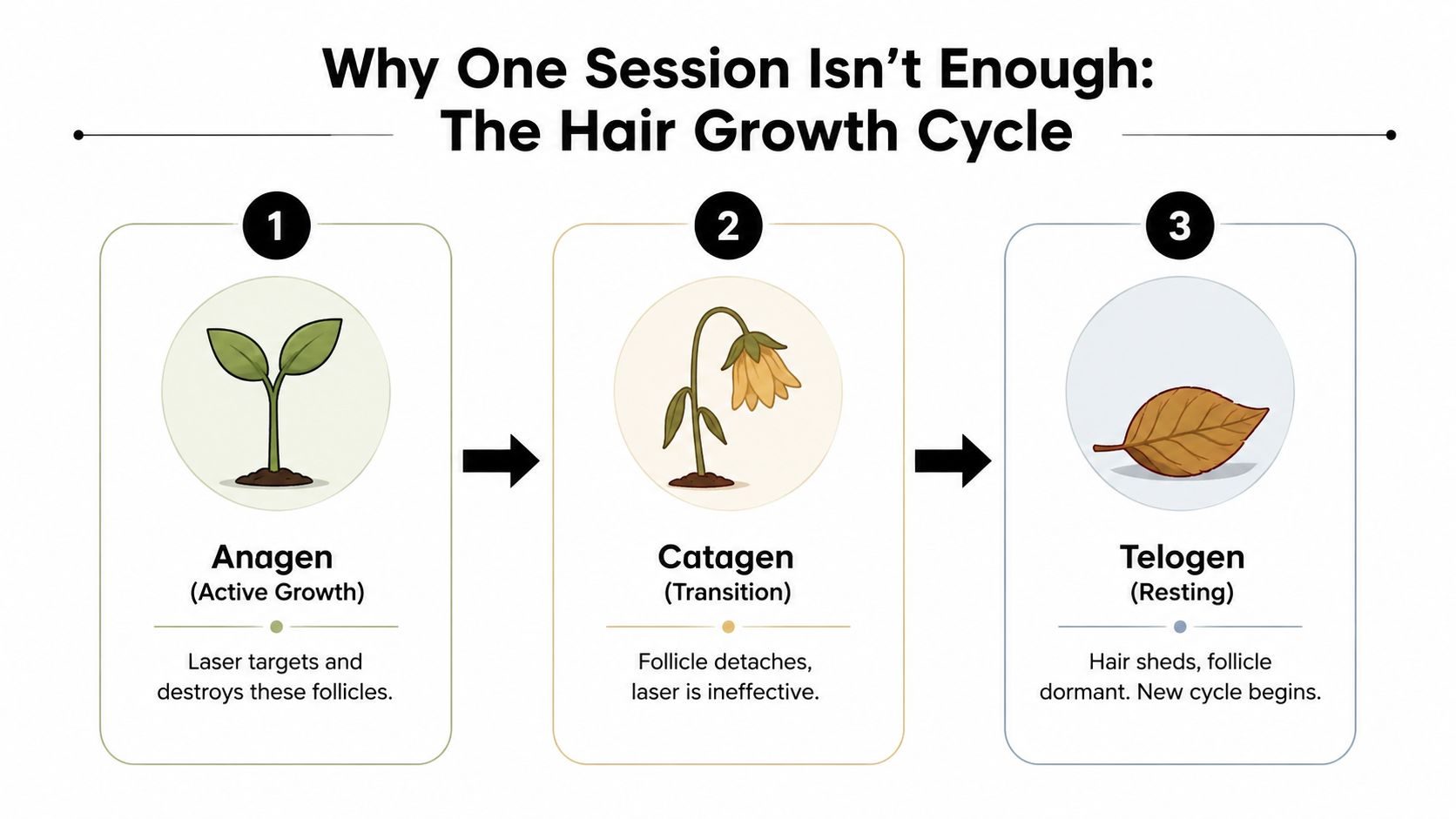
The three stages that shape your schedule
Anagen, active growth: The follicle is producing hair and is the main target for laser energy.
Catagen, transition: The follicle is changing and detaching from the active growth process, so treatment is less effective.
Telogen, resting: The follicle is dormant, and a later growth cycle must begin before it becomes a useful target.
The upper lip also tends to cycle more quickly and unpredictably than larger body areas. That's why providers commonly schedule facial treatments about 4 to 6 weeks apart, rather than treating the same area repeatedly on consecutive days. Waiting gives another group of follicles time to enter a more responsive phase. The biology of the anagen phase of hair growth helps explain why patience is part of the treatment itself.
Spacing matters, but one late appointment doesn't erase all progress. If you miss a visit, contact the clinic and ask how to resume based on your current regrowth. Treating too early may catch too few responsive follicles, while a long delay can make the pattern harder to evaluate.
Factors That Change Your Session Count
Two clients can treat the same upper-lip area and still need different totals. The main variables are hair pigment, hair texture, skin tone, device selection, and hormonal activity. A useful way to understand the difference is to treat each factor as part of the laser's targeting problem. The clearer the hair target and the more suitable the settings, the more predictable the response may be.
Dark, coarse hair usually gives the laser a stronger target because it contains more pigment than very fine or pale hair. Fine peach-fuzz hair can respond unevenly, while white, gray, or very light hair may contain too little pigment for the laser to absorb effectively. A responsible provider should assess whether your hair is a suitable laser candidate before recommending a package.
Skin tone changes how carefully treatment must be configured. Laser energy interacts with pigment in both the hair and the skin, so deeper skin tones call for careful wavelength and energy selection. Modern systems can offer more options than older platforms, but the device name alone cannot determine whether a treatment plan is appropriate for you.
Clinical factors in context
A prospective analysis of 200 patients with skin types IV and V included 48 upper-lip cases. After 6 laser sessions, 59% of those upper-lip cases had more than 50% improvement at the six-month follow-up, compared with higher response levels reported for lower-face and chin-or-upper-neck areas in the same analysis (facial laser hair removal analysis). This supports a practical point: skin type and treatment area can affect how quickly improvement becomes visible.
Hormonal status can add another layer. In a clinical analysis of facial hirsutism, patients with higher androgen levels needed an average of 8.1 sessions, compared with 5.7 sessions in the comparison group (facial hirsutism treatment analysis). Those figures are averages, not a personal forecast. They do explain why someone with hormonally influenced upper-lip growth may need 8 or 10 sessions when another client finishes closer to 4 to 6.
Variable | Profile | Estimated sessions |
|---|---|---|
Hair contrast | Dark, coarse hair against lighter skin often gives the clearest treatment target | Often nearer the lower end of the plan |
Fine or light hair | Sparse, fine, or lightly pigmented hair may respond less consistently | May require additional assessment or treatment |
Deeper skin tone | Requires careful wavelength and energy selection to protect epidermal pigment | May need a more conservative, individualized course |
Hormonal influence | Higher androgen activity can promote new or persistent facial growth | Clinical data show averages can extend beyond a standard series |
Combined factors | Hormonal growth plus fine hair or a deeper skin tone creates several treatment challenges at once | May require extended treatment and maintenance |
Device technology affects both safety and effectiveness. Wavelength, cooling, and energy settings determine how well the provider can manage the contrast between your hair and skin. Ask which wavelength is being used and why it suits your skin and hair, rather than selecting a clinic based only on its advertised session count.
How the Upper Lip Compares to Other Areas
The upper lip is small, but surface area isn't the only factor that determines difficulty. Legs and underarms often contain more uniform, coarse hair, which makes progress easier to see from one visit to the next. Upper-lip hair may become finer and lighter as treatment continues, so the area can look inconsistent even when some follicles are responding.
Facial growth also deserves special attention because hormonal changes can recruit new follicles over time. A provider may reduce the original group of hairs successfully while new growth appears nearby. That pattern isn't necessarily a failed treatment, but it does change the plan from a one-time series to an ongoing reduction strategy.
A practical area comparison
Area | Typical sessions | Variability | Best device match |
|---|---|---|---|
Upper lip | About 4 to 8 initially, with possible maintenance | Higher, especially with hormonal growth or fine hair | Device selected for both skin tone and facial hair |
Underarms | Often a straightforward multi-session course | Usually more predictable when hair is dark and coarse | Wavelength matched to skin and hair contrast |
Legs | Often require a longer body-area schedule | Growth cycles and hair density vary across the leg | Efficient platform suited to a larger surface |
Bikini area | Multi-session treatment is common | Hormonal sensitivity can affect regrowth | Platform and settings chosen for pigmentation and density |
The upper lip also gives the provider less room for error. A leg can tolerate a broad treatment pattern, while the face requires careful placement around the vermilion border and nearby skin. Comfort features, cooling, and precise technique can matter as much as speed.
For clients with medium-to-deep skin tones, a platform that includes an Nd:YAG wavelength may offer useful safety flexibility when selected and operated correctly. Splendor X, for example, combines Alexandrite and Nd:YAG wavelengths in one pulse, allowing a trained provider to tailor treatment to different skin and hair characteristics. Light skin with dark, coarse hair generally offers the strongest contrast on any suitable device, but device selection remains important for every client.
Your Session Timeline and What Maintenance Really Looks Like
Treat the plan as a gradual calendar rather than a quick fix. Facial appointments are commonly spaced 4 to 6 weeks apart, so a complete initial course can extend across several months. The exact timing should follow your provider's assessment of regrowth, not an automatic appointment schedule.
During the early visits, you may notice slower growth, patchy areas, or hairs that shed after treatment. That doesn't mean the area is finished. The next appointments address follicles that weren't receptive during the first pass, so the visible result develops unevenly before it becomes more consistent.
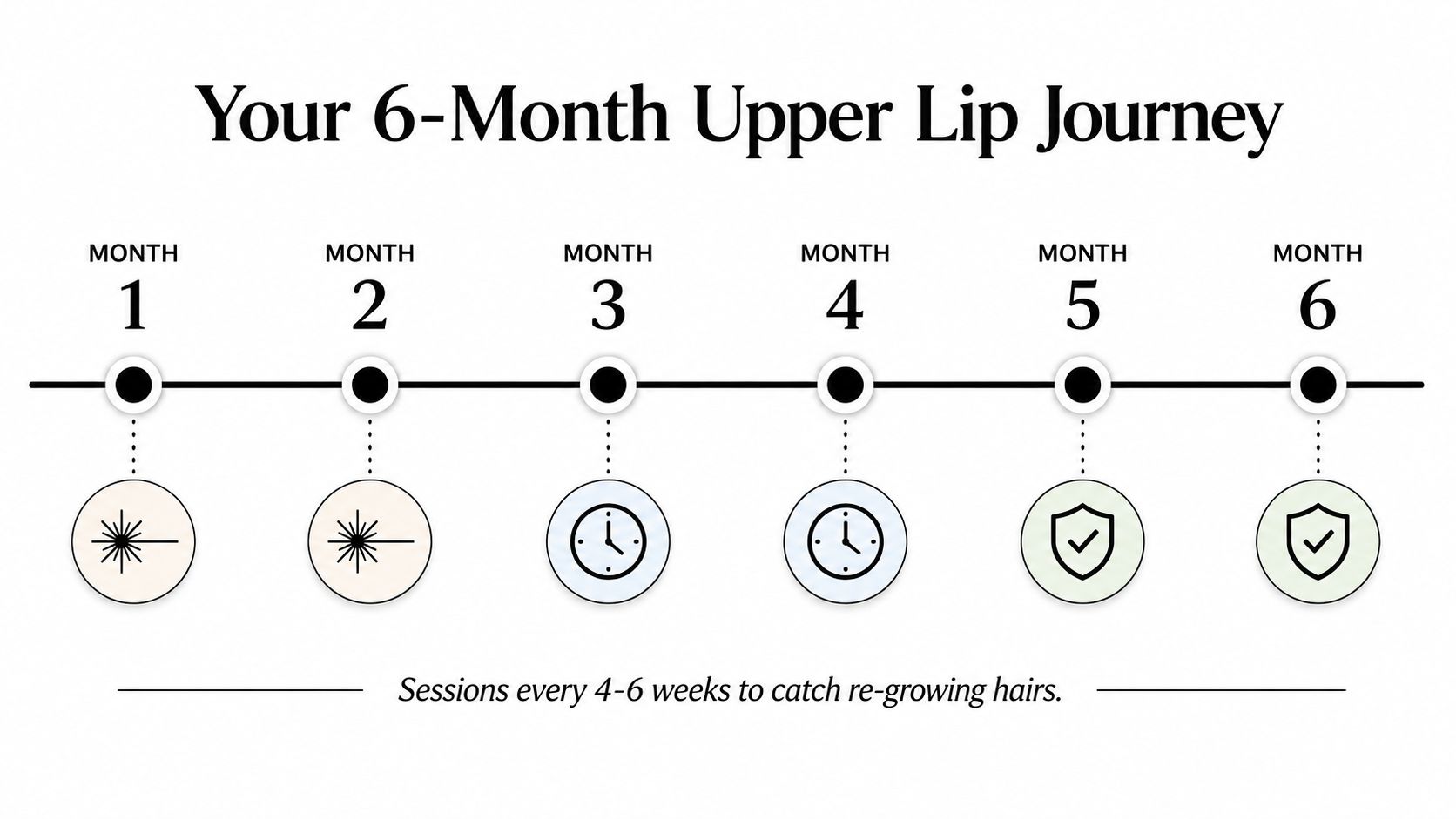
How to read the calendar
A useful way to plan is to think in stages:
Early stage: The first visits establish how your skin reacts and how the hair sheds or regrows.
Progress stage: Later sessions target additional growth cycles, and the remaining hair may appear finer or more scattered.
Review stage: Your provider evaluates whether you need more treatment, a change in settings, or a different approach.
Clinical results vary, so avoid treating a projected calendar as a promise of complete clearance. In one randomized upper-lip study, treatments took place every 4 weeks for up to 6 sessions. The group that combined laser with eflornithine achieved complete or near-complete removal in 93.5% of treated sites, compared with 67.9% with laser alone by the study's end (randomized upper-lip laser study). That evidence shows why an adjunct may be discussed when laser alone isn't producing the desired response.
After the initial series, facial maintenance is common. Hormonal fluctuation can activate follicles that weren't producing visible hair during the original course, so occasional touch-ups may be part of a realistic long-term plan. The recommended interval between laser hair removal treatments should be based on actual regrowth, not on treating skin before new target hairs appear.
When More Sessions Signal Something Different
If the upper lip shows little change late in the planned course, booking more appointments should not be the automatic next step. The provider needs to review the hair pattern, laser settings, wavelength, treatment timing, and possible hormonal influences. Turning the device higher without that review may increase irritation without addressing the reason for the poor response.
Three patterns deserve a careful conversation:
Rapid regrowth: Hair returns unusually quickly between visits, especially when it becomes darker or coarser than the original growth.
Expansion beyond the treated area: New hair appears on the chin, jawline, or sideburns while the upper lip is still being treated.
Texture conversion: Fine, barely visible fuzz becomes more pigmented and coarse, which may indicate that previously quiet follicles are becoming active.
These signs do not diagnose a medical condition. They do show why appointment after appointment should not continue without reassessment. A small cosmetic area can require a longer plan when the hair pattern reflects a broader hormonal influence. Research examining androgen status and treatment sessions found an association between higher androgen levels and a greater treatment burden (clinical analysis of androgen status and treatment sessions). The finding cannot predict your personal session count, but it supports checking for contributing factors when progress differs from expectations.
What to ask for next
An aesthetic provider can document changes in density, texture, and distribution, then recommend medical follow-up. They should not diagnose PCOS, thyroid disease, or another endocrine condition. A primary care clinician, gynecologist, or endocrinologist can decide whether blood testing fits your history and symptoms.
Ask your provider:
Has the original hair density decreased?
Is the new growth inside the treatment zone or spreading elsewhere?
Were the wavelength and settings appropriate for my skin and hair?
Should I pause additional sessions while seeking medical evaluation?
A hormonal cause does not make laser irrelevant. It changes the plan. Laser may work best alongside medical management and ongoing maintenance, rather than being presented as a complete solution on its own.
Hormonal Hair Versus Cosmetic Hair on the Upper Lip
Cosmetic upper-lip hair is usually fine, scattered, and stable. It can be bothersome without indicating a medical problem. Coarse, dark, dense hair that appears suddenly, spreads to the chin or sideburns, or keeps changing calls for a different assessment.
The key difference is pattern and change, not appearance alone. A small upper-lip area may be the first visible sign of broader androgen-related growth, while noticeable hair can remain purely cosmetic. Tell your provider when it began, whether your menstrual cycle changed, and whether you have acne, relevant medications, or a family history of similar growth. This context helps explain why one person may need 4 to 6 sessions while another needs 8 or 10.
Signs that justify medical follow-up
Consider speaking with a medical professional before buying a large package if you notice:
New coarse hair after previously stable growth
Hair on the chin, jawline, neck, or sideburns
Irregular menstrual cycles or other reproductive changes
New or worsening acne with facial hair
Regrowth that seems unusually rapid despite properly spaced sessions
Other symptoms that began around the same time
A facial-hair study reported that patients with higher androgen levels averaged 8.1 sessions, compared with 5.7 sessions in a comparison group (published facial hirsutism study). These figures cannot predict your result, but they show how hormonal factors may increase the treatment burden.
Your aesthetic provider can document changes and recommend medical follow-up, but cannot diagnose PCOS or another endocrine condition. A primary care clinician, gynecologist, or endocrinologist can decide whether evaluation fits your history. If PCOS concerns are part of the discussion, PCOS weight loss tips from The Axelrad may help you prepare questions, but general information does not replace individualized advice.
Getting Ready for Your Upper Lip Plan
Start with the consultation, not the package. Ask the provider which wavelength fits your skin tone, how they handle a patch test, who performs the treatment, and what happens if you miss an appointment. You should also ask how they define progress, when they reassess, and whether maintenance visits are priced separately.
Use the package as a planning tool
A six-session package may be a reasonable starting point, but your consultation should address what happens if you need more. Ask whether unused sessions roll forward, whether the clinic allows you to purchase individual follow-up visits, and whether the provider will recommend additional treatment only after examining your response.
Your appointment plan should leave enough space between visits for regrowth to become assessable. If you're scheduling around work, travel, or events, review the clinic's laser hair removal appointment guidance and leave a buffer before an important occasion in case you experience temporary redness or sensitivity.
Prepare the treatment area
Follow the clinic's instructions because preparation rules can vary by device and skin condition. Common guidance includes:
Keep the follicle intact: Avoid waxing, plucking, or threading for about 4 weeks before treatment so the laser has a follicular target.
Shave carefully: Shave roughly 24 hours before if your provider recommends it, and don't arrive with razor irritation.
Pause active products: Ask whether to stop retinoids or alpha hydroxy acids for 5 to 7 days before treatment.
Limit sun exposure: Avoid tanning and protect the area, since increased skin pigment can affect treatment safety.
Plan for comfort: If your skin is unusually sensitive around menstruation, discuss scheduling, but follow the provider's advice rather than assuming a specific cycle day is required.
Your upper lip should be clean and calm on appointment day. Bring a list of skincare products and medications, disclose recent tanning, and tell the provider about any history of pigmentation changes or cold sores so they can plan appropriately.
NYC Laser Hair Removal offers upper-lip treatment as a small-zone service with single sessions and multi-session package options. Visit NYC Laser Hair Removal to discuss your skin, hair pattern, session interval, and realistic maintenance needs with a Long Island provider before booking a complete plan.
Comments