
Laser Hair Removal Upper Lip and Chin: Complete Guide
You're standing in front of a mirror in bright daylight, tilting your chin, checking the upper-lip shadow again, and deciding whether to pluck one more hair before you leave the house. That tiny routine can eat up time every day, and it has a way of turning a small cosmetic concern into a constant interruption. Laser hair removal upper lip and chin works well because it targets the follicle itself, not just the visible hair, so the goal isn't another round of maintenance. It's a real reduction strategy for two of the most stubborn facial zones.
Why Upper Lip and Chin Hair Is a Daily Frustration
The upper lip and chin are different from larger body areas because you see them every time you talk, eat, apply makeup, or catch your reflection in natural light. A faint shadow on the upper lip can make foundation feel unfinished. A few coarse chin hairs can turn into a morning ritual of tweezing, checking, and rechecking before meetings or social plans.
Those habits add up. Waxing appointments, threading visits, and at-home plucking can keep the surface smooth for a short time, but they don't change where the hair is coming from. That's why so many people start looking for a structural fix instead of another temporary routine.
Why facial hair feels so persistent
The face is small, but the results are noticeable. A little regrowth is more noticeable on the lip or chin than on the leg, and that makes the area feel harder to manage than it technically is. People often describe the experience as less about hair removal and more about staying ahead of hair they can't ignore.
That's especially true when the hair is coarse, dark, or hormonally driven. Chin hair often has a different pattern from upper-lip fuzz, and that difference matters when you're choosing treatment expectations. A clinic should talk about those zones separately, because they don't behave like one single facial package.
Practical rule: if you're scheduling your day around tweezing or waxing the same facial spots again and again, you're already dealing with a maintenance problem, not a one-off cosmetic annoyance.
For readers looking at treatment on Long Island, the appeal of laser is simple. It replaces repeated short-term fixes with a plan built around measurable reduction, steady spacing, and realistic upkeep. That's the mindset needed before starting any facial series.
How Laser Hair Removal Actually Works on the Face
Laser treatment works by sending light into the hair shaft, where dark pigment absorbs that energy and converts it to heat. That heat damages the follicle enough to slow or stop future growth. The result depends on treating the right hair at the right time, not on blasting the area more aggressively.
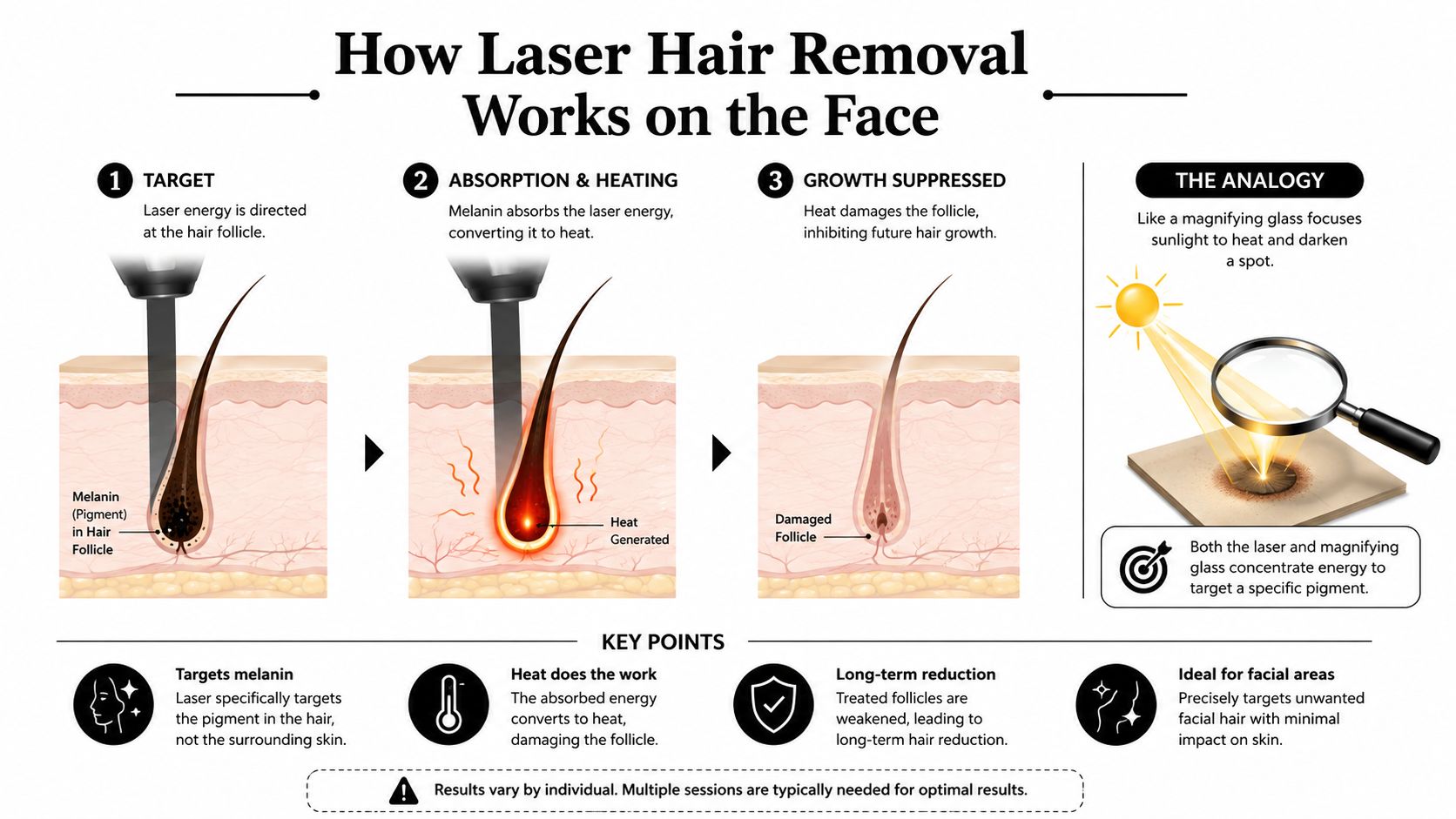
Hair grows in cycles, and laser only works well on follicles that are actively growing. That's why one appointment can't clear every visible hair at once. Some follicles are ready to respond, others are resting, and the face tends to keep that pattern moving quickly.
Why device choice matters on the face
At NYCLASER, treatment is performed with Splendor X, which uses dual wavelengths. In plain terms, that gives the provider more flexibility when matching treatment to different skin tones and hair characteristics. The clinic's own discussion of this technology is outlined in its explanation of dual-wavelength laser use.
That matters on facial areas because the upper lip and chin often sit close to the mouth, the jaw, and other sensitive contours. Precision matters more than brute force. A well-matched device and careful settings are what make facial laser practical rather than awkward.
The face also tends to need patience. Even when treatment is working well, hairs don't vanish instantly. They shed over time, and new cycles continue to appear until enough active follicles have been treated across several visits.
Practical rule: facial laser succeeds when the clinic treats the follicle, respects the cycle, and spaces the sessions properly. It fails when someone expects the whole face to behave like one uniform area.
Upper Lip vs Chin Why These Zones Behave Differently
Upper-lip hair and chin hair belong to the same face, but they do not behave the same way. The upper lip is often finer, lighter in texture, and more diffuse. The chin usually presents with coarser, darker hairs that are easier to see and easier to track during treatment.
That difference changes expectations in the chair. Upper-lip work often feels more delicate and the progress can look subtle between visits, while chin treatment tends to show clearer changes sooner because the hairs are more visible and more rooted. I treat them as two separate facial areas for that reason, especially when a patient wants a realistic plan instead of a generic facial package.
The chin also raises a different conversation when hormones are involved. Many readers notice chin hair first during androgen-related shifts, and that pattern can keep reappearing even after a good response. Laser can reduce it, but hormonally influenced growth is one reason the chin often stays on a maintenance schedule later. If you want a focused overview of that area, see our guide to chin laser hair removal.
The 2017 IPL study gives a useful clinical snapshot of the difference between these zones. Women treated on the upper lip achieved an average 52.87% hair reduction after 6 sittings, while the chin achieved 73.81% over the same course (PMCID: PMC5227079). The upper-lip and chin results in that study were also similar in women with and without PCOS, which matters because it shows that hormonally influenced growth does not automatically make treatment ineffective.
What the biology suggests in practice
Upper-lip hair often behaves like a fine but stubborn surface pattern. It can respond well, yet it usually asks for patience because the hairs are smaller and less dramatic between sessions. A patient may look nearly unchanged for a stretch, then notice a gradual softening in density and shadow.
Chin hair is different. It is often thicker, easier to measure, and more likely to draw attention during regrowth. That is why progress there can feel more obvious, but it is also why the chin can be more frustrating when hormones keep stimulating new hairs.
The 2011 Nd:YAG study also reinforces why clinicians treat these zones as core facial targets. The face was the most frequently treated area at 84.7%, and within the face the chin was treated most often, followed by the upper lip and jaw line (PubMed 21519944). That same study reported a mean of 8.9 treatments per patient, with a mean hair reduction of 54.3% overall.
Clinic insight: upper lip and chin can both improve a lot, but they do not improve in identical ways. The chin often gives clearer visible change, while the upper lip can be more subtle and more sensitive to incomplete cycles.
For people asking whether laser helps with facial hair tied to PCOS or other hormonal shifts, the answer has to stay honest. It can help, often substantially, but the chin especially may remain a maintenance zone. That is not a failure. It is how hormonally active facial hair behaves.
Typical Number of Sessions and Treatment Timeline
Upper lip and chin hair do not follow the same pace, so the treatment plan should not treat them as one uniform facial area. The upper lip often responds with a cleaner early reduction, while the chin usually needs a longer view because it is more likely to keep producing new hairs between visits. A short series can help, but the full result usually comes from steady appointments and a realistic timeline.
What the treatment series usually looks like
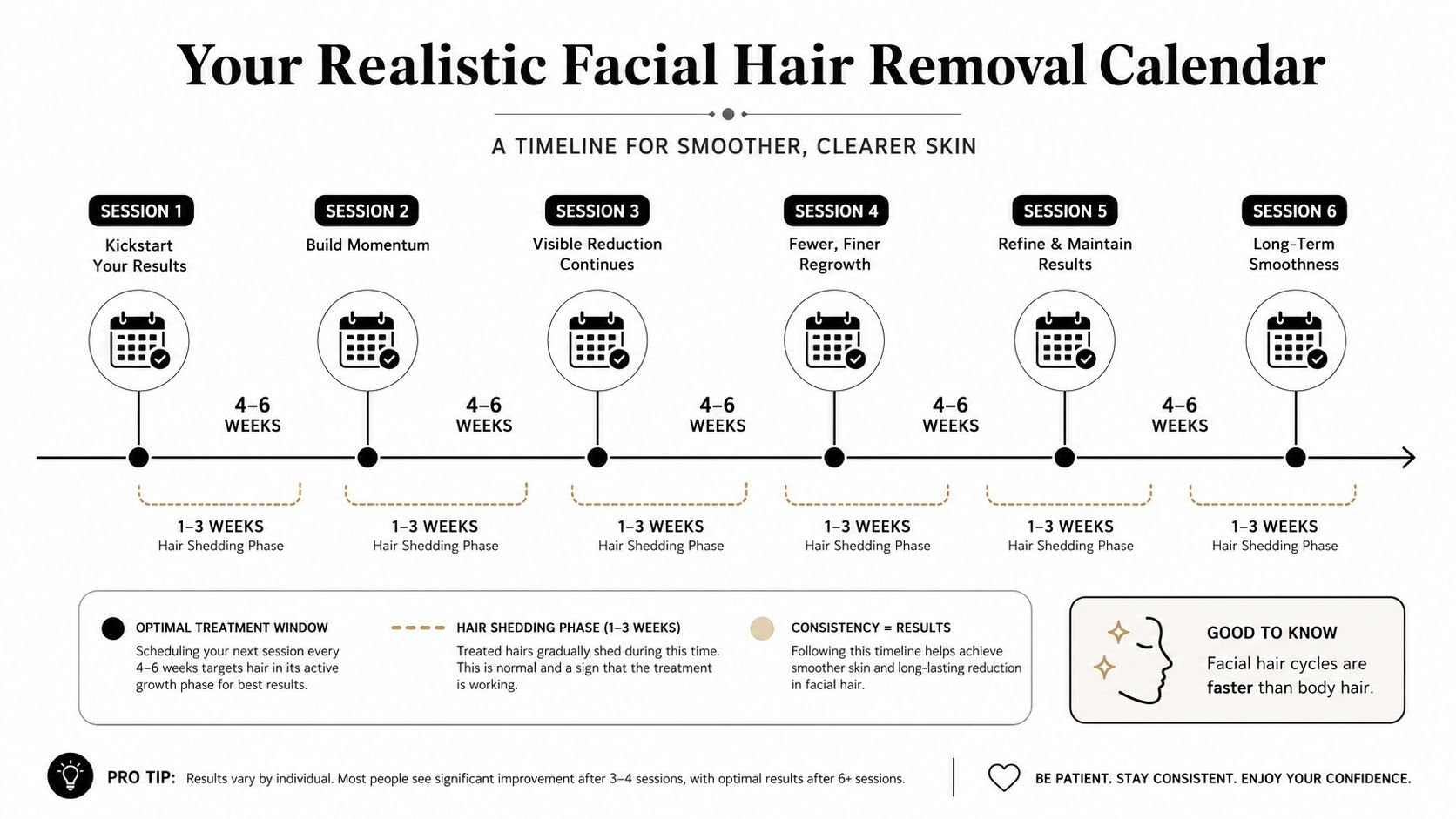
Early visits are usually about reducing the most obvious growth and making the hair patchier. On the upper lip, that often means a quicker change in shadow and daily upkeep. On the chin, the same early progress can be followed by new coarse hairs that were not active at the last visit, so the result can look uneven before it starts to settle.
Facial laser studies show that repetition is normal, not a sign that something is wrong. One published Nd:YAG study reported a mean of 8.9 treatments per patient, with a range of 4 to 22 sessions, and most patients rated their outcome as good or satisfactory. That pattern matches what we see in clinic. The face tends to reward consistent scheduling more than aggressive spacing or random touch-ups. (PubMed 21519944)
Why the upper lip and chin may need different pacing
The upper lip usually has finer, more superficial facial hair, so improvement can show up as softer regrowth and less visible shadow before the area is fully clear. The chin is different. It often contains thicker terminal hairs, and if hormones are driving the growth, fresh hairs can continue to appear even while older hairs are getting weaker.
That difference changes the timeline. The upper lip may settle into a shorter course with fewer maintenance visits, while the chin often behaves more like a long-term management area. For clients with PCOS or other hormonal shifts, I explain that the chin can improve a lot without ever becoming a one-and-done zone. The goal is reduction that changes daily life, not a promise that no new hair will ever return.
What happens after the main series
A common mistake is stopping as soon as the hairs look finer. Finer does not always mean finished. It often means the follicle is responding, but some active growth remains in reserve, especially on the chin.
If hormones are still active, maintenance may be part of the plan later. That is more likely for the chin than for the upper lip. Some people need only an occasional touch-up, while others choose to return when regrowth becomes noticeable enough to matter in everyday grooming.
Session timing matters as much as the number of visits. Facial treatments are usually spaced several weeks apart so each appointment can catch follicles as they cycle into the active growth phase. If visits are pushed too close together, the same hairs are not always ready to respond, and the timeline becomes less efficient. A visual timeline calendar for facial hair removal showing six treatment sessions scheduled every four to six weeks.
A practical plan is straightforward. Start with a consistent series, judge the upper lip and chin separately, and base any maintenance visits on actual regrowth rather than on the hope that all facial hair will stop at the same pace.
What a Session Actually Feels Like on Your Face
The appointment starts with a quick review of the treatment area, then protective eyewear goes on and the provider maps the upper lip and chin separately. On small facial zones, the actual laser time is short. Most of the visit is prep, positioning, and making sure the skin is treated evenly.
The sensation is usually described as a sharp snap, fast enough that it's over before your brain has time to dwell on it. The upper lip often feels more sensitive than people expect because the skin is thin and the area sits right under the nose. The chin can feel less intense for some clients, though coarse hairs can make the pulses more noticeable.
Cooling and numbing options
With Splendor X, cooling helps keep the experience manageable. Many clients don't need topical numbing cream for the upper lip or chin because the treatment area is so small and the session moves quickly. When numbing is used, it's usually a comfort preference rather than a requirement.
Most first-time clients are surprised by how short the visit is. Once the skin is clean and the area is set up, the treatment itself can be done in minutes. The bigger concern is usually anticipation, not the actual appointment.
A few practical details make the visit easier. Skip makeup on the treatment area, come with skin that's clean and product-free, and don't load up on caffeine if you know it makes you more sensitive. Mild pinkness right after treatment is common and usually settles on its own.
Good in-clinic rule: if the session feels tolerable but brisk, that's normal. Facial laser shouldn't feel like you're enduring something dramatic, because the zones are small and the appointment should stay efficient.
Side Effects Risks and the Aftercare That Prevents Them
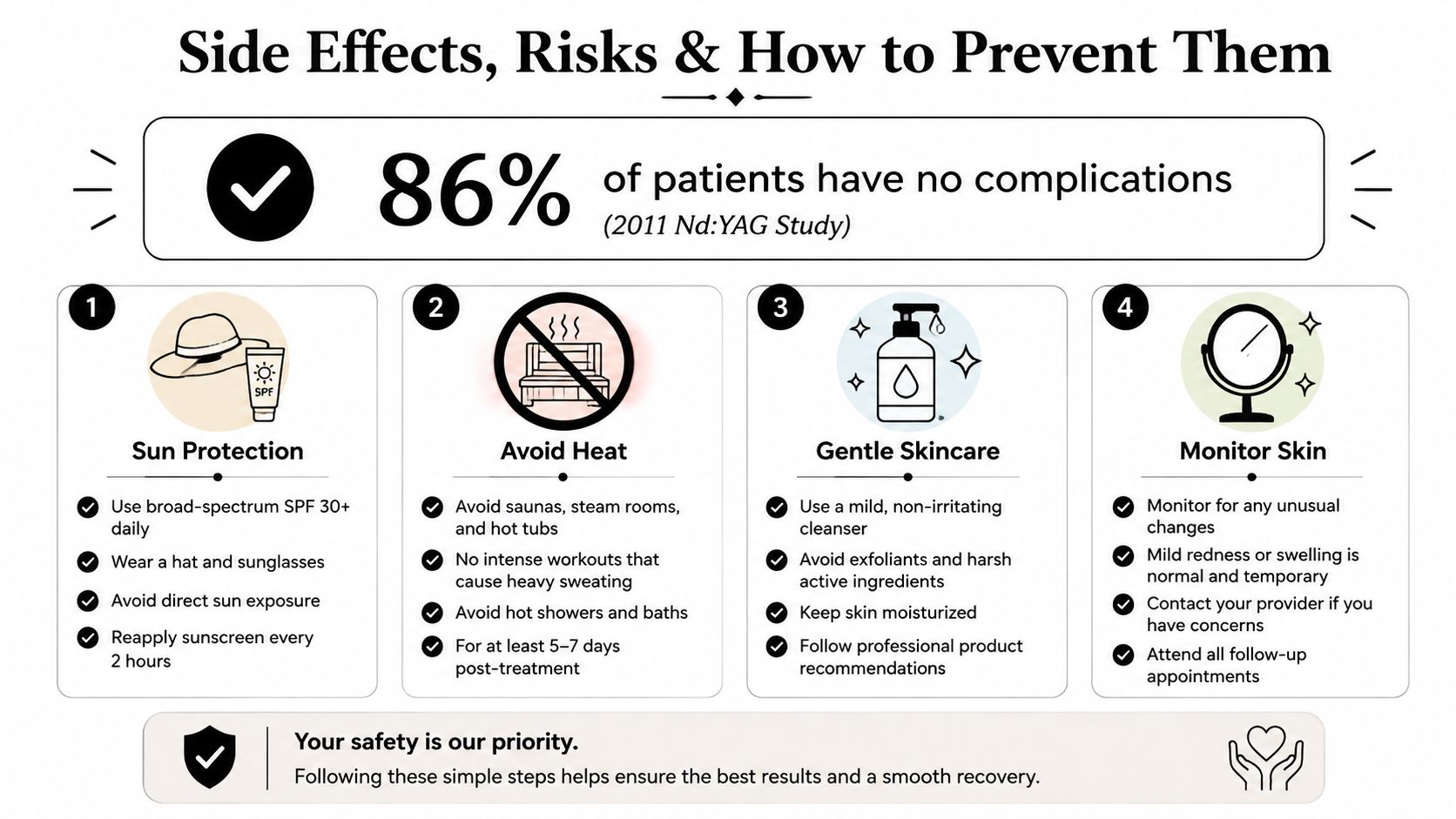
The part patients usually appreciate is that facial laser is generally well tolerated, but side effects still deserve respect. In the Nd:YAG study cited earlier, most patients had no complications, and the issues that did appear were usually temporary skin changes rather than lasting problems. On the face, the upper lip and chin do not behave the same way, so the aftercare has to account for both thin, reactive skin and, in many chin cases, ongoing hormonal hair growth.
What's normal and what isn't
Mild redness and a little swelling can show up right after treatment, especially on the upper lip where the skin is thin and close to the surface. Some clients also notice small bumps or a warm, prickly feeling for a short time. Those reactions usually mean the follicles were treated, and they generally settle without intervention.
The chin can react differently. Coarse chin hairs sometimes leave the area looking and feeling more irritated than the upper lip, even when the treatment itself is appropriate. What should raise concern is darkening, lightening, blistering, or burning that stays intense instead of calming down. Crusting that lingers, or skin that looks increasingly inflamed, should be reported to the clinic promptly.
How to reduce risk between visits
Aftercare is where clients protect the result or create extra irritation. A simple routine is usually the safest choice. The clinic's guidance works well alongside the practical advice in post-laser skin care, especially for the upper lip, where makeup, sunscreen, and skin care products often touch the area every day.
Use simple rules:
Avoid direct sun: treated facial skin should not take extra UV exposure while it is recovering.
Skip harsh actives briefly: retinoids and strong exfoliants can make the skin more reactive after treatment.
Don't pick shedding hairs: let them release on their own instead of forcing them out.
Use gentle sunscreen daily: this matters throughout a treatment series, not just on the day of the appointment.
If you notice blistering, signs of infection, or a burn that does not settle, that is not routine aftercare. It needs follow-up. For readers comparing how practices handle intake and calls, how Simbie AI handles patient calls shows one way front-desk systems can stay organized without adding friction to the visit. The goal after treatment is calm skin, steady shedding, and no unnecessary irritation.
Packages Pricing and Booking at NYCLASER
At NYCLASER, the upper lip and chin fall under the Small treatment zone category. That makes sense because both areas are compact, fast to treat, and easy to schedule around a busy week. The clinic offers single sessions, 3-session bundles, and 6-session bundles, so clients can choose between testing the waters and committing to a full reduction plan.
The 6-session bundle is the most realistic starting point for people who want to judge results seriously. Research on facial hair reduction shows that meaningful change often takes several visits, not one or two. A bundle helps keep the schedule consistent, which matters more than most first-time clients expect.
How to book and what to expect
Booking is straightforward through nyclaser.com, and the Westbury location is at 355 Post Avenue Suite 101, Westbury, NY 11590. Business hours run Monday through Saturday, 10am to 6pm. For a first visit, bring a short history of any facial hair concerns, especially if the chin has been changing with hormones, stress, or medication changes.
One practical advantage of a clinic setup is that scheduling can stay organized without adding work to your day. For readers comparing how practices handle intake and calls, it's worth looking at how Simbie AI handles patient calls as an example of how automation can support front-desk flow without replacing the clinical visit itself.
NYCLASER's approach is built around clear zone definitions, flexible bundles, and Splendor X technology for a range of skin tones. That combination matters when you're treating a face, because the upper lip and chin rarely need a one-size-fits-all plan.
Quick Answers and Your Next Step
Yes, laser can work on darker skin tones when the device and settings are chosen correctly. Splendor X's Nd:YAG wavelength is used for that reason, because it expands the range of skin types that can be treated more safely.
Yes, upper lip and chin are commonly treated in the same visit. They're both small facial zones, and combining them usually makes scheduling easier without changing the overall logic of the treatment plan.
If you miss a session by a few weeks, the series isn't ruined. Results may slow down, because timing matters for catching follicles in the right growth phase, but you usually just get back on schedule and continue.
Makeup is usually fine after redness settles, but heavy foundation right away is a bad idea. If you need coverage, keep it light and let the skin calm first.
Book a consultation through the clinic and ask for a facial plan that treats the upper lip and chin as separate zones, not one generic face package. The right plan should match your skin tone, your hair pattern, and your tolerance for maintenance.
NYC Laser Hair Removal offers Splendor X facial treatment for the upper lip and chin, with zone-based pricing and package options that fit a real treatment series. If you're ready to reduce daily tweezing, waxing, and shadow checks, visit NYC Laser Hair Removal and schedule a consultation to see what a practical facial plan looks like for your skin and hair.
Comments