
Laser Hair Removal on Chest and Stomach: A New York Guide
Laser hair removal on the chest and stomach usually involves 4 to 6 sessions spaced 4 to 6 weeks apart, with long-term reduction ranging roughly from 65% to 85%, depending on the area, hair, skin, settings, and follow-up period. It's a substantial reduction rather than a promise that every hair will disappear permanently.
You may be considering treatment after years of shaving, trimming, waxing, or just tolerating a torso that feels too dense. Perhaps you're in Westbury or elsewhere on Long Island, planning for summer events, wanting less friction during workouts, or looking for a more manageable routine before a vacation. The practical question isn't only whether the laser works. It's whether the provider, technology, schedule, and treatment plan fit your skin and hair.
Chest and abdominal treatment can be worthwhile, but it isn't an instant cosmetic fix. A qualified clinic should assess your skin tone, tanning history, hair pigment, density, medication history, and expectations before choosing settings. The best results come from a structured plan that treats active follicles safely and allows time for different growth cycles to respond.
What to Expect from Laser Hair Removal on Chest and Stomach
A Westbury client may arrive before summer, after years of shaving, trimming, or tolerating a dense torso. He may want a smooth chest and abdomen, or less density, fewer ingrown hairs, and less daily upkeep. Those goals can be treated, but they require different decisions about the target level of reduction, treatment areas, and future maintenance.
Laser hair removal on chest and stomach uses concentrated light energy to reduce hairs that regrow. The FDA-recognized term is permanent hair reduction, meaning a long-term, stable decrease in regrowth after a completed treatment regimen. It does not promise that every follicle disappears permanently after one visit. The regulatory background on permanent hair reduction explains why a planned series and occasional maintenance may be needed.
The treatment plan in practical terms
A responsible provider builds the course around your skin, hair, response, and schedule rather than selling a one-visit result.
Initial consultation: The provider reviews hair color, coarseness, density, skin tone, recent tanning, medications, and previous reactions to light-based treatment.
Treatment series: Appointments are repeated because follicles respond at different points in their growth cycle.
Progress review: Regrowth and skin response are assessed, with wavelength, fluence, cooling, or other settings adjusted when appropriate.
Maintenance: Hormonal changes, follicle cycling, and previously inactive follicles can contribute to later regrowth.
Chest and stomach treatment covers a broad, uneven surface. Hair near the sternum may be coarser or denser than hair near the ribs, while the lower abdomen may respond at a different pace from the upper chest. Ask whether the plan evaluates each zone separately and defines what reduction means for your preferred appearance.
NYCLASER is a Westbury option offering larger-area treatment with Splendor X technology and zone-based scheduling. The practical question is how well the clinic fits your routine. Choose a provider that can explain its skin assessment, test-pulse process, wavelength and fluence choices, response tracking, and maintenance plan after the initial course.
How Chest and Stomach Laser Hair Removal Works
A Westbury client with dense chest hair may notice shedding after treatment, then see new hairs appear weeks later. That pattern does not mean the session failed. Laser reduction depends on the hair's growth stage and on how precisely the provider matches wavelength, pulse duration, cooling, and fluence to the skin and hair.
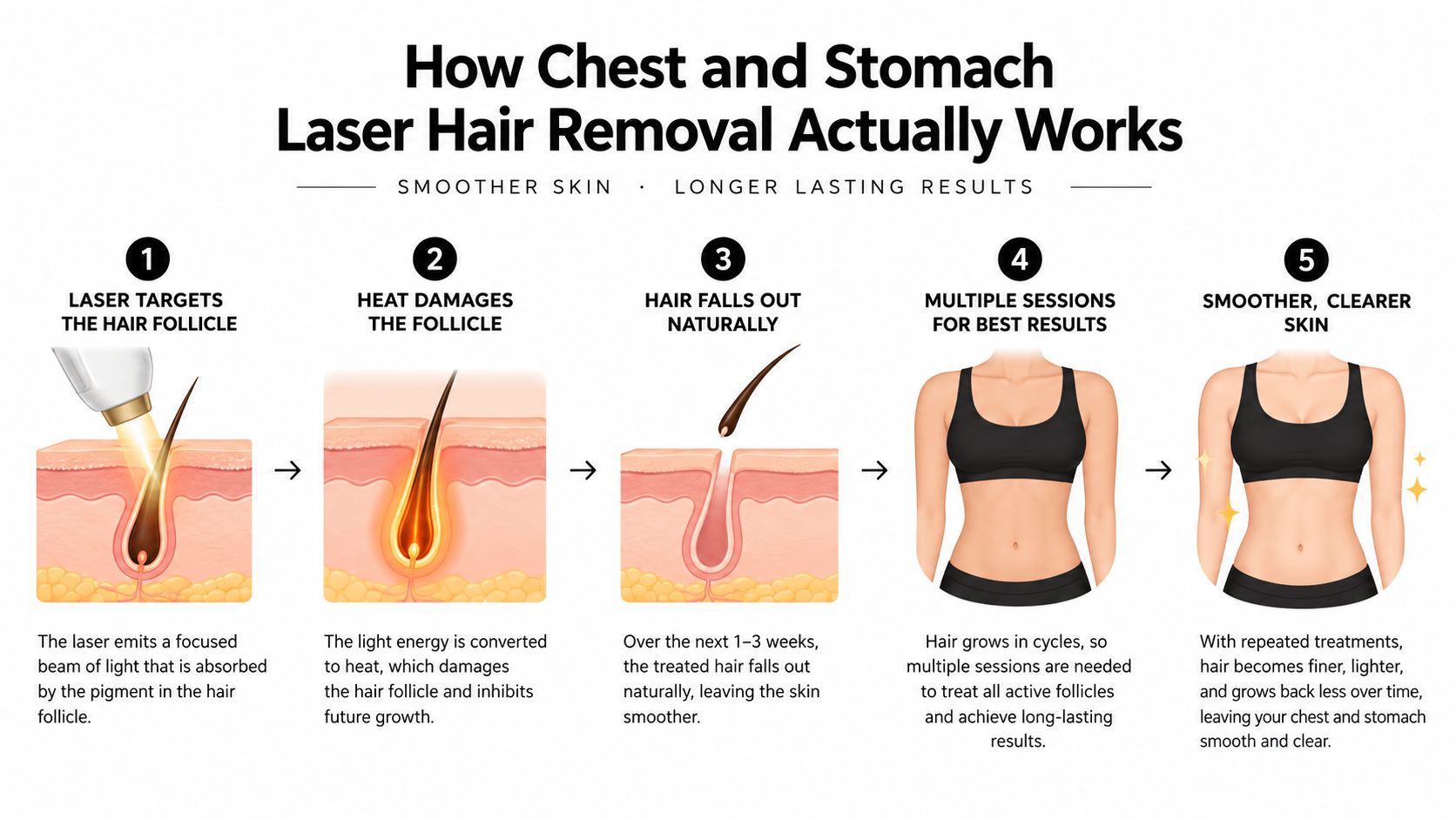
Laser treatment uses selective photothermolysis. The device sends light into melanin within coarse, pigmented hair. The pigment absorbs that energy, converts it to heat, and carries heat toward the follicular structures that support continued growth.
The surrounding skin contains melanin too. Settings must therefore create sufficient follicular injury while limiting epidermal heating. Hair color, thickness, skin phototype, wavelength, pulse duration, cooling, spot size, and fluence all affect that balance. Dark, coarse hair on the chest or abdomen usually gives the laser a clearer target than fine, light-colored hair.
Why one session cannot treat every follicle
Follicles do not grow in synchrony. One appointment affects hairs in a susceptible active phase, while follicles in other phases may respond during later visits. That timing explains why treatment is delivered as a course and why regrowth can appear after an apparently successful session.
Chest and abdominal hair also varies in density and coarseness across the trunk. Trunk hair may respond less readily than axillary or pubic hair, so the practical goal is durable reduction rather than guaranteed permanent removal of every hair.
A 2023 literature review reported mean hair reduction at 12 months of 74% for the chest, with a range of 65% to 85%, and 71% for the abdomen, with a range of 60% to 82%. It described an 810-nanometer diode laser as safe and effective for male trunk hair removal, while noting variation by laser type, hair characteristics, skin type, settings, and follow-up period. The clinical review of male trunk hair removal supports a realistic expectation: substantial reduction is achievable, but complete permanent clearance should not be promised.
Splendor X is a diode-based platform used for larger treatment zones. Its performance still depends on assessment, appropriate settings, cooling, and gradual adjustment. Review the provider's laser hair removal technology before choosing a clinic, and compare technical explanations with appointment availability in Westbury.
Who Is a Good Candidate for Chest and Abdomen Laser Treatment
The strongest candidate usually has dark, coarse hair and enough contrast between the hair and surrounding skin for the device to target the follicle effectively. That doesn't exclude people with darker skin tones, but it does make wavelength selection and conservative settings especially important.
Light, gray, white, or very fine hair can be more challenging because the laser depends on pigment. A consultation should also identify whether chest or abdominal growth appears unusually rapid, newly developed, or hormonally influenced. When the growth pattern is changing, the treatment plan needs to account for the possibility that new follicles may become visible over time.
Skin tone changes the safety conversation
Epidermal melanin competes with follicular melanin for absorbed energy. Alexandrite near 755 nanometers is generally efficient for lighter skin with dark hair, but its stronger melanin absorption can increase the risk of epidermal injury or pigmentary change in darker skin. Diode systems around 808 to 810 nanometers penetrate further and are commonly used across intermediate phototypes.
For darker skin, long-pulsed 1,064-nanometer Nd:YAG is generally favored because it has lower absorption in epidermal melanin. The trade-off is that the provider may need to carefully titrate energy to affect the follicle effectively. Longer pulse durations, adequate cooling, conservative escalation, and test spots help manage the balance between efficacy and safety. Technical guidance on wavelength selection outlines why a device should never be selected by marketing language alone.
Ask these questions before booking:
Which wavelength fits my skin tone? The answer should relate to your actual phototype and current tanning, not just the device name.
Will you perform a test spot? Test-pulsing can reveal how your skin responds before treating a broad torso.
How do you monitor pigment changes? The clinic should explain what temporary darkening, lightening, blistering, or persistent irritation requires.
What happens if growth becomes thicker nearby? A provider should discuss the uncommon possibility of paradoxical hypertrichosis and how it would be evaluated.
Splendor X may support treatment across varied skin and hair types, but the platform doesn't replace clinical judgment. Avoid tanning, disclose photosensitizing medication and previous pigmentary reactions, and postpone treatment when the skin is recently sun-exposed or irritated.
What a Typical Session Looks Like at NYCLASER in Westbury
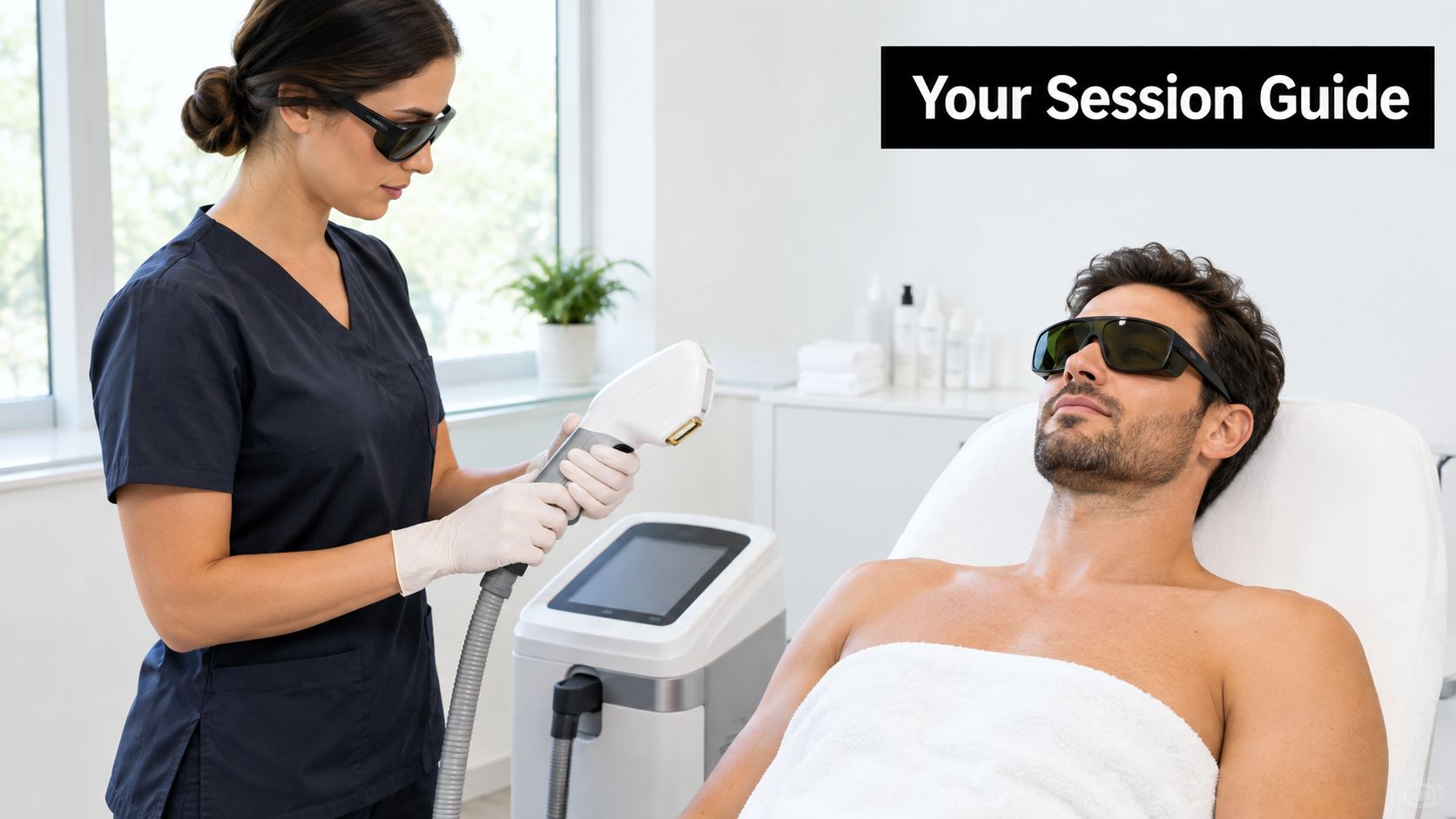
You arrive for a large chest and stomach appointment with the treatment area already shaved, but the visit still begins with an assessment. The technician reviews recent sun exposure, medications, skin reactions, and shaving, then examines hair density and skin tone across the torso. A Westbury client should expect this review to shape the plan, not a preset treatment used for every appointment.
The skin is cleansed to remove deodorant, lotion, sweat, and oil that could interfere with contact or cooling. If tanning, pigment, hair density, or another factor creates uncertainty, the provider may perform a test pulse before treating the full zone. That extra step can affect appointment time, but it gives the technician useful information before applying energy across a broad area.
Why large areas need an adapted technique
Chest and abdomen treatments cover more surface area than a lip or underarm appointment. A provider may use motion-based passes over broad zones to distribute energy and manage comfort, then use stationary pulses where hair is denser or the pattern requires more focused treatment. Cooling and consistent skin contact support tolerability, but technique still has to match the client's hair and skin.
A clinical study of men treated with an 810-nanometer diode across trunk areas, including the chest and abdomen, reported overall hair reduction of 80.6% ± 2.8%. Its protocol used stationary fluences of 20 to 35 J/cm² and motion-based treatment at 6 to 10 J/cm². The lower-energy motion approach was intended to improve comfort over larger areas. These study figures are not universal prescriptions. Clinical information on diode treatment and trunk protocols explains why fluence, pulse duration, spot size, cooling, hair thickness, and phototype require individual adjustment.
During treatment, expect heat, snapping, or a brief elastic-band sensation. Give feedback, while recognizing that comfort cannot determine the protocol by itself. Settings that feel easy may under-treat the follicle; settings that are too aggressive can increase reaction risk.
Afterward, follow the clinic's product instructions and limit immediate heat and friction. Contact the provider about blistering, worsening pain, marked swelling, or pigment changes that do not settle.
Pain, Side Effects, and Long-Term Results Explained
A Westbury client planning chest and stomach treatment usually wants two answers before booking: how manageable the discomfort will be and whether the result will fit his schedule. Chest and abdominal hair can vary in thickness and density, so sensation changes across the same appointment. Coarse, concentrated areas often feel sharper than finer growth. Cooling, steady pacing, and clear feedback help, but comfort alone does not determine whether the settings are appropriate.
Redness and small raised areas around treated follicles are common short-term responses. They should gradually settle under the clinic's aftercare instructions. Mild tenderness or warmth may also occur during the early recovery period. Keep the area clean, reduce friction, and follow the provider's product guidance rather than adding unapproved creams.
Normal response versus a reason to call
Contact the provider promptly about:
Blistering or open skin: These signs can indicate excessive thermal injury and need assessment.
Severe or increasing pain: Discomfort should ease, not intensify, after treatment.
Persistent pigment change: Darkening or lightening should be documented and reviewed, particularly on darker skin.
Unexpected thicker growth: New or denser hair near the treated area should be reported rather than ignored.
Skin tone affects treatment planning because epidermal melanin can absorb laser energy. That raises the risk of burns and temporary or lasting pigment changes when the wavelength, fluence, cooling, or timing does not suit the client. The Mayo Clinic guidance on laser hair removal safety recommends an experienced provider and a discussion of medications, skin history, and sun exposure before treatment.
Paradoxical hypertrichosis, meaning unexpected new or thicker growth near a treated area, is uncommon but possible. It has been reported around treated zones, with male cases more often involving sites such as the back, arms, and shoulders than the chest or abdomen. Ask how the provider records unexpected growth and adjusts the plan if it appears. A clinic that discusses rare complications openly gives a more useful consultation than one that promises a risk-free result.
For a busy Westbury client, long-term success means reduced density, slower regrowth, and finer remaining hairs, not permanent inactivity of every follicle. Hair cycles, hormonal changes, and previously inactive follicles can affect maintenance needs. Ask how the clinic spaces follow-up sessions and whether chest and stomach are assessed separately, since one zone may respond faster than the other. That practical plan matters as much as the initial treatment choice when appointments must fit work, exercise, travel, and social commitments.
Preparation and Scheduling Tips for Busy New Yorkers
A Westbury client with early workouts, outdoor plans, or frequent business travel should schedule laser hair removal around skin exposure, recovery time, and the clinic's treatment intervals. Preparation belongs on the calendar before the appointment is booked. A provider should also explain how skin tone, hair density, wavelength, and fluence affect the plan for the chest and abdomen.
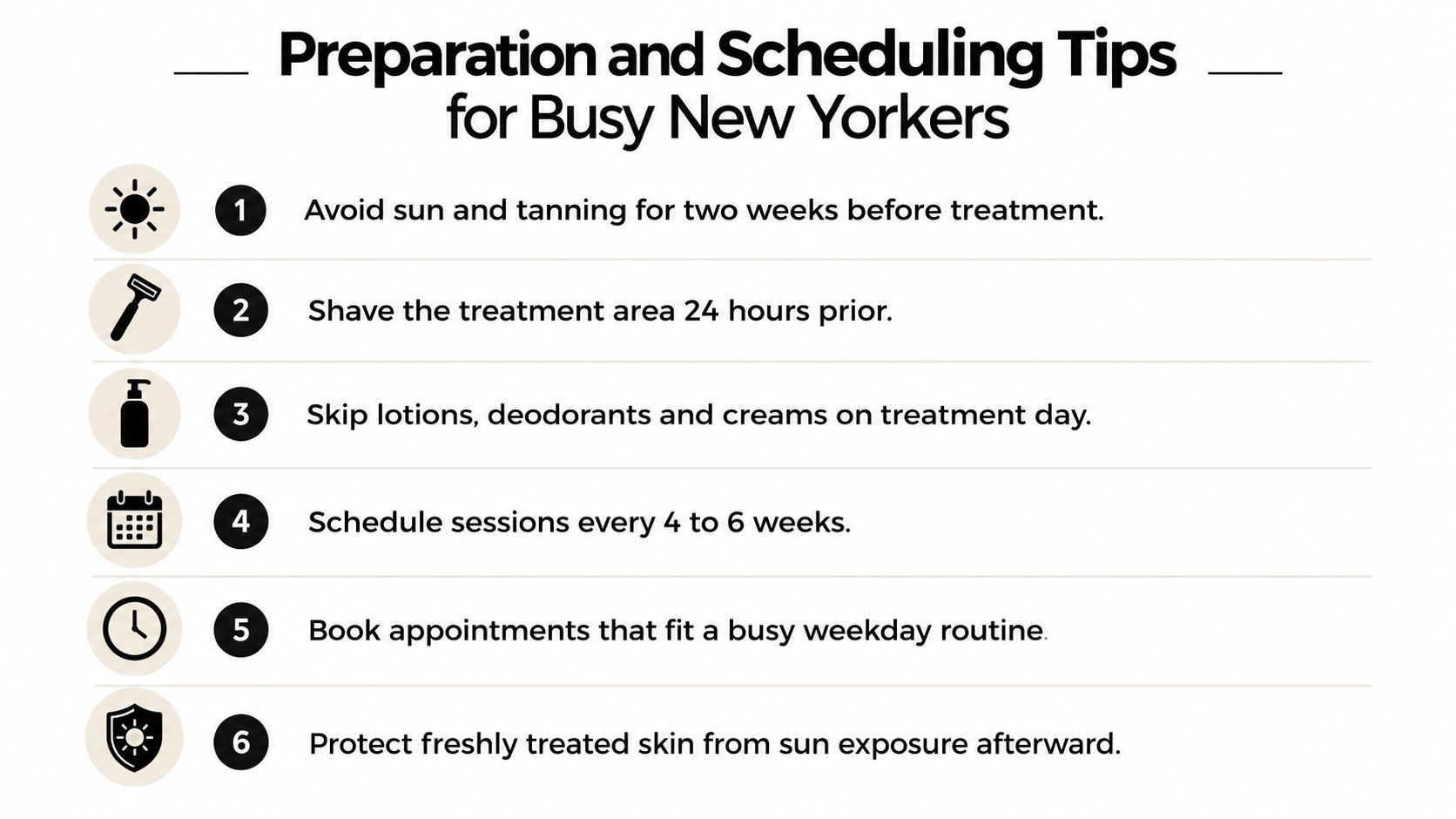
Avoid tanning and significant sun exposure before treatment. Tell the clinic about photosensitizing medication, recent pigment changes, active irritation, and any previous reaction to laser or intense light. The provider may postpone treatment until the skin returns to its usual baseline. This protects comfort and gives the practitioner a more reliable starting point for selecting settings.
A workable appointment routine
Use this checklist before a consultation or session:
Avoid tanning: Keep treated skin away from intentional tanning and tell the clinic about recent outdoor exposure.
Shave as directed: Shaving removes surface hair while leaving the follicle available to the laser. Follow the provider's timing.
Arrive with clean skin: Leave lotions, deodorant, oils, and creams off the treatment area unless the clinic gives different instructions.
Protect the area afterward: Use sensible sun protection and reduce friction while freshly treated skin settles.
Reserve the next appointment: Keep the course aligned with the interval recommended for your growth cycle.
Build around real life: Avoid booking directly before a beach weekend, intense heat exposure, or an event where temporary irritation would be inconvenient.
Chest and stomach hair do not always progress at the same pace. Ask whether the provider tracks each zone separately and how the schedule will be adjusted if one area responds sooner. The right interval supports follicle targeting without forcing appointments into a busy calendar.
Review this guide to what not to do before laser hair removal before your visit. Clinics and wellness businesses can also use administrative resources such as hire medical virtual assistant to coordinate communication, but treatment decisions belong with the qualified provider.
Plan around seasons, not promises
Winter and early spring may make sun avoidance easier for many New Yorkers. Summer requires closer coordination with outdoor workouts, beach trips, and heat exposure. If the skin is tanned or irritated, rescheduling is safer than compressing the plan for an upcoming event.
The FDA-recognized goal is permanent hair reduction, rather than guaranteed permanent removal of every hair. Results depend on follicle cycling, hair characteristics, skin response, and the settings selected by the practitioner. Choose a Westbury clinic that explains expected reduction, wavelength and fluence choices, preparation requirements, and follow-up planning clearly. That operational fit matters when appointments must work alongside employment, exercise, travel, and social commitments.
Understanding Packages, Zones, and Pricing at NYC Laser
Chest and stomach treatment usually belongs to a larger treatment-zone category because it covers a broad area and requires more time and planning than a small facial zone. A package should therefore be evaluated by what it includes, how the clinic handles both areas, whether sessions can be scheduled consistently, and what maintenance looks like after the initial course.
A single appointment can be sensible for testing comfort, assessing your response, or treating a limited goal. A shorter bundle may suit someone who wants a defined reduction without committing immediately to a longer plan. An extended plan can make more sense when the goal involves broad density reduction and the provider expects ongoing review.
Plan Type | Typical Use Case | Best For |
|---|---|---|
Single-session entry | Testing skin response, comfort, and treatment fit | A first-time client who wants an informed starting point |
Short bundle | Beginning a structured course across chest, abdomen, or both | Someone seeking consistent progress while keeping the commitment measured |
Extended plan | Continuing an initial series with progress reviews and possible maintenance planning | A client with dense trunk hair or a long-term reduction goal |
NYC Laser Hair Removal lists chest and abdomen among its larger treatment zones and offers single sessions alongside multi-session options. Its laser hair removal chest cost guide can help you identify the questions to ask about zone definitions, package terms, and whether chest and abdomen are treated together.
Compare value beyond the headline price
Ask whether the quoted plan covers both chest and stomach, whether the provider reviews progress between sessions, and what happens if one area responds faster than the other. Confirm cancellation rules, booking availability, aftercare support, and whether maintenance sessions are purchased separately.
A low upfront price isn't automatically better if it leads to inconsistent appointments, unclear settings, or a plan that doesn't match your hair and skin. A higher package price isn't automatically better either. The useful comparison is the quality of assessment, the transparency of terms, and the likelihood that you can complete the recommended course.
Clinics also need clear communication when they explain larger-area treatments online. For businesses assessing patient education and acquisition, this overview of med spa marketing for 2025 offers broader context. For a client, the practical lesson is simpler: choose a provider whose public information matches the clarity you receive during consultation.
Common Questions About Chest and Stomach Laser Hair Removal
How many sessions will I need?
Chest and stomach treatment usually starts with a planned series rather than one appointment. The required course depends on hair density, coarseness, skin tone, pigment, treatment settings, and the level of reduction you want. Chest and stomach can respond at different rates, so a provider should assess each zone separately instead of treating the torso as one uniform surface.
Clinical evidence supports substantial reduction, not guaranteed complete clearance. Reviewed results found meaningful long-term reduction on both the chest and abdomen, with outcomes varying between the two areas. Use that evidence to set a realistic expectation, then ask the provider how your hair and skin characteristics may affect the plan.
Will my chest respond differently from my stomach?
It can. Hair thickness, density, and growth patterns vary by anatomical site, and male trunk treatment reviews have reported differences between chest and abdominal hair. One area may look smoother sooner while the other continues to show scattered regrowth.
A slower response does not automatically indicate poor treatment. The provider may adjust technique or settings according to the response while protecting the surrounding skin. Ask whether progress is reviewed by zone, especially if your chest and stomach are changing at different speeds.
What happens if I pause halfway through?
A pause may not remove your progress, but it can make the overall course less predictable. You may miss treatment opportunities as follicles enter an active growth phase, while untreated or previously inactive follicles can produce visible regrowth later.
Tell the clinic if work, travel, illness, or sun exposure causes a delay. The provider can decide whether to continue, reassess your skin, or wait until treatment conditions are safer. Do not change shaving, waxing, or appointment timing without discussing it first.
Do I need maintenance after the initial series?
Maintenance may be appropriate because hormonal changes, follicle cycling, and previously inactive follicles can lead to additional growth. The practical goal is controlled, durable reduction, rather than a promise that the torso will never produce another hair.
Report new or thicker growth, particularly near treated zones. A provider can distinguish ordinary regrowth from a pattern that deserves closer assessment.
Can I book around a Westbury work schedule?
NYCLASER states that its Westbury clinic operates Monday through Saturday and offers online booking. Confirm current availability, appointment length, package terms, and preparation requirements directly with the clinic because business details can change.
Choose an appointment schedule you can maintain safely and consistently. If you are preparing for a summer event, discuss timing early enough to account for the treatment course, sun exposure, and possible maintenance. One last-minute visit cannot replace a properly scheduled plan.
NYC Laser Hair Removal offers personalized treatment for larger areas such as the chest and abdomen, using Splendor X technology with single-session and multi-session options. Visit NYC Laser Hair Removal to review the Westbury location, arrange a consultation, and discuss a plan suited to your skin, hair, schedule, and reduction goals.
Comments