
How Many Sessions for Laser Hair Removal Legs
Most legs need 6 to 8 laser hair removal sessions, spaced 4 to 8 weeks apart. Full-leg treatment often moves toward 8 to 10 sessions because a larger surface area contains more follicles with different growth patterns.
Could four appointments be enough for your lower legs but not your thighs? That's the question generic “6 to 8 sessions” advice often misses. Your treatment count depends on whether you're treating the lower legs, upper legs, or both, along with hair characteristics, skin tone, device selection, appointment spacing, and hormonal changes.
Laser hair removal is best understood as a planned reduction series, not a one-time smoothing service. The aim is to treat follicles when they're vulnerable, assess how your hair responds, and adjust the plan as regrowth becomes more selective and uneven.
Why One Session Will Not Get Your Legs Smooth
Why can your legs look less hairy after one appointment yet still grow new hair soon afterward? The laser reduces visible density, but one visit cannot reach every follicle that may produce hair. A treatment plan is therefore a series, as described in Mayo Clinic guidance and leg-treatment information.
Regrowth after the first session does not automatically signal failure. The laser affects follicles that are ready to respond during that visit. Hair appearing later may come from follicles that were less responsive at the time, so the next appointment addresses a different portion of the overall growth pattern.
Think in zones, not just “legs”
Lower legs often show a more consistent pattern, while upper legs may contain finer and less uniform hair. The shin, knee area, and inner thigh can also respond differently from one another. Full legs combine these sub-zones, so the overall appointment count may be shaped by the area that responds more slowly.
That difference explains why a generic session estimate can mislead. A lower-leg plan may progress differently from an upper-leg plan, even on the same person. Device choice, skin tone, hair color and thickness, appointment spacing, and hormonal changes can all alter how quickly each zone responds. Dermatology guidance on leg hair reduction also describes this zone-specific variation in dermatology guidance on leg hair reduction.
Separate reduction from clearance. Reduction means fewer, finer, slower-growing hairs. Near-complete clearance requires a longer series and may still be followed by maintenance if dormant follicles later become active.
Practical rule: Regrowth between appointments is expected. Track progress by declining density, slower return, and finer texture, rather than expecting every hair to disappear immediately.
Your consultation should assess hair biology, skin tone, treatment zone, and hormones before setting a plan. Treating the legs as one uniform surface can make the estimate less useful, especially when upper-leg and lower-leg responses differ.
The Hair Growth Cycle Behind Repeat Sessions
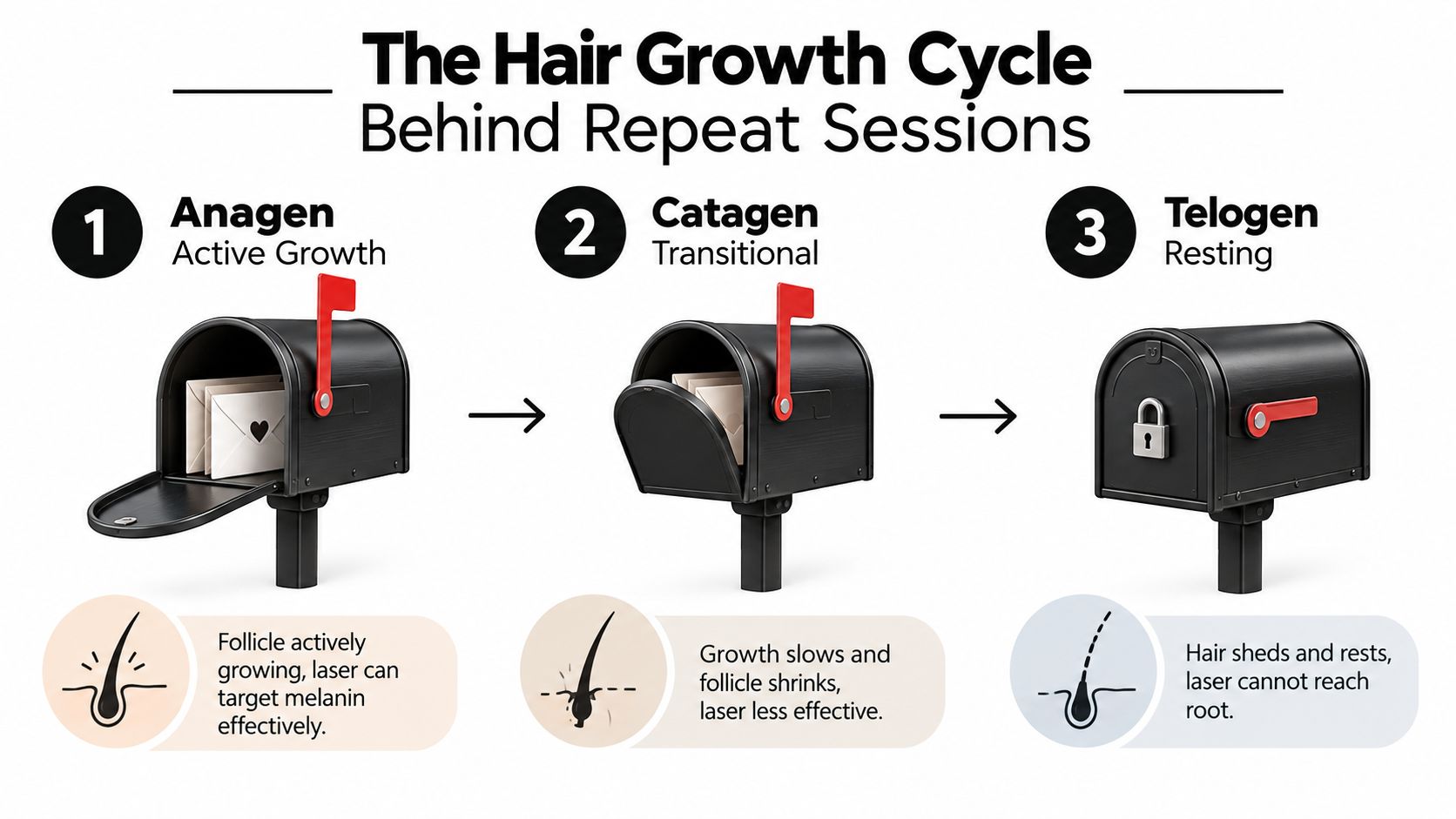
Why do leg treatments require repeat appointments? Each follicle cycles through anagen, catagen, and telogen. Anagen is active growth, catagen is the transition stage, and telogen is the resting stage. Laser energy works most effectively during active growth, when the follicle contains enough visible pigment for the device to target.
A single appointment reaches the follicles that are ready at that time. Follicles in catagen or telogen are like lights that are currently off, so a later visit addresses another group after it enters anagen. That staggered timing is why upper-leg, lower-leg, and full-leg plans can require different appointment counts.
Why spacing controls the outcome
Leg follicles commonly need several weeks before another useful group becomes ready. Clinical treatment plans often space appointments 4 to 6 weeks apart, although the suitable interval depends on visible regrowth and the zone being treated.
Lower-leg and thigh follicles do not always follow identical patterns. Coarser thigh hair may remain in a slower cycle, while finer hair can show a different response. A provider may lengthen the interval when regrowth is still limited, because returning too soon can mean treating the same already-addressed group rather than a newly active one.
For a clearer explanation of the growth stage targeted by laser, read about the anagen phase of hair growth.
Shortening the interval cannot force dormant follicles into anagen. Scheduling should follow the biology visible in each zone, not a fixed calendar. Repeat sessions therefore reflect follicle timing, while progress is judged by reduced density, slower return, and finer texture.
The following video offers another visual explanation of why hair growth stages matter:
Factors That Move Your Session Count Up or Down
How many sessions will your legs need? “Six to eight sessions” is a starting estimate, not a promise. The actual count can shift by zone, device choice, hair biology, and how your skin responds to treatment settings.
Factor | Lower Need, toward 6 | Higher Need, toward 10+ |
|---|---|---|
Hair pigment and thickness | Dark, coarse hair gives the laser a clearer target | Blonde, red, gray, white, or very fine hair may respond less predictably |
Skin tone | A clinician can choose settings appropriate for lighter skin | Deeper skin tones may call for conservative settings and careful wavelength selection |
Treatment zone | A defined lower-leg area may have more uniform density | Full legs combine a larger surface area with different hair patterns |
Hormonal influence | Stable growth patterns are easier to plan | PCOS, perimenopause, or other endocrine changes can encourage new growth |
Hair color changes the estimate because laser energy targets pigment in the follicle. Dark, coarse hair usually offers a stronger target than light or depigmented hair. Lighter hair does not automatically mean that you need more appointments. It means the provider should explain the treatment's limits when the follicle contains little usable pigment.
Skin tone affects planning
Skin tone affects how a clinician sets treatment intensity while protecting the surrounding skin. Devices with different wavelengths can give the provider more options across skin tones, yet the appropriate choice still depends on your individual assessment rather than a package label.
The treatment zone matters just as much. Lower legs, upper legs, and full legs should not receive one automatic forecast. Hair can differ from ankle to thigh in density, thickness, and pigment, so one zone may thin sooner while another needs more attention.
Hormonal changes can alter the plan after treatment starts. PCOS, perimenopause, pregnancy-related changes, and other endocrine factors may activate additional follicles or increase future maintenance needs. Earlier sessions were not wasted. New growth signals can bring different follicles into the treatment target.
Device selection also matters. A clinician may adjust wavelength and settings according to skin tone, hair characteristics, and the zone being treated. That is why a lower-leg estimate may differ from an upper-leg estimate, even during the same visit.
Ask for a zone-specific estimate. “How many sessions for laser hair removal legs?” is less useful than “How many sessions do you expect for my lower legs, thighs, and full-leg plan separately?”
Realistic Treatment Timelines for Legs
How long should you set aside for smoother legs? The answer depends on the zone, the device settings, and how quickly treated follicles return to a responsive growth stage. A lower-leg plan may follow a different calendar from an upper-leg plan, even when both are treated during one appointment.
A calendar you can use
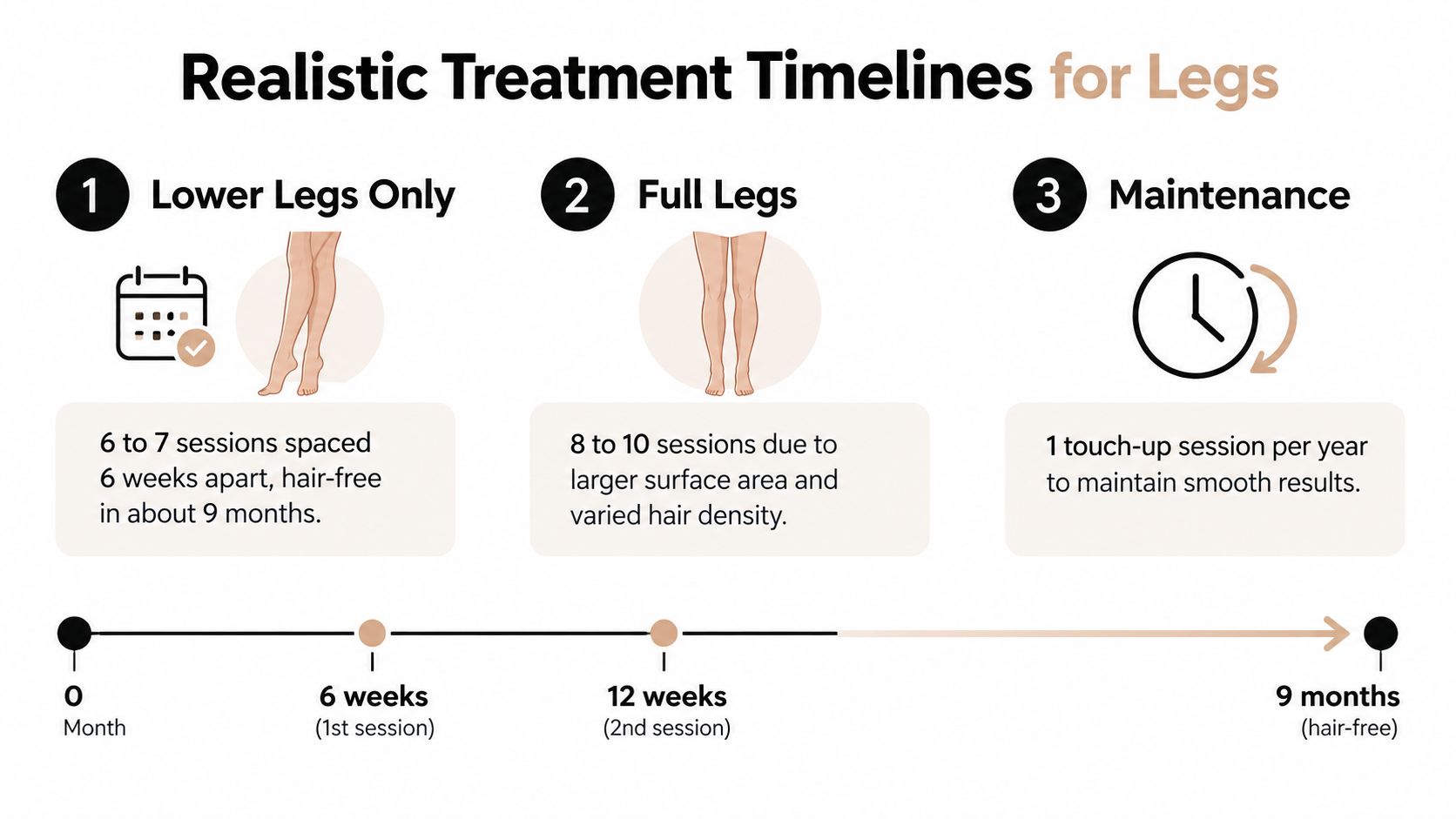
Lower legs only: Six sessions spaced six weeks apart create a calendar of roughly eight months from the first visit to the sixth. The interval may change as regrowth becomes slower and sparser.
Upper legs: Thighs may need a similar series, but fine hair, uneven density, or hormonal patterning can make progress less uniform. A six-session plan at six-week intervals still spans about eight months, while later adjustments may extend the schedule.
Full legs: Treating the thighs and lower legs together requires more coverage and coordination. Six visits at six-week intervals take about eight months, though separate zones may reach visible milestones at different times.
These examples show why “six sessions” is not the same as “six weeks.” The sessions are points on a calendar, while the interval gives another group of follicles time to enter a treatable stage. Some plans start around four weeks apart when visible regrowth returns sooner, then move toward six to eight weeks as the cycle slows.
Appointment length also affects planning. Lower legs usually require less treatment time than full legs, while the device, hair pattern, and clinic workflow can change the duration. You can review the practical factors that affect how long laser treatment takes before arranging work, travel, or other commitments.
Leave extra room before a wedding, holiday, or summer event. Sun exposure may require a provider to delay treatment, and a missed appointment can lengthen the overall course. The most realistic finish date is therefore a range, not a fixed promise. As growth slows, visits may become more widely spaced, with each zone assessed on its own response.
Single Session Versus 3-Session and 6-Session Packages
Which package fits your legs depends on the area, hair pattern, and what you want to learn from treatment. A single appointment can test comfort and skin tolerance, but it is rarely a realistic endpoint for leg reduction. Three sessions provide an early response check, while six sessions create a substantial initial series for many clients.
Package | Session Count | Expected Reduction | Best-Fit Zone | Ideal Client |
|---|---|---|---|---|
Single session | 1 | Initial, partial reduction | Small test area or defined zone | Someone assessing tolerance or preparing for a short-term need |
Short package | 3 | Visible thinning and a clearer growth pattern | Lower legs or another focused area | Someone testing response before committing to a longer course |
Core package | 6 | Substantial cumulative reduction | Full legs or a larger treatment plan | Someone ready to follow a complete initial series |
A single session helps you assess the sensation, observe your skin's reaction, or test a small patch. It cannot show the final result because many follicles will be outside the responsive growth stage at that appointment. Upper-leg, lower-leg, and full-leg areas may also respond differently, so one visit offers only a limited preview.
Three sessions create a more useful checkpoint. You may notice uneven thinning, slower regrowth, and a clearer difference between responsive and stubborn zones. Lower legs may provide an easier early assessment when density is concentrated there, while upper legs can require more observation. The information helps your provider adjust treatment settings and spacing, but it does not represent the full potential of a longer leg series.
Six sessions often suit clients treating a larger area, especially full legs. The package covers upper and lower zones that can differ in density, hair thickness, and growth timing, so additional visits may still be appropriate. Package pricing can spread the cost of a planned course. Confirm what happens if you need more sessions or if your goals change.
Choose after a consultation. A clinician should assess your skin, hair color, density, device choice, and treatment area before you commit to a package.
What Results Look Like After Each Milestone
How should your legs look after each appointment? Expect patchy thinning before uniform smoothness. The shin, knee, and thigh can progress at different speeds because their follicles do not enter the responsive growth stage together. Hair thickness and density also vary by zone, so upper-leg, lower-leg, and full-leg treatment plans may show different milestones.
After the first appointment, some treated hairs may shed while others continue growing normally. Shaving may feel easier, yet visible return remains expected. The useful early question is whether overall density begins to decline as appointments continue.
The first three checkpoints
At the session-three checkpoint, compare regrowth speed, dense patches, and shaving frequency. Lower legs may show a clearer early change when hair density is higher, while upper legs can appear more gradual. A clinician can compare the ankle, knee, and thigh instead of judging the entire leg as one surface.
By session six, you often have a clearer view of the longer-term pattern. Some zones may be sparse and easier to manage, while fine or hormonally influenced hairs remain. Results mean reduction, not a promise that every follicle will stay inactive permanently.
Photos make gradual change easier to judge. Take them in similar lighting before treatment and at planned checkpoints, then review laser hair removal legs before-and-after examples with your clinician if you need help interpreting progress.
After the initial series
Maintenance is a separate phase from the original course. Dormant follicles may later become active, and hormonal changes can affect regrowth. A maintenance appointment targets selected return rather than automatically repeating the full starting process.
Contact the clinic if regrowth changes suddenly, pigment differences persist, or your skin reacts more strongly than expected. Your provider can decide whether the next interval, wavelength, or treatment setting needs adjustment.
How NYCLASER Approaches Leg Treatments With Splendor X
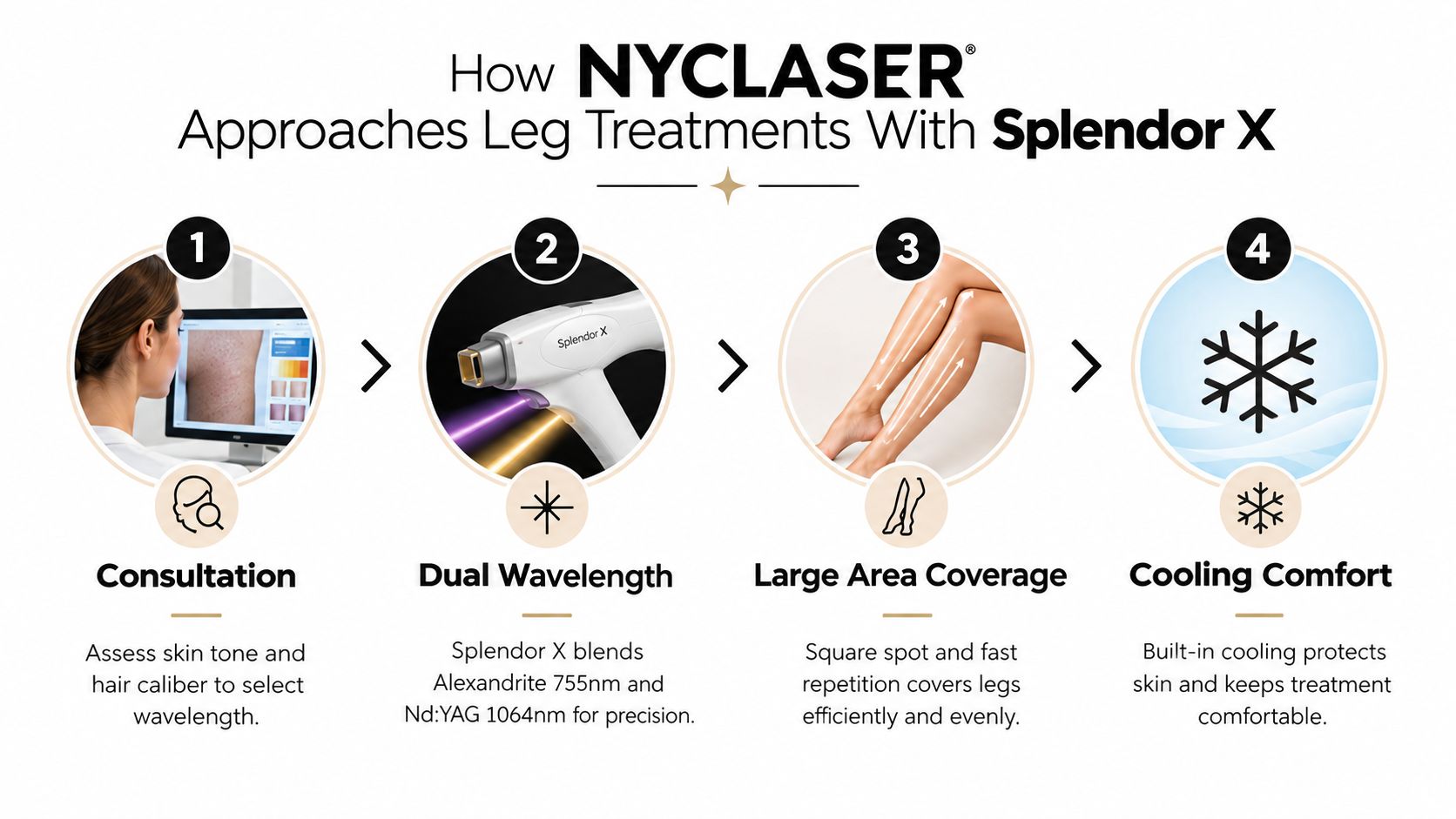
NYCLASER offers leg hair-reduction treatments with Splendor X, a dual-wavelength platform that combines Alexandrite and Nd:YAG technology. The relevant point for a client isn't the device name alone. It's whether the clinician evaluates your skin tone and hair caliber before selecting the approach.
A consultation should begin with medical history, medications, hormonal factors, recent sun exposure, and hair-removal habits such as waxing. Waxing removes the follicle's visible target, so the provider needs to know about recent use before planning treatment. A patch test can also help the team observe your skin's response before covering a large area.
Why wavelength selection matters
Alexandrite and Nd:YAG wavelengths interact differently with skin and hair pigment. A qualified provider can use the consultation to determine which approach better balances targeting the hair with protecting the skin. This is especially important when treating a large area such as full legs, where consistency across the surface matters.
Splendor X also uses a square spot design and built-in cooling features intended to support coverage and comfort during larger treatments. NYCLASER lists lower legs and full legs among its treatment areas and offers single-session, three-session, and six-session options. Those options give clients a way to begin with a defined commitment while keeping the final session count dependent on progress.
Your written plan should identify the zone being treated, expected checkpoints, recommended spacing, and what to do if your response differs from the initial estimate. Ask how the clinic will handle redness, perifollicular swelling, pigment changes, or a delayed appointment.
The useful device question isn't “Will this guarantee fewer sessions?” No platform can erase the influence of growth cycles, hair pigment, skin tone, or hormones. Ask instead how the device will be selected and adjusted for your legs.
Your Next Step Toward Smooth Legs
Start by defining the treatment area. Mark whether your goal is lower legs only, upper legs, or full legs, then note where hair is densest and where it is finest. A few clear photographs of the ankle, knee, thigh, and any stubborn patch can help you discuss a realistic target during consultation.
Write down relevant changes before you book. PCOS, recent pregnancy, perimenopause, thyroid concerns, medication changes, and recent tanning or significant sun exposure can affect how the clinic schedules and adjusts treatment. You don't need to diagnose the reason for regrowth yourself. Give the clinician enough context to plan safely.
Questions to take to consultation
Which device and wavelength will you use for my skin tone and hair color?
Will you treat my lower legs and thighs at the same interval?
What session range do you expect for each zone?
What result should we assess at the third and sixth visits?
What happens if fine hair remains after the initial series?
What sun precautions and shaving instructions apply between appointments?
Expect the plan to sit within a broad range rather than a guaranteed number. Most leg courses fall around 4 to 8 sessions, while full-leg treatment can extend toward 6 to 10 sessions, based on the cited clinical guidance above. The right plan also includes spacing, safety checks, progress reviews, and a maintenance strategy.
Book a consultation before purchasing a large package. That conversation should leave you with a zone-specific estimate and a calendar that fits your skin, hair, schedule, and goal.
NYC Laser Hair Removal offers consultations and Splendor X treatments for lower legs and full legs, with single-session, three-session, and six-session options. Visit NYC Laser Hair Removal to discuss your expected session range, treatment spacing, and a practical plan for smoother legs.
Comments