
How Effective Is Laser Hair Removal for Permanent Results
So, how effective is laser hair removal? Let’s cut right to it. The short answer is yes—it’s an incredibly successful method for long-term hair reduction. Most of our clients see a 70-90% permanent reduction in unwanted hair after they complete their full series of treatments. It’s a reliable and proven choice for getting that smooth skin you’re after.
Your Guide to Laser Hair Removal Results
When we talk about "effectiveness," it’s important to think of it as a journey, not a single appointment. The results build on each other, session by session. Each treatment zaps hair follicles that are in their active growth phase, which is exactly why a full series is non-negotiable—it's the only way to catch every last follicle at just the right time.
The goal here is permanent hair reduction. This means that while the vast majority of coarse, dark hair will be gone for good, you might still have a few fine, lighter hairs left behind. This isn't just talk; it's backed by solid clinical evidence. Modern lasers like the Alexandrite have been shown to achieve long-term reduction rates of up to 84.25% in treated areas, which speaks volumes about the level of success you can expect.
If you're curious about the science, you can read more about the clinical findings on laser efficacy that support these numbers.
Expected Results at a Glance
To help you know what to expect, we’ve put together a quick guide to typical outcomes for different body parts. Of course, individual results always vary based on things like your hair color and skin tone, but this table gives you a general roadmap. It shows the average permanent hair reduction and the number of sessions usually needed for the most popular treatment areas here at our Long Island clinic.
Treatment Area | Average Reduction Rate | Typical Number of Sessions |
|---|---|---|
Underarms | 80-90% | 6-8 Sessions |
Bikini/Brazilian | 80-90% | 6-8 Sessions |
Full Legs | 75-85% | 8-10 Sessions |
Back or Chest | 70-85% | 8-10 Sessions |
Upper Lip/Chin | 70-80% | 8-12 Sessions |
As you can see, consistency is everything. Smaller areas with coarser hair, like the underarms, tend to respond really quickly. Larger areas or places where hair growth is influenced by hormones—like the face—might need a few more sessions to get that perfectly smooth finish. It's all part of the process, and understanding these variables is the first step on your journey.
How Lasers Target and Remove Hair
So, how does a simple beam of light get you that permanently smooth skin you're after? The science is actually pretty cool and surprisingly simple. It all comes down to a principle called selective photothermolysis—which is just a fancy way of saying we use light (photo) and heat (thermo) to destroy (lysis) a very specific target.
Think of the laser as a highly focused, heat-seeking missile. Its one and only mission is to find the dark melanin pigment packed inside your hair follicle. When the laser pulses, that light energy travels right through your skin without a problem, gets absorbed by the dark pigment in the hair, and instantly converts into intense heat right at the root.
This burst of heat is just enough to damage the follicle, effectively disabling its ability to grow new hair. The beauty of it is the precision; the energy is delivered so quickly and is so focused that it zaps the follicle while leaving the surrounding skin completely untouched.

Why Timing Your Sessions Is Crucial
Now, this is where timing becomes everything. Your hair doesn’t grow all at once. Every single follicle on your body is independently cycling through three distinct phases, and the laser can only do its job during one of them.
Here's a quick look at that hair growth cycle:
Anagen (The Growth Phase): This is the active phase where the hair is physically connected to its root system. That connection is the perfect pathway for the laser's energy to travel down and destroy the follicle. This is the only phase where the treatment actually works.
Catagen (The Transition Phase): Here, the hair detaches from its root and stops growing. With no connection, the laser's energy can’t reach the follicle to disable it.
Telogen (The Resting Phase): The old hair is just hanging out, waiting to shed, while the follicle lies dormant. Any hair in this phase is totally unresponsive to the laser.
At any given moment, only about 10-20% of your hair is in that active anagen phase. That small percentage is the only hair a single session can treat, which is exactly why multiple sessions aren't just a suggestion—they're absolutely essential for getting real, lasting results.
The Strategy Behind Multiple Treatments
We strategically space each laser session 4 to 8 weeks apart. That interval is the sweet spot, giving the next group of dormant follicles enough time to wake up and enter the active anagen phase, making them the perfect targets for your next treatment.
This methodical approach ensures that over the course of your treatment plan, we can systematically target and disable the vast majority of hair follicles in a given area. It's a game of patience and precision.
By sticking to your schedule, you ensure that we catch each new wave of active hair growth right when it’s most vulnerable. If you skip or delay sessions, you risk disrupting this cycle, allowing follicles to be missed and dragging out the time it takes to see those final, smooth results. For a deeper dive into the mechanics, our guide on how laser hair removal works explains the science and process in more detail. At the end of the day, your commitment to the schedule is one of the biggest factors in how effective your journey will be.
Key Factors That Influence Your Results
Think of laser hair removal like a personal fitness plan—what works wonders for one person might need a few tweaks for another. Your final results depend on a unique mix of personal factors. Understanding them is the best way to set realistic goals and build a plan that gets you the smooth skin you're after.
The whole process works on a simple but powerful principle: contrast. The laser needs to easily tell the difference between the dark pigment (melanin) in your hair and the lighter tone of your skin. This contrast gives the laser’s energy a direct path to the hair follicle, letting it work its magic without disturbing the surrounding tissue.
Not long ago, this meant the "perfect" candidate had fair skin and dark, coarse hair. That classic combo offered the highest contrast, making it easy for older lasers to deliver great results. But technology has come a long way since then.
Skin Tone and Hair Color: The Modern Approach
While contrast is still the name of the game, today’s advanced technology means almost everyone is a great candidate. At NYCLASER, we use the Splendor X system, a perfect example of this leap forward. It’s not just one laser—it’s a sophisticated blended system that fires two different wavelengths at the same time.
Alexandrite Wavelength: This is the gold standard for lighter skin tones (Fitzpatrick types I-III). It’s brilliant at zeroing in on dark hair against a fair background.
Nd:YAG Wavelength: This longer wavelength is specifically designed for darker skin tones (Fitzpatrick types IV-VI). It cleverly bypasses the pigment in your skin's surface and goes deeper to hit the hair follicle directly, making the treatment both safe and incredibly effective.
This dual-wavelength technology allows us to completely customize the treatment to your exact skin and hair type, ensuring fantastic results whether you have fair, olive, or deep skin. This adaptability is a huge reason the industry is growing so fast. In fact, the global laser hair removal market is expected to hit $7.17 billion by 2034, largely because new devices can now safely and effectively treat a much wider range of people. You can dive deeper into the market trends and the tech behind them to see just how much things have changed.
How Your Treatment Area Matters
Another big factor is where on your body you’re getting treated. Different areas respond at different speeds, mostly because of hair density, thickness, and hormonal influences.
Take the legs and underarms, for example. The hair there tends to be coarser and grows in a more uniform cycle. Because of this, these areas often respond very quickly, and clients usually see a major reduction in just a few sessions. The hair is thick, dark, and exactly what the laser loves to see.
On the flip side, facial hair—especially on the chin or upper lip—can be a bit more stubborn. That's because these spots are heavily influenced by hormonal shifts.
The Role of Hormones in Hair Growth
Hormones are powerful messengers that can really shake up your hair growth cycles. Conditions like Polycystic Ovary Syndrome (PCOS) or natural hormonal changes from life events like pregnancy or menopause can trigger new hair to grow.
It's important to remember that laser hair removal can only treat hair follicles that are currently active. It can't stop new ones from developing later on due to hormonal changes.
This just means that while we can get incredible clearance in hormone-sensitive areas, you might need an occasional touch-up session down the road to manage any new growth that pops up. It doesn’t mean the first round of treatments didn't work; it’s just a biological reality. A personalized consultation lets us talk through all of this and create a long-term plan to keep your skin smooth, no matter what.
Your Treatment Journey from Start to Finish
So, you’re thinking about starting laser hair removal. It’s an exciting step, but it’s totally normal to wonder what the whole process actually looks like from start to finish. Let’s break it down so you know exactly what to expect. This isn’t a one-and-done kind of thing; it’s a strategic series of treatments designed to deliver the best possible results.
Most clients need a full course of 6-8 sessions, which we carefully space 4-8 weeks apart. This timing is everything. It allows us to catch each hair follicle as it cycles into its active growth phase, which is when the laser is most effective. Your entire journey will unfold over several months, with each session building on the last to steadily reduce unwanted hair.
Think of it as a collaboration between your unique biology—your skin, hair, and hormones—and the advanced technology we use to treat it. This infographic shows how all those factors come together.
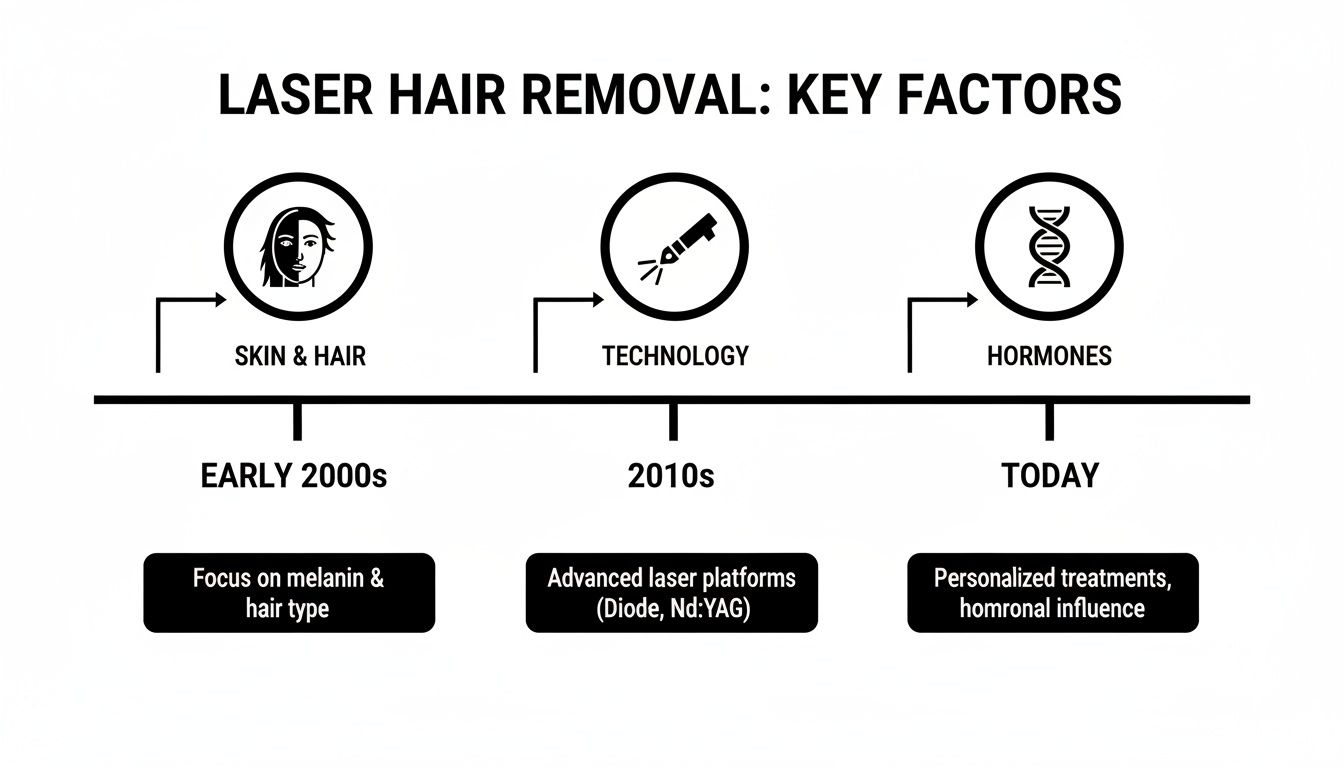
This visual really drives home that getting smooth, hair-free skin is a partnership between your body and our tools.
What to Expect During Each Session
First-timers always ask what the treatment feels like. The most common comparison is a quick, warm snap, kind of like a rubber band flicking against your skin. But honestly, with the advanced cooling technology built right into our Splendor X system at NYCLASER, the sensation is momentary and very easy to handle.
Here’s a quick rundown of what goes down during a typical appointment:
Prep: We'll start by cleaning the treatment area and giving you a pair of protective glasses to wear.
Treatment: Our certified technician will glide the laser’s handpiece over your skin, delivering precise pulses of light energy directly to the targeted follicles.
Duration: You’ll be surprised at how fast it is. Small areas like the upper lip can be done in just a few minutes. Larger zones, like the legs or back, might take up to an hour.
One of the best parts? There’s minimal to no downtime. You can get right back to your day immediately after your appointment, making it super easy to fit into a packed Long Island schedule.
Pre- and Post-Treatment Care: Your Role in Getting Great Results
Your commitment to the process is a huge part of your success. Following the right care guidelines before and after each session is non-negotiable for ensuring your safety and getting the most out of your investment.
Before Your Appointment (The Don'ts):
Avoid the Sun: Keep the treatment area out of the sun and away from tanning beds for at least two weeks before your session. Tanned skin can increase the risk of side effects.
Don't Wax or Pluck: For at least four weeks, resist the urge to pull hair out from the root. The laser needs that hair shaft in the follicle to do its job.
Shave the Area: This one is a must. You need to shave the treatment area 24 hours before you come in. This clears the surface hair so the laser's energy can go straight to the follicle where it counts.
After Your Appointment (The Do's):
Sunscreen is Your Friend: Your skin will be more sensitive to the sun, so slather on a broad-spectrum SPF 30+ daily.
Keep it Cool: For the first 24 hours, skip the hot showers, saunas, and intense workouts that make you sweat.
Be Patient: Over the next 1-3 weeks, you'll notice the treated hairs shedding. This is a great sign—it means the treatment is working!
Following this simple roadmap makes the whole process predictable and stress-free. With today’s technology, the results are incredibly reliable. Clinical studies and countless client stories show a 70-90% permanent hair reduction after a full course of treatments. Better yet, client satisfaction is over 90%, thanks to less irritation and so much time saved.
Here in Nassau County, that means our clients see amazing results with Splendor X on all kinds of areas, from bikini lines to backs. If you're curious to learn more about how many treatments you might need for your specific goals, our guide on how many laser hair removal sessions you will actually need is a great next step. This kind of planning ensures you get the absolute best outcome for your investment in smooth, carefree skin.
Understanding Permanent Hair Reduction
"So, is laser hair removal actually permanent?" This is hands-down one of the first questions we get, and for good reason. The honest answer is all about understanding a key phrase used by the FDA: permanent hair reduction. Getting clear on this sets the stage for a successful journey to smooth skin.
When our laser targets a hair follicle, the damage is real and permanent. That specific follicle gets zapped and won't be growing a thick, dark hair ever again. In that respect, the results are absolutely lasting.
But here’s the thing—your body is incredibly smart and always changing. It keeps millions of hair follicles in reserve, many of them just sleeping under the surface. Over your lifetime, things like aging, hormonal shifts, or even certain medications can wake up some of these dormant follicles and tell them to start growing new hair.
The Role of Hormones and New Hair Growth
This is a totally normal biological process, and it doesn't mean your treatments didn't work. Think of it like weeding a garden. You can pull every single weed until the plot is perfectly clear, but over time, new seeds will inevitably blow in and sprout. You just need to pluck them out to keep your garden looking great.
Hormonal fluctuations are the number one reason you might spot a few new, fine hairs months or years after your last session. This is especially true for hormone-driven areas like the chin, upper lip, and abdomen.
This is exactly where maintenance sessions come in. It’s not about retreating the hair we already eliminated. It’s about quickly and easily zapping any new hairs your body decides to activate down the road.
Framing it this way from the start helps you see the big picture. Your initial set of treatments is designed for mass clearance—getting rid of all the hair that's active right now. Maintenance is just the simple, easy strategy to keep it that way.
Protecting Your Investment with Maintenance
For most of our clients, keeping those silky-smooth results is a breeze. An occasional touch-up, usually just once or twice a year, is all it takes to manage any new growth and keep your skin just how you love it.
These quick appointments aren't a sign of failure. They’re the smartest, most cost-effective way to protect your investment in yourself. Instead of starting all over again, you're just doing a little upkeep. This is a huge part of understanding how effective laser hair removal is for the long haul—it's a lasting solution that’s simple to maintain. For a deeper dive on what to expect years later, check out our guide on how long laser hair removal lasts offers great tips and insights.
At the end of the day, laser hair removal delivers a permanent reduction of the vast majority of your unwanted hair. With a simple maintenance plan in place, you can enjoy the freedom of smooth, carefree skin for years and years to come.
Answering Your Top Questions
It's smart to ask questions before diving into any new treatment. To make sure you feel totally comfortable and informed, here are the straightforward answers to the questions we hear most often from our clients here on Long Island.
Does Laser Hair Removal Hurt More Than Waxing?
Not at all. In fact, most of our clients say it’s far more comfortable than waxing. The feeling is often described as a tiny, warm snap, like a rubber band flicking against your skin. It's over in an instant.
Unlike the sharp, lingering sting of waxing, the sensation from the laser is incredibly brief. Plus, the advanced cooling system built into our Splendor X laser makes a world of difference. It chills the skin right before each pulse, keeping the whole experience smooth and very manageable.
Can I Get Laser Hair Removal if I Have Dark Skin?
Absolutely. While older laser technology struggled with darker skin tones, today's advanced systems have made the treatment safe and highly effective for just about everyone. It’s one of the biggest reasons how effective laser hair removal has become for so many different people.
Our Splendor X system uses a specific Nd:YAG wavelength that's brilliant at bypassing the pigment in your skin. It goes straight for the melanin in the hair follicle itself, making it the gold standard for darker complexions. Just be sure to avoid any active tanning before your appointment to guarantee the best, safest results.
At-home IPL devices are a different story. They use a scattered, less-focused light that can be risky for darker skin because the energy can get absorbed by skin pigment instead of the hair. Professional lasers give you the precision needed for a safe, targeted treatment.
What Happens if I Miss a Session?
Staying consistent is really the key to getting fantastic results. We time your appointments to catch hair in its active growth phase, so missing a session can throw that cycle off.
If you have to skip an appointment, it might mean your final results are slightly delayed or that you’ll need an extra session to catch the hair follicles we missed. But we get it—life happens. Just give us a call as soon as you know you need to reschedule, and we'll work with you to adjust your plan and get you right back on track.
Why Are Professional Lasers So Much Better Than At-Home Devices?
It really boils down to three things: power, precision, and permanence. To get rid of hair for good, you need enough focused energy to disable the follicle so it can't grow back.
Professional Lasers: These are medical-grade machines that use a concentrated, single wavelength of light. They're powerful enough to destroy the follicle, leading to permanent hair reduction. They are always operated by trained technicians who know exactly how to adjust the settings for your skin and hair type.
At-Home IPL Devices: These gadgets use a much weaker, scattered light (Intense Pulsed Light) that usually just stuns the follicle temporarily. It might slow down growth for a bit, but it’s not strong enough to deliver permanent results.
For a safe, lasting outcome that’s backed by clinical proof, nothing beats a professional treatment. It’s a true investment in permanently smooth skin that at-home devices just can’t replicate.
Ready to start your journey to permanently smoother skin? The expert team at NYCLASER in Westbury is here to create a personalized plan just for you. Book your appointment online today and discover the freedom of a life without razors and waxing.
Comments