
Hair Removal for Chest: A Complete Guide
You're standing in front of the mirror after another round of shaving. The chest looks smooth for the moment, but the familiar problems are already on their way: prickly regrowth, razor burn, stray cuts, or the question of whether waxing would last longer. For some people, the goal is a completely smooth chest. Others want less density, a cleaner outline, or relief from repeated grooming.
Hair removal for chest isn't one-size-fits-all. Shaving, waxing, depilatory creams, and laser treatment each make different compromises involving longevity, discomfort, skin sensitivity, and maintenance. For Long Island men and women, the most practical choice usually depends on your hair color and density, skin tone, tanning habits, desired finish, and willingness to attend a treatment series.
Understanding Your Chest Hair Removal Options
A person who shaves a dense chest before a beach weekend may get the immediate look they want, but the result can become rough within days. Waxing lasts longer, yet it can be uncomfortable and may provoke irritation or ingrown hairs. Depilatory creams can cover a broad area quickly, though the chemicals require careful skin testing. Laser treatment takes more planning, but it can reduce growth over time rather than repeatedly cutting or pulling visible hair.
Chest grooming is common enough to be a meaningful part of broader body-grooming behavior, but the exact prevalence varies by country, age group, and survey wording. In one peer-reviewed exploratory study, 63.6% of surveyed men had recently shaved or trimmed body hair below the neck, and among men who removed body hair, 56.0% reported chest depilation. The same study found that the groin and abdomen were also frequent targets, showing that chest grooming often forms part of a wider torso routine. The peer-reviewed body-depilation study provides useful context, but it shouldn't be treated as a universal rate for every Long Island client.
Practical rule: Decide whether you want temporary smoothness, reduced density, or long-term reduction before choosing a technique.
A consultation is especially useful if you want to preserve some hair rather than remove everything. A practitioner can discuss shaping, density reduction, and the transition between the chest, abdomen, shoulders, and collarbone. That matters because the hair near those borders may be finer or less evenly pigmented than the thicker hair in the center of the chest.
How Each Method Works and What to Expect
Each method changes the hair at a different level. Shaving cuts the shaft at the skin surface, waxing removes the shaft and root together, depilatory creams chemically break down the hair, and laser treatment uses light energy to affect selected follicles. The right comparison isn't just “which method works,” but how much maintenance and skin irritation you're willing to accept.
The practical differences
Shaving is inexpensive, fast, and easy to control at home. It also has the shortest visible lifespan because the follicle remains intact. Chest stubble, nicks, razor burn, and ingrown hairs can become recurring problems, particularly when someone shaves dense or curly hair against the direction of growth.
Waxing can leave the chest feeling smooth for longer than shaving because it removes hair from the root. The trade-offs are pain, temporary redness, and the need to allow regrowth before another appointment. Waxing and plucking should be stopped before laser treatment because the follicle needs to remain present for the laser to target it.
Depilatory cream dissolves hair near the surface without a razor. It can be convenient for a broad area, but the active ingredients may irritate sensitive or recently sun-exposed skin. If you're comparing products, review the directions and patch-test requirements for a men's formula such as Nads For Men hair removal cream, rather than assuming every cream is suitable for the chest.
Laser hair removal targets pigment in the follicle and is intended for long-term hair reduction. It doesn't deliver a guaranteed permanently hair-free result, and it works best when treatment settings match the hair and skin. A dermatology reference describes four to six initial treatments spaced approximately four to six weeks apart as a minimum practical protocol because follicles respond most readily during the active-growth phase. The dermatology reference on laser hair removal also emphasizes that later maintenance may be necessary.
Method | Duration of Results | Pain Level | Average Cost per Session |
|---|---|---|---|
Shaving | Short-term, with frequent regrowth | Low, though irritation is possible | Varies by razor and products |
Waxing | Longer than shaving, until regrowth | Moderate to high for some clients | Varies by area and provider |
Depilatory cream | Short-term, similar to surface removal | Usually low, but irritation is possible | Varies by product |
Laser hair removal | Long-term reduction, with possible maintenance | Varies by settings, hair, and sensitivity | Varies by clinic and treatment plan |
No honest practitioner should promise that one session will settle the chest permanently. Hair thickness, pigment, skin tone, tanning, and growth cycles all affect the outcome.
Preparing for Laser Hair Removal Treatment
Laser results depend on preparation as much as equipment. A safe chest protocol starts with an assessment, not a machine setting chosen from a menu. The consultation should cover your skin phototype, recent sun exposure, hair color and caliber, medications, sensitivity, and whether you want complete removal or controlled reduction.
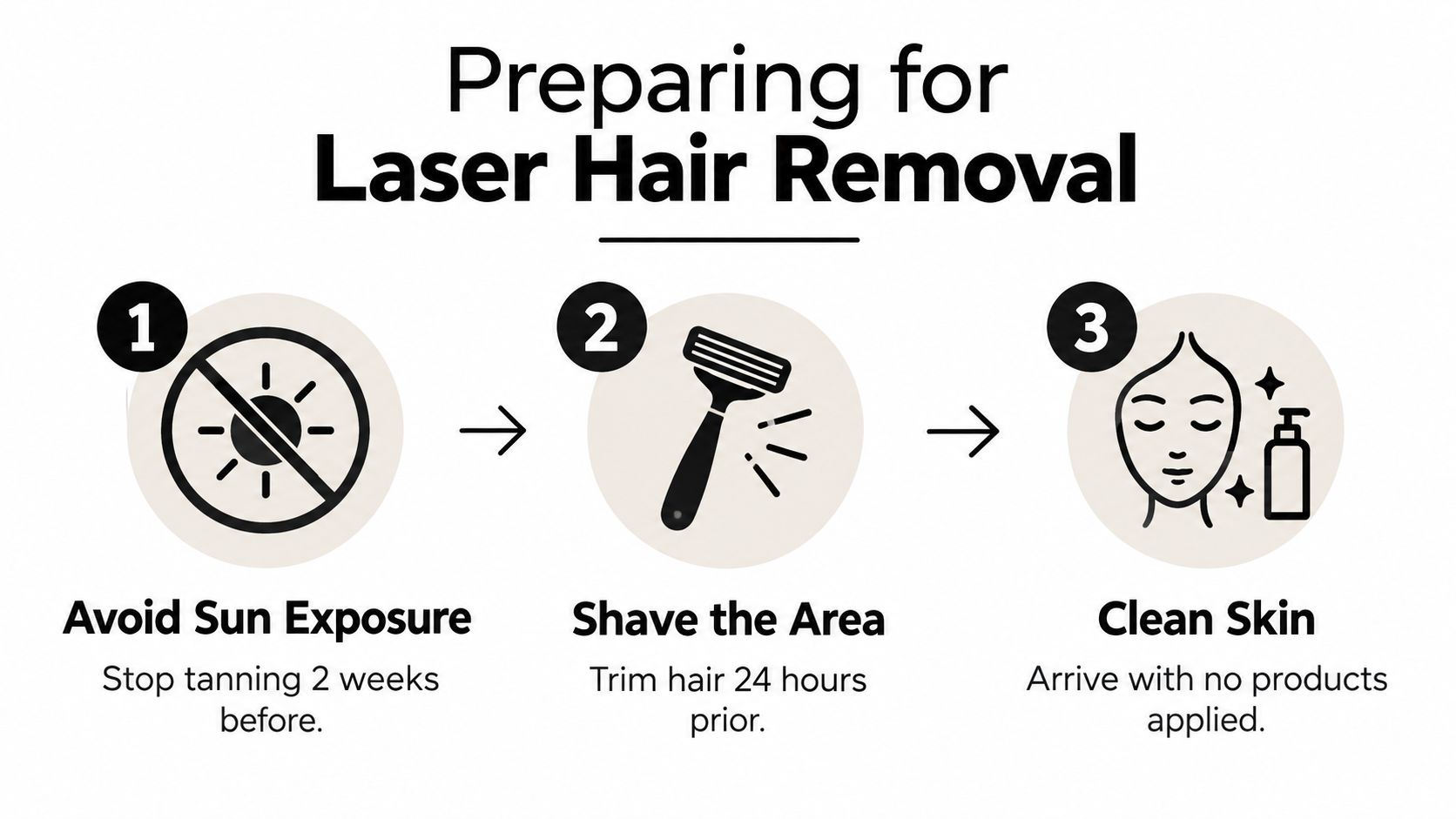
Follow these preparation steps
Avoid tanning and disclose recent exposure. Tanned skin contains more competing pigment, which can raise the risk of burns or temporary pigment changes. The American Academy of Dermatology says people of all skin tones can undergo laser hair removal, but stresses that the operator must understand how to treat the patient's skin tone. The AAD's guidance on unwanted-hair removal is a useful starting point for questions about experience and safety.
Stop waxing and plucking. Laser needs the follicle as a target. Shaving is generally preferred because it leaves the follicle in place while reducing the surface hair that could absorb excess energy.
Shave before the appointment. Follow your clinic's timing instructions, usually leaving the area cleanly trimmed rather than bringing long surface hair to the session. If your skin reacts easily, a gentle product such as botanical shave cream 8 oz may be worth considering, but stop using anything that causes stinging, redness, or a rash.
Arrive with clean skin. Deodorant, oils, fragrance, and heavy creams can interfere with treatment comfort and skin assessment. Tell the practitioner about medications or skincare products that may increase photosensitivity.
A Long Island client with darker skin or a recent tan needs individualized planning, not a generic promise that every device works identically. Mayo Clinic also notes that darker skin requires careful laser and setting selection because melanin can absorb energy and increase the risk of burns or lasting pigment changes. This practical preparation guide can help you organize questions before a consultation.
During treatment, the practitioner divides the chest into a workable grid, applies the selected settings, and uses cooling or other epidermal protection as appropriate. Splendor X technology may be used in a clinic setting, but the device name alone doesn't determine safety. Test spots, conservative adjustments, and a documented response matter more than a broad equipment claim.
Choosing Between Single Sessions and Bundles
A single laser session makes sense when you're testing comfort, evaluating how your skin responds, or treating a small area before committing to a broader plan. It also gives you a chance to assess consultation quality, communication, and whether the clinic distinguishes reduction from permanent eradication.
A bundle is usually more logical for a full chest because laser treatment follows hair-growth cycles. One visit only reaches the follicles that are responsive at that time. Later appointments address follicles that become active afterward, so a series is part of the biology rather than an arbitrary sales structure.
Compare the commitment
Single sessions offer flexibility. You pay as you go and can reassess after each visit. The drawback is that inconsistent scheduling can leave some growth cycles untreated, and the per-session price may not be as favorable as a package.
Bundles support continuity. A three- or six-session package can make it easier to reserve appointments and plan a complete course. It may also reduce the effective session cost, although you should compare the total price, expiration rules, cancellation policy, treatment area, and what happens if your skin needs a delay.
Chest density varies widely. A client with thick, dark terminal hair may progress differently from someone with sparse, fine, or uneven hair. Before purchasing, ask whether the package covers the chest alone or a combined area such as the chest and abdomen, and whether future maintenance is billed separately. This guide to laser hair removal packages outlines the kind of package details worth reviewing.
The most useful bundle is one that matches a realistic treatment plan. Don't buy a large package solely because a discount sounds attractive if the provider hasn't assessed your hair, skin, tanning pattern, and goals.
Why Laser Hair Removal Stands Out
Laser treatment stands out because it changes the maintenance problem. Shaving asks you to repeat the same task as soon as visible stubble returns. Waxing removes the current growth but requires another cycle of regrowth and extraction. Laser treatment aims to reduce the follicle's future output, so successful treatment can leave regrowth finer, lighter, and slower rather than just cutting it shorter.

The evidence supports realistic optimism, not a guarantee of total eradication. A prospective clinical study of simultaneous alexandrite and Nd:YAG emission reported mean thorax hair reduction of 74.1% after four treatments with one year of follow-up, and hair counts continued declining after the final session. Transient reactions resolved within two to seven days in that study. The clinical study of alexandrite and Nd:YAG treatment is particularly relevant because it assessed the thorax over time rather than judging the result immediately after treatment.
Technology still needs judgment
Alexandrite at 755 nm can be effective when dark hair contrasts with lighter skin, while Nd:YAG at 1064 nm is generally favored when deeper penetration and greater epidermal safety are needed for darker or recently pigmented skin. Those wavelengths aren't interchangeable, and a practitioner still needs to individualize fluence, pulse duration, spot size, cooling, and test spots.
The best experience is not necessarily the most aggressive one. It's the one that reduces unwanted hair while protecting the skin, respects your schedule, and leaves room to adjust when chest hair responds unevenly.
A short visual explanation can help first-time clients understand the treatment process:
Debunking Common Myths About Chest Hair Removal
Myth one: laser hair removal guarantees a permanently hair-free chest. Laser is more accurately described as long-term hair reduction. Some follicles may respond strongly, while others produce finer regrowth or require maintenance. Hormonal changes can also influence future growth, so a careful provider avoids promising an identical result for every client.
Myth two: chest laser treatment is automatically too painful. Sensation varies with hair thickness, settings, skin sensitivity, and the cooling system. Many clients describe warmth, snapping, or brief discomfort rather than prolonged pain, but no practitioner should guarantee that you'll feel nothing. A test area can give you a more useful answer than someone else's pain rating.
Myth three: darker skin cannot be treated. The American Academy of Dermatology states that people of all skin tones can have laser hair removal, provided the operator has experience with that skin tone. Darker skin requires careful wavelength and setting choices because excess absorption by epidermal melanin can increase the risk of burns or pigment changes. Mayo Clinic's laser hair-removal information also emphasizes this need for careful selection.
Myth four: every unexpected hair after treatment means the laser failed. Delayed shedding, untreated growth cycles, and fine residual hair can all look like failure during the early stages. A less common issue, paradoxical hypertrichosis, involves unexpected thickening or new growth beyond the treated area. A systematic review found pooled prevalence of about 3%, but only 0.08% in non-facial and non-neck areas, which makes chest treatment materially different from the facial cases often discussed. The systematic review of paradoxical hypertrichosis supports reporting progressive new growth rather than ignoring it.
Aftercare and Maintaining Smooth Results
The first priority after chest laser treatment is to reduce heat and friction. Follow the clinic's instructions, avoid tanning, and use sun protection because recently treated skin can react more readily to ultraviolet exposure. Don't scratch, scrub, or apply irritating products while the area feels unusually warm or sensitive.
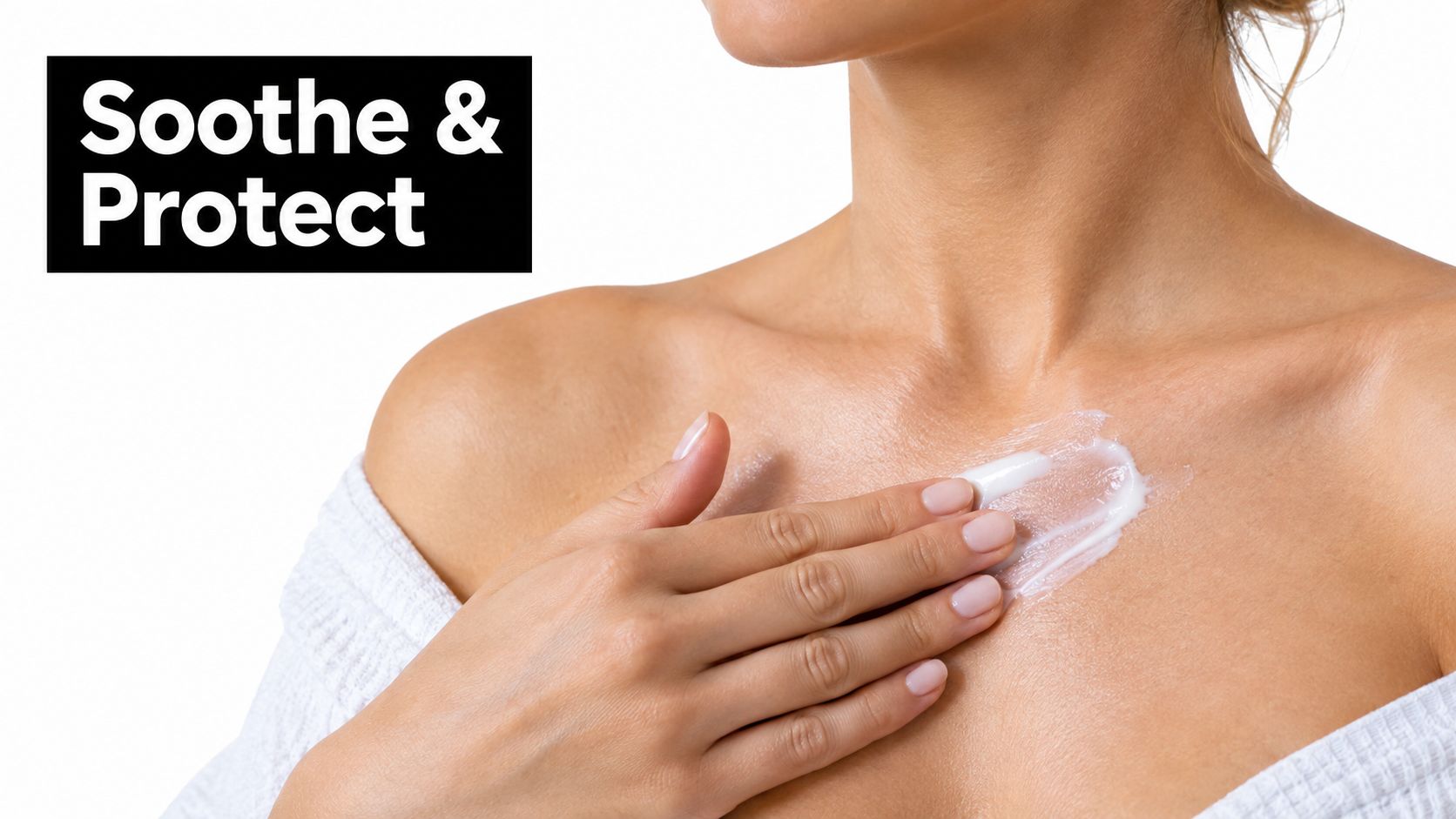
Keep the routine simple
Clean gently: Use mild cleansing and avoid aggressive exfoliation immediately after treatment.
Moisturize appropriately: Choose a bland, fragrance-free moisturizer if the skin feels dry, unless your practitioner advises otherwise.
Protect from the sun: Cover the chest and use the recommended broad-spectrum sunscreen when exposure is unavoidable.
Avoid pulling the hair: Don't wax or pluck between laser sessions. Shaving is the usual way to manage visible regrowth while preserving the follicle for later treatment.
Report unusual changes: Blistering, persistent swelling, marked pigment changes, or progressive new growth deserve prompt clinical review.
Hair may shed gradually rather than disappearing at once. Keep appointment intervals consistent, but reschedule if the treatment area is tanned or irritated. Once the main series is complete, occasional maintenance can help manage residual or hormonally influenced growth. These post-laser skincare guidelines offer additional practical aftercare points.
Taking the Next Step Toward Smoother Skin
The most sensible choice depends on the finish you want and the maintenance you will realistically follow. Shaving remains useful for short-term grooming. Waxing can provide a longer interval between smoothness and regrowth. Creams may suit some people who tolerate them well. Laser treatment is the more strategic option when you want to reduce repeated grooming across a broad chest area and accept that results develop over a series.
For Long Island clients, the consultation should cover more than a quick price quote. Ask how the provider handles your skin tone, recent tanning, uneven hair pigment, fine hair near the shoulders or collarbone, and the possibility of preserving a natural outline instead of removing every hair. You should also understand the difference between expected shedding, normal regrowth, and a reaction that needs review.
Choose a clinic that documents your baseline, explains realistic reduction, and gives clear preparation and aftercare instructions. The quality of the decision often matters more than choosing the most fashionable technology name.
NYC Laser Hair Removal offers personalized chest and chest-and-abdomen laser treatments in Westbury using Splendor X technology, with single sessions and multi-session packages for different treatment plans. Visit NYC Laser Hair Removal to review chest treatment options and schedule a consultation about your skin tone, hair pattern, and smoother-skin goals.
Comments