
Brazilian Laser Hair Removal How Many Sessions: Full Guide
Typically, about 6 to 8 sessions of Brazilian laser hair removal are needed, usually spaced 6 to 8 weeks apart. For the Brazilian zone, that usually means you should expect the plan to sit toward the higher end of the range, not the low end.
That's the answer most first-time clients want before they book. The harder part is understanding why your own timeline can look a little different from someone else's, even when you're both treating the same area.
What to Expect from Your Brazilian Laser Series
You may be sitting at your first consultation wondering if this is a one-and-done appointment or a long project. For a Brazilian, it's a course of care, not a single fix. A clinical benchmark commonly cited by major medical guidance is 6 to 8 sessions, spaced 6 to 8 weeks apart, while some patients in other areas may fall into an even lower range depending on hair thickness, skin tone, and treatment zone Cleveland Clinic.
Start with the real timeline, not the marketing version
The Brazilian area tends to be more stubborn than less dense body sites because it's hormonally influenced and often has coarse, active regrowth. That's why the lower-end counts that work for some body areas don't always translate well here. If you're planning a series, think in months, not days.
Spacing matters more than squeezing visits together. The follicle has to be in the right stage for the laser to have a real effect, so a rushed calendar usually doesn't help. A good plan is steady, consistent, and realistic about how hair behaves on its own schedule.
Practical rule: If a clinic promises a fully finished Brazilian after one session, that's not a treatment plan, it's a sales pitch.
A first appointment usually tells you how your skin reacts and how your hair sheds, but it won't tell the whole story. The early visits build momentum, then later visits clean up the hairs that were not targetable yet. That's why the same person can look “half done” after one session and nearly finished only after the full series.
Why Multiple Sessions Are Required
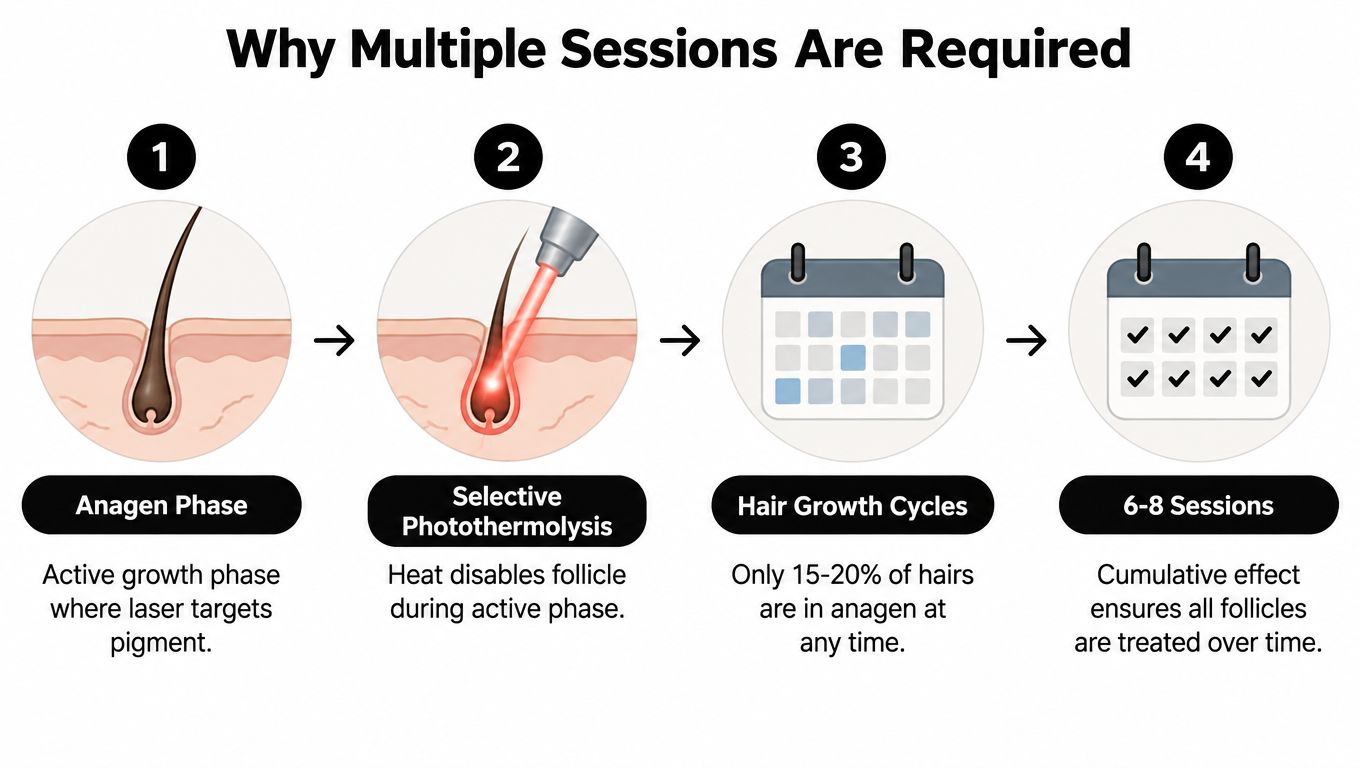
You may notice shedding after your first Brazilian appointment and still see new hairs soon afterward. That pattern usually reflects the growth cycle, not treatment failure. Laser energy works most effectively when a follicle is in anagen, its active growth phase. Hairs in catagen or telogen are less responsive, so one visit can affect only the follicles ready at that time Dermatologist New York.
The growth cycle sets the schedule
Brazilian hair does not enter its active phase all at once. Each appointment reaches a different group of follicles as they become targetable, which is why sessions must be staged rather than compressed into a short series. A clear anagen phase explanation can help you understand why visible regrowth between visits is expected.
Appointment spacing also has a practical trade-off. Waiting allows more follicles to reach the appropriate phase, while booking too soon may treat fewer useful targets and add cost without improving the outcome. Published clinical guidance commonly places appointments roughly 4 to 8 weeks apart, with the exact interval adjusted to your shedding and regrowth pattern Dermatologist New York.
Research summarized in the Mirror Plastic Surgery education page also describes reduction after an initial group of treatments rather than a complete one-visit result. The practical message is straightforward: laser produces cumulative thinning as successive appointments reach different follicles.
What this means in practice
A Brazilian series should be judged by slower regrowth, finer texture, and longer hair-free intervals, not immediate perfection. Early visits establish the response; later visits address follicles that were inactive during earlier appointments.
Your body's timing is the hidden variable. Once the plan follows that timing, session spacing becomes a clinical decision rather than an arbitrary delay.
Factors That Change Your Session Count
Two clients can start Brazilian laser hair removal on the same day and finish on different schedules. That's not a sign that one clinic is better than the other, it's a sign that anatomy and hair behavior aren't identical. One study across multiple body areas reported a minimum of 3 treatments and an average of 5.31 treatments overall, while another found bikini-area patients sometimes needed 5 to 6 additional sessions to get good results PubMed study.
The main variables that shift the total
Factor | Impact on Sessions |
|---|---|
Hair thickness | Coarser, denser hair often takes more visits to fully thin out |
Skin tone | The device choice and settings can affect how aggressively a clinic can treat |
Hair color | Less pigment can make targeting less efficient |
Hormonal influence | Regrowth can keep the area active after the first series |
Treatment area | The Brazilian zone often behaves more stubbornly than less dense body sites |
Technology | Different systems can produce different comfort and response profiles |
The biggest mistake is treating the average as a promise. The average is only a starting point. If your hair is coarse, your skin is a deeper tone, or your regrowth is hormonally driven, the total can move upward.
A Brazilian rarely behaves like a flat, predictable body zone. The area has its own rhythm, and the treatment plan should respect that instead of forcing a generic number.
This is also where honest consultation matters. A careful clinician won't just quote a session count and move on. They'll look at the hair you have, the skin you have, and the pattern of regrowth you're likely to show over time.
Typical Timeline and Scheduling

A Brazilian series usually begins with a consultation, then moves into repeat visits spaced to match the hair cycle. The exact day matters less than the gap between appointments. If treatments are booked too close together, many follicles will still be in the wrong phase to respond well.
The first few visits can feel slow. Hair sheds, then thins, and the change becomes easier to see as the course continues. That is why a single appointment rarely gives a full answer, as shown in the Mirror Plastic Surgery education page.
A practical timeline usually looks like this:
First visit: the clinic checks skin response and hair behavior.
Middle visits: most of the reduction happens as new hairs enter the target phase.
Later visits: the area grows sparser and easier to maintain.
After the series: a touch-up may still be needed if regrowth returns.
The spacing should stay steady. For a clear reference on how long to wait between laser sessions, the interval between visits matters almost as much as the number of visits.
Video can also make the process easier to picture when the treatment rhythm feels abstract.
Calendar planning matters because a Brazilian series works best when it is treated as a committed appointment plan. Leaving too much time between sessions often stretches the process and weakens the momentum of the series.
Understanding Long-Term Results and Maintenance
A Brazilian series is about hair reduction, not a promise that every follicle will stay quiet forever. That distinction matters, especially in an area where hormones can keep encouraging new growth over time. A longitudinal alexandrite study found a minimum of 3 sessions spaced 4 to 6 weeks apart with a mean of 5.6 treatments, while more recent guidance describes 6 to 8 sessions as typical and notes that some hormonal regrowth cases need 8 to 10 plus annual maintenance Wiley study.
The real question is not permanence, it's upkeep
Clients often ask whether laser hair removal is permanent. A better question is how often regrowth is likely to show up after the initial course. In practice, many people get a major reduction and then keep the result clean with occasional maintenance instead of restarting the whole series.
That maintenance piece isn't failure. It's part of how the treatment works when hormones, aging, or hair cycling bring some activity back. The Brazilian zone is one of the most common places to see that happen because it's more responsive to internal shifts than some other body areas.
There's also a difference between a “finished” series and a “done forever” expectation. The former is realistic. The latter usually leads to disappointment. A clinic should say that plainly before you commit.
Bottom line: durable reduction is the goal, and occasional touch-ups can be normal.
If your hair is especially reactive to hormones, expect the conversation to include maintenance from the start. If it isn't, you may still be done for a long stretch after the initial course. Either way, the long-term plan should be built around your body, not a generic brochure line.
Preparing for Your Treatment Journey
The best results usually start before the first pulse. Shave the treatment area as instructed, keep the skin calm, and avoid anything that could make the laser less effective or the skin more reactive. A practical prep guide on what not to do before laser hair removal is useful if you want the short version before booking.
Simple prep that protects your results
Shave, don't wax: the follicle has to stay in place for the laser to target it.
Skip self-tanner and heavy sun exposure: pigmentation changes can interfere with treatment planning.
Show up with clean, dry skin: lotions and oils don't belong in the treatment zone.
Tell your clinician about medications or skin changes: good planning starts with full disclosure.
Follow aftercare closely: cool the area, avoid friction, and let the skin settle.
If you want to compare at-home skin support with professional care, natural options such as natural smoothskin remedies from AloeCure can be a helpful complement for general skin comfort, but they don't replace a proper laser plan.
NYC Laser Hair Removal uses Splendor X for hair reduction across different skin and hair types, and that kind of technology matters when you're trying to balance comfort with consistent response. The right device doesn't eliminate the need for multiple sessions, but it can make the treatment process smoother and more suited to the person in front of you.
If you're planning a Brazilian series and want a treatment plan that matches your hair type, skin tone, and schedule, NYC Laser Hair Removal can help you map out the right number of sessions and the right spacing. Book a consultation to start with clear expectations, practical prep, and a plan built around real results, not guesswork.
Comments