
Brazilian Hair Removal for Men What to Expect
You're standing in the bathroom with a trimmer in one hand, searching for “Brazilian hair removal for men” with the other. You want less hair, fewer shaving problems, or a cleaner look, but you're not sure what a male Brazilian includes, whether waxing or laser makes more sense, or how sensitive areas are handled.
That hesitation is common. Male intimate grooming has deep roots, with modern historical summaries tracing pubic-hair removal by men back at least 30,000 years to early flint razors. The modern Brazilian wax became commercially recognizable after Janea Padilha opened J Sisters salon in Manhattan in 1987, later performing the first male treatment for a client's husband. The style spread further through the 1990s and early 2000s, and by 2007, J Sisters' male services, nicknamed “bro-zilians,” had entered mainstream culture. (Historical overview of male grooming)
Today, the decision isn't limited to booking a wax. You can shave for short-term control, wax for several weeks of smoothness, or choose laser when your goal is long-term reduction. The right option depends on your skin tone, hair texture, tolerance for maintenance, and whether you want complete removal or less density.
For men in Westbury, Nassau County, and across Long Island, a thoughtful consultation should answer practical questions before treatment begins. This guide explains the zones involved, compares the three main methods, covers anatomy-specific laser safety, and outlines how to prepare for and schedule a treatment series.
Introduction to Brazilian Hair Removal for Men
You may arrive wanting fewer shaving bumps, a cleaner outline, or less hair overall, while still wondering what “male Brazilian” includes. The term is not used consistently. Depending on the provider and plan, it can refer to the pubic mound, shaft area, scrotum, perineum, perianal region, and upper inner thighs. Ask the practitioner to name every treatment zone before booking.
The service now fits into a wider range of grooming choices, from a single wax appointment to a planned course of laser reduction. An industry market overview describes growing interest in male Brazilian waxing, but broad market figures do not determine what will suit your skin, hair, or goals.
Hair removal is personal, and complete removal is only one option. You might want a smooth front with limited perianal work, less density, a defined outline, or fewer shaving-related problems. Hygiene can be part of the decision, but removing hair is not medically required for cleanliness. Comfort, appearance, sport, intimacy, and convenience are all reasonable considerations.
The method should match the result you want. Shaving cuts hair at the surface and requires frequent upkeep. Waxing removes the hair from the root and provides temporary smoothness. Laser uses repeated treatments to reduce growth over time, making it a longer-term hair-reduction decision rather than a single grooming appointment.
A useful starting point: decide whether you want temporary smoothness, less daily grooming, or long-term reduction. That choice narrows the methods worth discussing.
At a first consultation, explain your current routine, irritation, hair pattern, and preferred coverage. A qualified practitioner can then discuss suitable technology, settings for intimate skin and your skin tone, expected maintenance, and whether a test spot is appropriate. You should leave knowing what will happen before treatment begins.
What a Male Brazilian Covers and How It Differs
Think of the intimate area as a group of neighborhoods. A clinic may treat one neighborhood, several connected zones, or the entire map. Asking for “a Brazilian” without clarifying the boundaries can lead to different expectations between you and the provider.
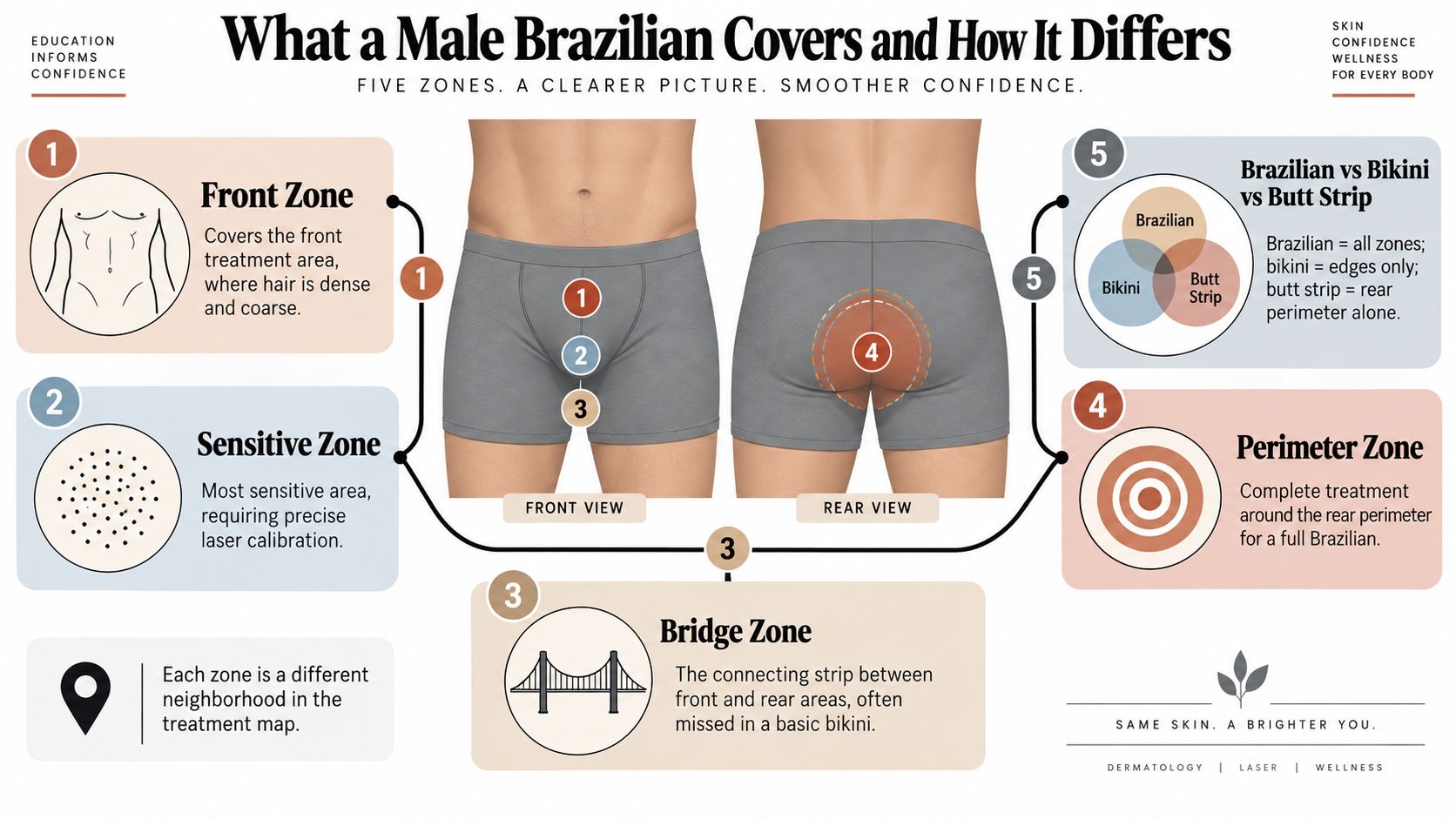
The main treatment zones
The front zone usually refers to the pubic mound and the shaft area. Hair here is often coarse and dense, which can make it visually prominent and more noticeable during regrowth. Some clients remove everything, while others keep a small trimmed shape.
The scrotum zone covers the hair-bearing skin of the scrotum. This area is highly sensitive and has thinner, mobile skin, so waxing technique and laser calibration require particular care. A practitioner should explain positioning, cooling, and what sensations to expect before starting.
The perineum is the strip of skin between the scrotum and anus. Basic bikini services often leave it untouched, while a full male Brazilian may include it. If you care about complete coverage, name this zone directly during consultation.
The perianal zone means the hair-bearing skin around the anus. Some providers include it in a full Brazilian, while others price or schedule it separately. You don't need to feel embarrassed asking about it. Clear language helps prevent surprises.
The upper inner thighs may be included when hair extends beyond the central intimate area. They can create a more blended finish, especially if the goal is to avoid a sharp line between treated and untreated skin.
Brazilian, bikini, and manscaping are different
A bikini treatment generally focuses on hair visible outside underwear or swimwear. It may clean the sides and upper edges without treating the scrotum, perineum, or perianal region.
Manscaping is broader and less precise. It can mean trimming or shaving the abdomen, chest, groin, or thighs, often without a defined treatment plan for sensitive anatomy.
A full Brazilian aims to cover the intimate zones you and the provider agree on. Partial removal is also valid. You might choose the front and scrotum while leaving the perianal area alone, or treat the perianal region without removing all front hair.
Before treatment, ask three direct questions:
Coverage: Which exact zones are included?
Method: Is the area being waxed, shaved, or treated with laser?
Boundaries: Can I keep a small patch or request a partial plan?
The more specific you are, the easier it is for the practitioner to deliver the result you want.
Waxing Shaving and Laser Compared for Lasting Results
Shaving, waxing, and laser produce different kinds of results. Shaving cuts hair at the skin's surface, so the effect is brief. Waxing pulls visible hair from the root but leaves the follicle able to grow again. Laser uses light energy to heat selected follicles over repeated sessions, creating gradual, long-term reduction rather than instant permanent removal.
Method | How Long Results Last | Comfort and Skin Impact | Maintenance Pattern |
|---|---|---|---|
Shaving | Short-lived, because hair is cut at the surface | Fast and familiar, but razor bumps, cuts, and stubble can be troublesome in folds | Frequent trimming or shaving |
Waxing | Smoothness commonly lasts 3 to 6 weeks (industry summary) | Pulling hair from the root can sting, and sensitive skin may develop irritation or ingrown hairs | Repeat appointments as hair regrows |
Laser | Long-term reduction develops gradually through a series | Brief heat or snapping sensations are possible, with temporary redness and swelling among common reactions | Multiple sessions, followed by occasional maintenance when needed |
Shaving suits control, not lasting smoothness
Shaving works when you want a quick change or prefer to maintain short, trimmed hair. It can also be appropriate before a laser appointment, because removing hair above the skin helps the laser focus on the follicle beneath it.
The trade-off is repetition. Stubble may return quickly, and coarse hair combined with friction, sweat, and curved anatomy can make razor irritation difficult to manage. A clean blade, gentle skin stretching, and a fragrance-free product may reduce discomfort. Shaving still leaves the follicle fully capable of producing new hair.
Waxing gives a longer pause
Waxing can leave the skin smooth for longer than shaving, which may suit someone preparing for a trip, event, or a period of less frequent grooming. Hair is removed from the root, so regrowth takes time, but the follicle remains active. Irritation and ingrown hairs are also possible, particularly in areas exposed to friction.
Waxing fits a maintenance routine built around repeat appointments. It does not fit the goal of reducing hair growth over the long term, because each session removes the current hair without disabling its follicle.
Laser changes the maintenance equation
Laser becomes more practical when shaving or waxing has turned into a repeated chore. Hair follicles grow on different schedules, so only follicles in the active anagen phase respond most effectively during a given treatment. A male Brazilian therefore requires multiple sessions, allowing the provider to treat follicles as they enter that responsive phase.
Results also depend on the contrast between hair pigment and skin pigment, which is why intimate laser treatment needs individualized settings and careful assessment. The technology and safety considerations are covered in the next section.
Cost makes more sense when viewed across the entire routine. Shaving may seem inexpensive, but it requires continuing supplies and effort. Waxing creates a recurring appointment cycle. Laser usually involves a larger planned commitment at the beginning, followed by less frequent maintenance as reduction develops. For someone seeking a lasting change rather than another temporary appointment, that difference can shape the decision.
How Laser Works on Intimate Skin and Why Technology Matters
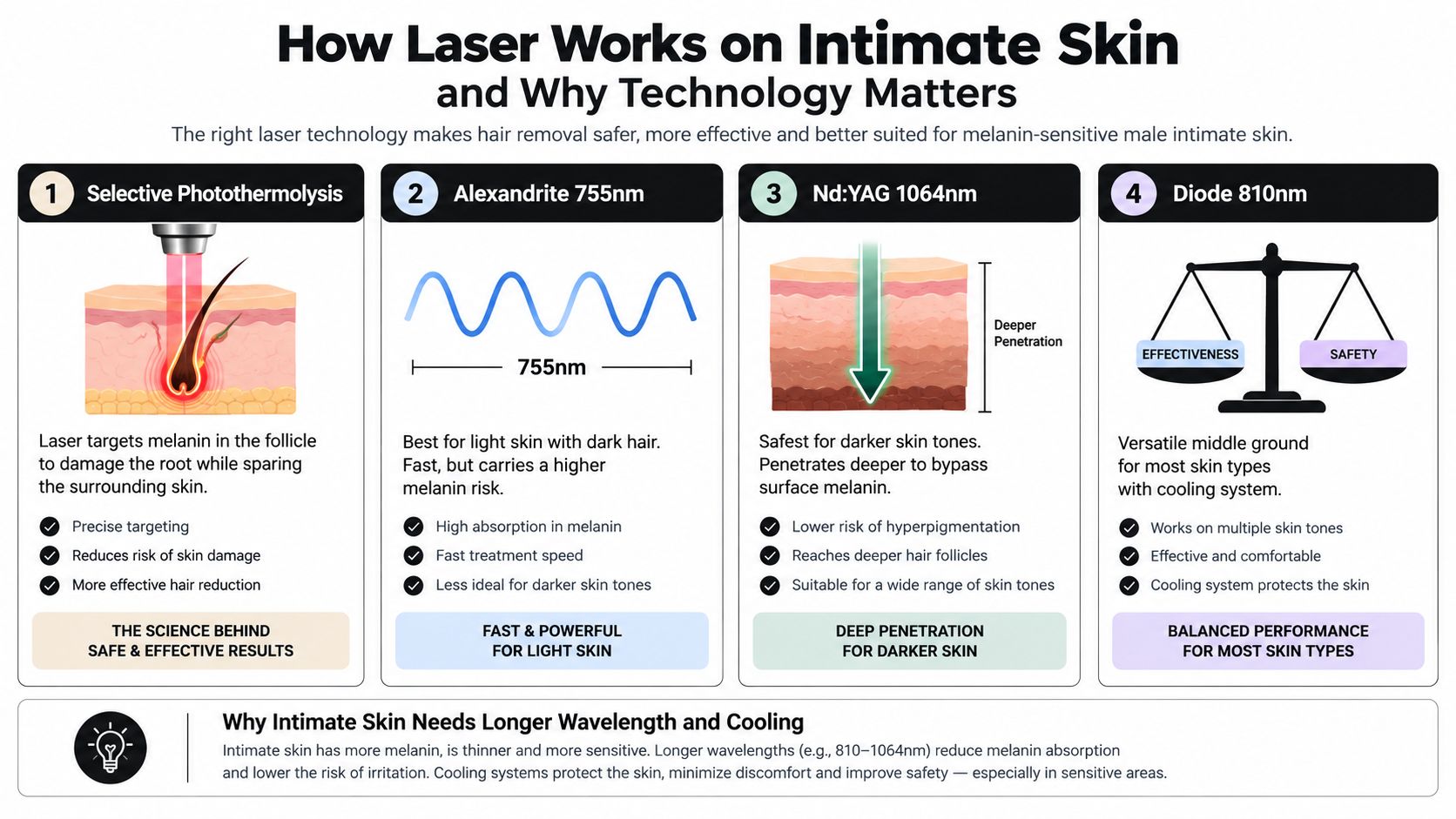
Laser hair removal relies on selective photothermolysis. In plain language, the device sends light into the skin, and pigment in the hair absorbs that energy. The resulting heat damages the follicle while the practitioner works to protect the surrounding epidermis.
Intimate treatment requires more precision than treating a broad, uniform surface. The pubic mound, scrotum, perineum, and inner thigh can differ in follicle density, hair thickness, skin thickness, and pigmentation. Epidermal melanin can compete with follicular melanin for the laser's energy, which is why skin-type matching, conservative fluence selection, wavelength choice, and strong cooling matter.
Wavelength changes the safety balance
Shorter wavelengths can carry greater pigmentary risk in darker skin. Independent reviews report that longer-wavelength Nd:YAG 1064 nm systems reduce pigmentary complications to roughly 2 to 3% in darker phototypes, compared with up to 19% with shorter-wavelength systems. (Review of laser hair removal safety and wavelengths)
That doesn't mean one wavelength is automatically correct for everyone. A lighter skin tone with dark, coarse hair may respond differently from darker skin with similar hair. Recent tanning can also change the risk profile. A responsible provider evaluates the skin in person, asks about tanning and medications, and may perform a test spot before treating the full area.
Splendor X is one platform used for individualized laser hair reduction, combining Alexandrite and Nd:YAG wavelengths so the practitioner can select an approach based on skin and hair characteristics. For men with diverse skin tones, the important question isn't whether a device sounds advanced. It's whether the operator chooses appropriate settings, protects the epidermis with cooling, and monitors how your skin responds.
For a plain-language overview of how laser platforms differ, review this guide to laser hair removal technology.
The video below offers another visual explanation of treatment technology and the hair-growth process.
Common immediate reactions include perifollicular erythema, which looks like redness around the follicles, and perifollicular edema, which appears as small areas of swelling. Crusting, blistering, and post-inflammatory hyperpigmentation are less common, but risk rises with sun exposure, tanning, higher Fitzpatrick skin types, or settings that don't match the skin.
Pain Comfort Prep and Aftercare You Can Actually Follow
Pain varies by zone and by person. The front may feel moderately sharp or warm, the scrotum is often the most sensitive area, and the perianal region can feel surprisingly quick but intense in short bursts. Laser sensations are commonly described as snaps, heat, or tiny rubber-band flicks, while waxing creates a brief pulling sensation each time hair is removed.
Cooling changes the experience. A chilled tip or directed cold air can reduce surface heat, while appropriate pulse selection helps the practitioner balance follicle treatment with skin comfort. You should be able to communicate during the appointment, especially if a particular zone feels too intense.
Before your appointment
Use this sequence to make the visit easier:
Shave as directed: Many laser providers ask clients to shave shortly before treatment, often around the day before, so the device can reach the follicle without heating long surface hair. Follow the clinic's exact instructions.
Avoid waxing and plucking: Removing the follicle from the root leaves the laser with less of its intended target.
Skip products: Arrive with clean skin and avoid lotions, deodorant, oils, or fragrance on the treatment area.
Disclose skin changes: Tell the practitioner about recent tanning, irritation, active rashes, medications, or a history of pigment changes.
Wear loose clothing: Soft, breathable underwear and relaxed trousers reduce friction after treatment.
Don't use numbing products without asking the clinic first. If you're considering topical anesthetic for the perianal region, start with a clinician-approved resource such as this complete guide to anorectal lidocaine, then confirm whether the product is appropriate for your planned service.
After treatment
For the early recovery period, treat the area gently:
Use lukewarm water: Avoid very hot showers and aggressive scrubbing.
Reduce friction: Loose clothing is more comfortable than tight underwear or compression garments.
Pause heat and sweat: Skip strenuous workouts, saunas, and activities that cause heavy perspiration until the skin settles according to your provider's instructions.
Choose bland soothing care: A fragrance-free aloe product may calm temporary warmth, provided the clinic approves it.
Leave bumps alone: Don't scratch, pick, or try to extract follicles immediately after treatment.
Redness and small swollen bumps can be expected immediately after laser. Contact the clinic if you develop blistering, worsening pain, marked swelling, drainage, or skin changes that concern you. The guide to Brazilian laser hair removal pain can also help you understand what sensations clients commonly discuss, but your practitioner's instructions should take priority.
Sessions Timeline Pricing and Realistic Results at NYCLASER
Laser reduction is a process, not a single-event makeover. Coarse terminal hair grows asynchronously, so follicles enter the active anagen phase at different times. Because laser works best on active follicles, repeated appointments are needed to reach hair that wasn't responsive during an earlier visit.
You may notice shedding or slower return after initial sessions, followed by finer or more scattered growth. Progress isn't always perfectly linear. Hormonal factors, hair color, skin tone, treatment settings, and the area's growth pattern all influence the result, so a consultation is more useful than a promise of an identical outcome.
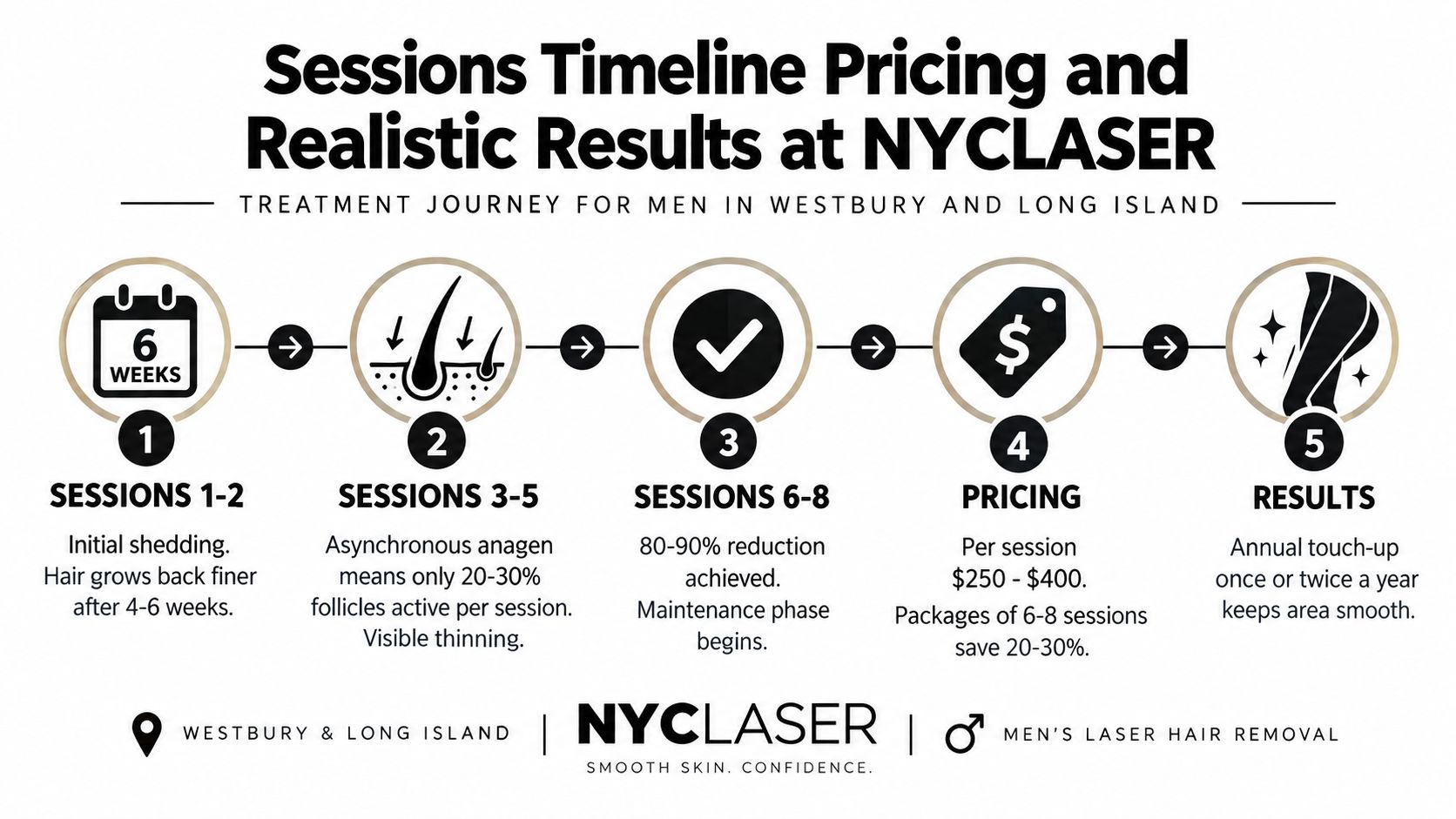
A practical planning model
A reasonable way to plan is to work backward from your goal. If you're preparing for a holiday, athletic season, or personal milestone, allow time for consultation, multiple treatment visits, and the gradual nature of shedding.
At NYCLASER, the Brazilian is listed as a treatment zone within a menu that ranges from Small through Extra Large areas. Clients can choose single sessions or multi-session bundles, including 3-session and 6-session options, with pricing determined by the selected zone and current clinic menu. Appointments are designed to be quick and comfortable, and the clinic describes them as typically requiring no recovery time.
For men in Westbury and nearby Long Island communities, the location is 355 Post Avenue, Suite 101, Westbury, NY 11590. The clinic offers online booking and is open Monday through Saturday, 10 a.m. to 6 p.m. Confirm current availability and treatment pricing before committing, since a consultation may change the recommended zone or plan.
For more detail on why a full Brazilian takes a series rather than one appointment, see this explanation of laser treatments for a full Brazilian.
A realistic budget conversation should include the total plan, not only the first visit. Ask whether the quote covers the front, scrotum, perineum, perianal region, and upper inner thighs, and whether maintenance visits are handled separately. Clear pricing is part of informed consent.
Is a Male Brazilian Right for You and Your Next Step
A male Brazilian may suit you if you're tired of repeated shaving, dislike waxing appointments, or want a gradual reduction in dense intimate hair. Dark, coarse hair often provides a clearer laser target than very light hair, but skin tone and recent tanning affect how the provider selects settings. A consultation is especially important if you have darker skin, a history of pigmentation changes, active irritation, or uncertainty about whether the area is ready for treatment.
You also don't have to choose complete removal. Partial grooming can be a better fit if you want less density while keeping some coverage. Ask about treating the front only, excluding the perianal area, or creating a gradual plan that lets you assess comfort and skin response before expanding treatment.
Laser isn't a good appointment to rush into after tanning or while the skin is inflamed. Postpone and ask for professional guidance if you have a rash, open cuts, unexplained lesions, or significant irritation. A reputable provider should welcome questions about test spots, cooling, wavelength selection, and aftercare rather than pressuring you into a package.
The most useful next step is a private consultation with a clear goal: less daily maintenance, a smoother appearance, reduced irritation, or long-term hair reduction. Bring your questions, describe your current grooming routine, and ask for the exact zones and total treatment plan in writing.
NYC Laser Hair Removal offers personalized Brazilian laser hair reduction in Westbury using Splendor X technology, with treatment plans adjusted for different skin and hair characteristics. Visit NYC Laser Hair Removal to review the service, request a consultation, and discuss the right coverage and schedule for your intimate grooming goals.
Comments