
A Guide to Laser Hair Removal for Sensitive Skin
Let's get right to the big question: can you actually get laser hair removal if you have sensitive skin? The answer is a resounding yes, but with a major caveat—it all comes down to using the right technology and having a plan tailored specifically for you.
Having reactive skin doesn't automatically rule you out. It just means we need to be smarter about how we approach the treatment to protect your skin's delicate balance while still getting you those smooth, long-lasting results you're after.
How Modern Lasers Make It Safe For Your Sensitive Skin
If you've been on the fence about laser hair removal because of your sensitive skin, you're definitely not alone. It’s completely understandable to worry about pointing a powerful light source at skin that gets irritated easily. But the technology has come a long, long way from the older, more aggressive methods. Today's treatments put skin safety first.
Think of it this way: old-school lasers were a bit like using a sledgehammer to crack a nut—they got the job done, but not without some collateral damage. Modern systems are more like a surgeon's scalpel, targeting the hair follicle with pinpoint accuracy and leaving the surrounding skin untouched. This precision is what makes laser hair removal for sensitive skin not just possible, but safe.
The Technology That Puts Your Skin First
Two huge leaps forward have completely changed the game: customizable laser wavelengths and advanced skin cooling. Instead of one harsh, fixed setting, a skilled technician can now adjust the laser’s energy to perfectly match your skin tone and sensitivity. This ensures the laser's energy goes exactly where it needs to—into the dark pigment (melanin) of the hair follicle—and not into your skin.
At the same time, a top-tier cooling system works to protect your skin's surface. This could be a continuous jet of cold air or a chilled sapphire tip on the device itself, both of which keep your skin comfortable during the treatment. It's this cooling action that dramatically reduces redness and makes the whole experience much more pleasant.
The entire goal is to heat the hair follicle enough to disable it, not to heat the skin. Advanced cooling and precise energy delivery are what make this happen, transforming a potentially irritating procedure into a comfortable and safe one for even the most reactive skin.
These elements are critical for creating a treatment plan that fits your skin's unique needs. This personalized approach not only minimizes the risk of a flare-up but also makes each session more effective, paving the way for that smooth, irritation-free skin you’ve been hoping for.
To ensure a safe and effective treatment, several key factors must be in place. This table breaks down what truly matters when it comes to protecting sensitive skin during laser hair removal.
Key Safety Factors for Sensitive Skin Laser Hair Removal
Safety Factor | Why It Matters for Sensitive Skin | Example |
|---|---|---|
Customizable Settings | One-size-fits-all energy levels can easily overwhelm sensitive skin, causing burns or hyperpigmentation. Adjustability is non-negotiable. | A technician lowers the laser's fluence (energy density) for a client with a history of eczema to prevent a flare-up. |
Advanced Cooling System | This is your skin’s first line of defense. It actively soothes the skin during the treatment, preventing heat from building up and causing irritation. | The Splendor X laser uses a Dual Cooling System that blasts chilled air to keep the skin's surface comfortable. |
Targeted Wavelengths | Different wavelengths are absorbed differently by skin and hair. The right one targets the follicle precisely without affecting the surrounding tissue. | Using a 1064nm Nd:YAG wavelength on darker or tanned skin to bypass melanin in the epidermis and safely target the follicle. |
Experienced Technician | An expert knows how to read your skin's reaction in real-time and make immediate adjustments. This expertise is just as important as the technology. | A technician notices slight redness and immediately adjusts the cooling or energy setting to prevent irritation. |
Ultimately, the combination of the right machine, a skilled operator, and a plan designed just for you is what creates a safe and successful outcome. When these elements come together, you can finally achieve the hair-free results you want without compromising your skin's health.
What’s Really Going On With Sensitive Skin?
If you’ve ever wondered why your skin flares up at the slightest provocation, you’re not alone. To figure out the best approach for laser hair removal, we first need to get to the bottom of what makes skin "sensitive" in the first place.
It’s not just a catch-all term; it means your skin's natural protective shield is a bit weaker than average. This makes it more vulnerable to things that others might not even notice.
Imagine your skin’s top layer—the stratum corneum—is a brick wall. The skin cells are the bricks, and natural fats and oils are the mortar holding it all together. When you have sensitive skin, that mortar is a little patchy or thin, leaving tiny gaps in your defensive wall. Dermatologists call this a compromised skin barrier.
With those gaps, irritants like chemicals, allergens, or even the focused heat from a laser can get in deeper and faster. Your body sees this as an attack and kicks off an inflammatory response, which shows up as redness, itching, burning, or swelling.
The Triggers Behind the Reaction
So, what causes those gaps in the wall? It's usually not just one thing but a mix of factors that team up against your skin.
Here are the usual suspects:
Genetics: You can thank your parents for this one. If they have sensitive skin, you're more likely to as well. Conditions like eczema, rosacea, and psoriasis are often passed down through family lines.
Underlying Skin Conditions: Chronic issues directly mess with your skin's barrier. Eczema, for instance, can interfere with the proteins your skin needs to stay strong, while rosacea involves over-reactive blood vessels just under the surface that are easily triggered.
Your Environment: Things you face every day—sun, wind, pollution, and even super hot or cold weather—can strip away your skin’s natural oils. This is like sandblasting the mortar right out of your skin's brick wall.
By getting to the root of what makes your skin tick, a good laser technician can predict how it might react. This is the key to creating a personalized laser hair removal for sensitive skin plan that works with your skin, not against it.
Knowing your triggers is incredibly empowering. It changes your consultation from a list of worries to a productive conversation. You can point out exactly what sets your skin off, and your provider can then fine-tune the laser settings and suggest aftercare that helps rebuild and protect your unique skin barrier. It’s all about making sure your path to smooth skin is as comfortable and safe as possible.
Choosing the Right Laser for Delicate Skin
When you have sensitive skin, the thought of a laser can be intimidating. But the truth is, the specific technology used makes all the difference. It’s like picking the right tool for a delicate job—you wouldn't use a sledgehammer to fix a watch, right? The same logic applies here. We need a laser that’s smart enough to target the hair follicle directly, leaving the sensitive surface of your skin completely untouched.
Older laser systems were a bit like a floodlight, scattering energy that could heat up the surrounding skin and cause redness and irritation. Thankfully, technology has come a long way. Today’s top-tier devices are built for precision, acting more like a laser pointer to deliver energy exactly where it needs to go—and nowhere else.
Why Wavelengths and Cooling Matter
So, what’s the secret sauce for treating sensitive skin safely? It really boils down to two things: the laser's wavelength and its cooling system. A longer wavelength is key because it can travel deeper into the skin to zap the hair follicle without getting absorbed by the epidermis (the top layer). This is a game-changer for preventing irritation and hyperpigmentation, especially for easily reactive skin.
At the same time, a powerful, built-in cooling system acts as your skin's bodyguard. It's not just there for comfort; it's an essential safety feature. By keeping the surface of your skin nice and chilled while the follicle below gets heated, the risk of a reaction drops dramatically.
The most advanced systems masterfully combine these two elements—a highly targeted wavelength and powerful, continuous cooling. This one-two punch is what makes modern laser hair removal not just effective, but exceptionally gentle and a fantastic option for even the most delicate skin.
The Splendor X Difference
This is where a system like Splendor X really shines. It features something called BLEND X technology, which is a pretty big deal. Instead of being limited to a single laser wavelength, it actually syncs two of the most effective types: Alexandrite (755nm) and Nd:YAG (1064nm). This unique combination allows a skilled technician to create a perfectly customized treatment for your exact skin tone and hair type, giving you a level of safety and precision that was once unheard of.
The Nd:YAG laser, in particular, is a hero for sensitive and darker skin tones. Industry studies consistently show that clinicians prefer technologies like diode and Nd:YAG lasers because of their excellent safety profiles. They are absorbed less by the epidermis, which drastically cuts down the risk of burns or pigment changes. If you're curious about the nitty-gritty, you can learn more in our guide on the science behind laser hair removal.
The infographic below helps visualize why this personalized approach is so critical.
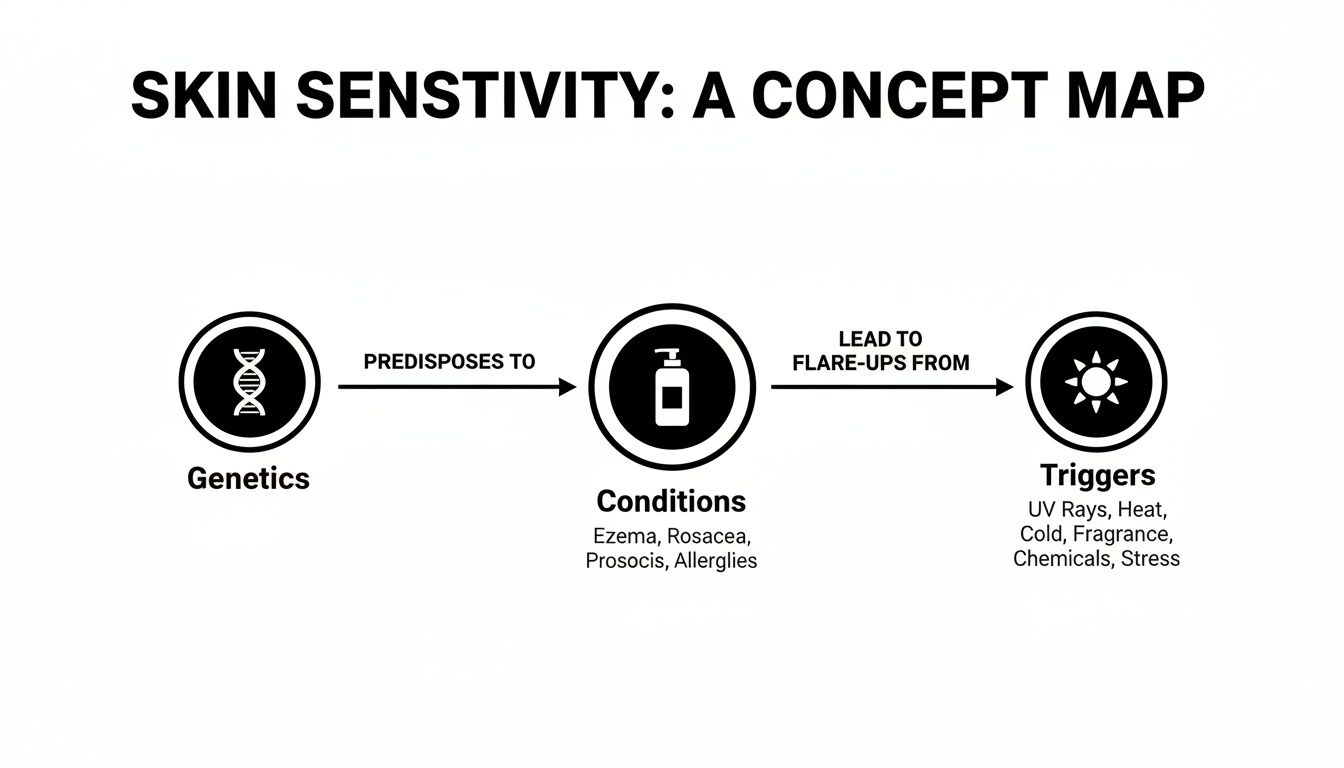
As you can see, skin sensitivity is often a complex puzzle where genetics, underlying conditions, and environmental triggers all play a part.
To top it all off, the Splendor X has a powerful Dual Cooling System that directs a continuous stream of cold air right where the laser is working. This keeps your skin protected and comfortable from start to finish, making the whole experience faster and much more pleasant. When you’re choosing a provider, finding one that invests in this kind of technology is the smartest move you can make for a safe and successful journey to smooth skin.
To make things clearer, let's break down how different laser types stack up for sensitive skin.
Laser Technology Comparison for Sensitive Skin
This table compares some of the common laser technologies you might encounter and how they fare for reactive skin.
Laser Type | Best For | Sensitive Skin Suitability | Key Feature |
|---|---|---|---|
Alexandrite | Lighter skin tones (Fitzpatrick I-III) with dark hair. | Good, but cooling is essential to prevent irritation. | Very fast and effective for the right candidates. |
Diode | A broad range of skin tones (Fitzpatrick I-IV). | Very Good. Offers a balance of safety and efficacy. | Longer wavelength than Alexandrite, making it safer for skin with more pigment. |
Nd:YAG | Darker skin tones (Fitzpatrick IV-VI) and tanned skin. | Excellent. The safest option for pigmented or sensitive skin. | Longest wavelength, bypassing the epidermis to target the follicle directly. |
Splendor X (BLEND X) | All skin tones (Fitzpatrick I-VI). | Superior. The safest and most customizable option. | Combines Alexandrite and Nd:YAG wavelengths for a tailored, highly effective treatment. |
Ultimately, technology like the Splendor X, which can blend wavelengths, offers the most sophisticated and safest solution, ensuring your treatment is perfectly dialed in for your unique needs.
How a Custom Treatment Plan Protects Your Skin
Having the best laser technology in the world is a great start, but it's only half the story. When it comes to laser hair removal for sensitive skin, the real magic happens in the treatment plan. This is what truly dictates whether your experience is safe, comfortable, and ultimately, successful. A generic, one-size-fits-all approach is a recipe for irritation, which is why a deeply personalized strategy isn't just a nice-to-have—it's everything.
This whole process kicks off long before the laser is even powered on. It all starts with a thorough consultation, which is easily the most critical step. Here, a skilled technician gets to know you and your skin—not just your skin and hair type, but your specific sensitivity triggers and history. Think of it as a fact-finding mission to understand exactly how your skin ticks.
Right after that initial chat comes the patch test. This is like a dress rehearsal for your skin. By treating a small, hidden area, the technician can see precisely how your skin reacts to the laser. It allows them to fine-tune the settings for maximum safety before you ever commit to a full session.
Dialing In the Perfect Settings
During your consultation and patch test, your technician is collecting all the intel needed to build your custom plan. They aren't just flipping a switch; they are meticulously calibrating several key variables to keep your skin's delicate barrier safe and sound.
This involves carefully adjusting:
Fluence (Energy Level): This is the power behind the laser’s energy pulse. For sensitive skin, the aim is to find that sweet spot—the lowest possible energy level that will still effectively disable the hair follicle without agitating the surrounding skin.
Pulse Duration: This setting controls how long the laser energy is actually in contact with your skin. An experienced technician can adjust this timing to heat the follicle just enough while preventing that heat from spreading to the epidermis.
Cooling Intensity: With advanced systems like the Splendor X, the integrated cooling can be turned up or down to ensure you’re comfortable and your skin is protected from start to finish.
A customized treatment plan is not static. It's a dynamic blueprint that is re-evaluated and adjusted before every single session to adapt to your skin's ongoing response, hormonal changes, or recent sun exposure.
Why a Smart Plan Matters Over Multiple Sessions
Getting rid of unwanted hair is a journey, not a single appointment. Both clinical studies and industry reports show that getting that lasting hair reduction takes a series of 6 to 8 sessions, usually spaced several weeks apart. This approach is essential for catching hairs in their active growth phase.
But it also means your skin gets repeated exposure to laser energy over time. A professional plan manages this by using smart strategies like adjusting the energy levels, cranking up the cooling, and performing new test spots if needed. This significantly lowers the risk of any issues cropping up down the line. You can see how market trends are pushing these safety-focused protocols in laser hair removal forward. This adaptive strategy ensures your skin's health is the top priority from your first session to your last, letting you focus on the goal: beautifully smooth, hair-free skin.
Pre-Treatment Prep and Aftercare Essentials
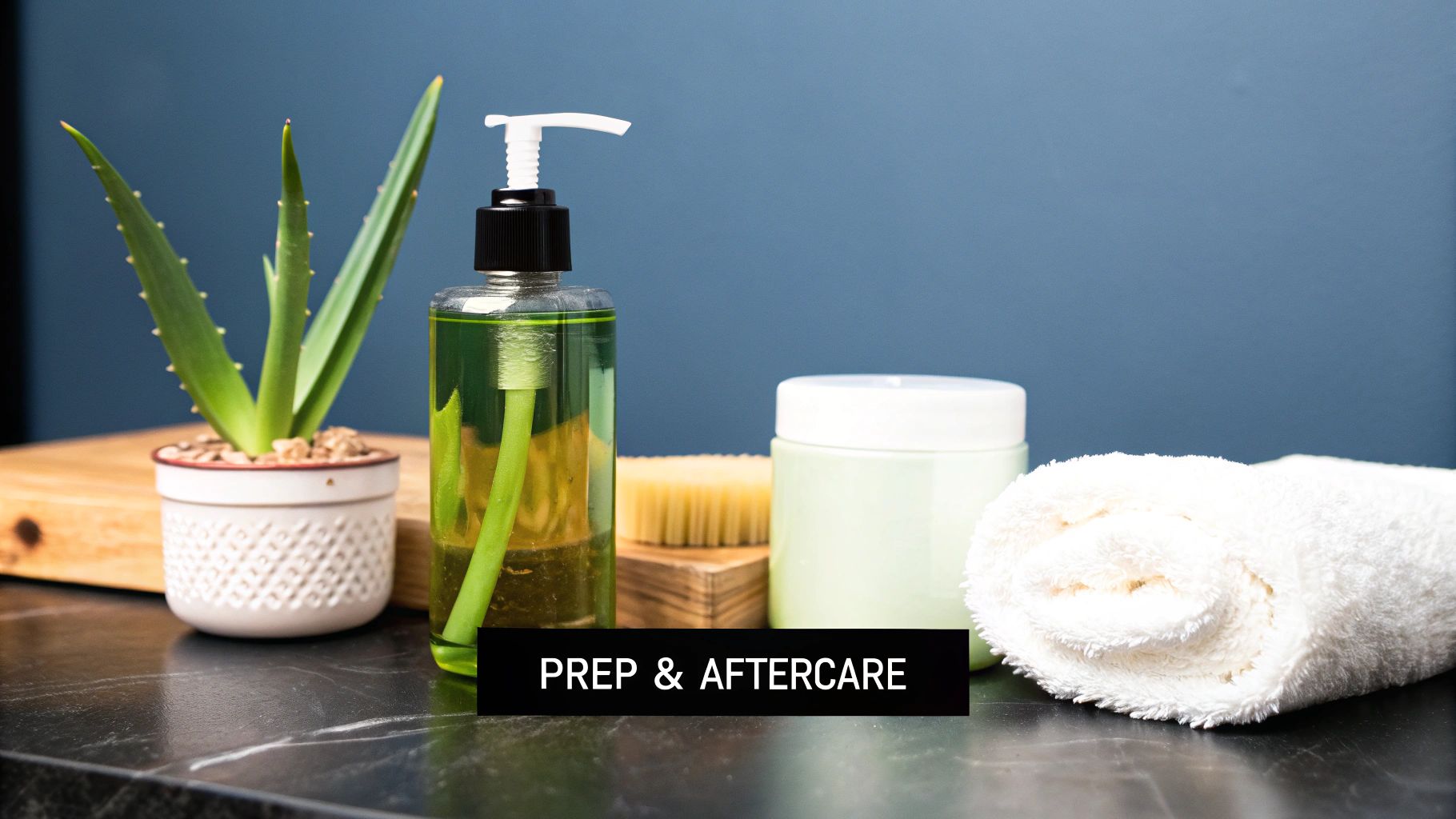
Your journey to smooth, hair-free skin doesn't just happen inside the treatment room. The prep work you do beforehand and the care you take afterward are absolutely critical, especially when dealing with sensitive skin.
Think of it as a partnership. Your technician handles the advanced laser technology, and you handle the at-home care that makes it all work. Before your appointment, your job is to get your skin as calm and stable as possible. Afterward, it’s all about soothing, hydrating, and protecting it while it heals.
Your Pre-Treatment Checklist
Getting your skin ready for laser hair removal for sensitive skin is mostly about what not to do. The goal is to avoid anything that could make your skin more reactive or interfere with the laser's ability to do its job.
Follow these simple rules to set yourself up for a great session:
Sun Is Not Your Friend: The laser targets melanin in the hair follicle. Tanned skin has more melanin, which can confuse the laser and lead to unwanted side effects. You'll need to stay out of the sun and away from tanning beds for at least four weeks before your appointment.
Put Harsh Skincare on Pause: For at least one week before your treatment, stop using products with retinoids, alpha-hydroxy acids (AHAs), or beta-hydroxy acids (BHAs) on the area we'll be treating. These ingredients are fantastic, but they make your skin more sensitive.
Shave, Don't Pull: The laser needs the hair root intact to work. Shave the area 24-48 hours before you come in. No waxing, tweezing, or using depilatory creams for at least six weeks prior—we need that follicle there!
A Gentle Aftercare Routine
It's completely normal for your skin to feel a bit warm and look a little red right after your session, almost like a very mild sunburn. This usually fades within a few hours. Your aftercare plan should be all about cooling things down and keeping your skin happy.
The first 48 hours are the most important. Treat your skin just like you would a sunburn: keep it cool, avoid friction, and slather on the moisture. This simple approach is the best way to prevent irritation and speed up recovery.
Here’s your game plan for a calm, comfortable recovery:
Cool It Down: A cold compress feels amazing. You can also apply pure aloe vera gel, which is a lifesaver for reducing redness and providing gentle hydration.
Moisturize, Moisturize, Moisturize: Use a basic, fragrance-free moisturizer. Nothing fancy needed—just simple hydration to help your skin's natural healing process.
Skip the Heat: For the next 48 hours, avoid hot showers, saunas, steam rooms, and intense workouts. Anything that makes you sweat can aggravate the treated skin.
Sunscreen is a Must: Your skin will be extra vulnerable to UV rays. Apply a broad-spectrum SPF 30+ every single day to prevent any chance of hyperpigmentation.
Knowing what to expect can make the whole process feel much smoother. For a deeper dive, check out our guide to laser hair removal side effects. By committing to this prep and aftercare routine, you're giving your sensitive skin the best possible chance to heal beautifully.
Finding the Right Laser Hair Removal Expert on Long Island
When you have sensitive skin, choosing a laser hair removal clinic isn't just about finding a good deal—it's about finding the right partner for your skin. This is probably the most important decision you'll make in this entire process. With a true expert, the journey is safe, comfortable, and effective. With the wrong one, you're rolling the dice.
Your mission is to find a provider on Long Island who gets it. They need to have the best tools for the job, but more importantly, they need a deep, practical understanding of how to handle skin that reacts to everything.
So, where do you start? Look for clinics that are open and honest about the technology they use. A great provider will be excited to tell you about their equipment, like the Splendor X, and can clearly explain why it's the gold standard for sensitive skin. Don't be shy during your consultation. Ask them point-blank: "What kind of laser do you use, and what features does it have to protect skin like mine?"
Digging into Credentials and Real-World Experience
The machine is only half the equation; the person operating it is the other half. You're looking for a licensed esthetician or a certified laser specialist who has dedicated training in treating a wide range of skin types and tones.
This is where patient reviews become your best friend. Hunt for testimonials from people who also mention having sensitive skin, eczema, or rosacea. See what they have to say about their experience. Did the clinic listen? Did they feel safe? Their stories will tell you a lot about how the clinic handles cases just like yours.
A top-tier provider will always require a detailed consultation and a patch test. This isn't just a box-ticking exercise. It’s a non-negotiable safety measure that shows they are committed to a cautious, personalized plan.
Think of it like this: You wouldn't hire a personal trainer who gives everyone the same workout. You need someone with the right equipment, proven experience, and a custom plan to help you reach your goals without getting hurt. That's what you're looking for in a laser specialist.
Why Treatment Packages Actually Make Sense
You'll notice most clinics offer packages of three, six, or more sessions. At first glance, this might look like a sales push, but there's a solid clinical reason behind it. Hair grows in different cycles, and a single laser session can only treat the hairs that are currently in their active growth phase. To get that smooth, long-lasting result, you have to catch every follicle at the right time.
This multi-session strategy is even more important for sensitive skin. It gives your technician the ability to start gently and make small, careful adjustments to the settings over time, ensuring your skin is always comfortable.
The laser hair removal market is growing fast, especially in North America where advanced lasers and specialized clinics are becoming more common. This is great news for you, as it means more access to top-notch care. You can read more about the growth of the laser hair removal market on databridgemarketresearch.com. By committing to a full treatment plan with a skilled Long Island provider, you're not just buying sessions—you're investing in a safer, more successful outcome for your sensitive skin.
Still Have Questions? Let's Talk Specifics
Even after covering the ins and outs of the technology and prep work, a few questions always pop up, especially when sensitive skin is involved. Let's get straight to the answers you're looking for.
Will It Be More Painful for Me?
This is the number one question we hear, and the answer is usually no. While there’s a definite sensation—most people compare it to a quick rubber band snap—the experience isn't necessarily more intense just because your skin is reactive.
Modern systems like the Splendor X are designed with you in mind. They have a built-in cooling mechanism that keeps the surface of your skin comfortable while the laser does its work below. Plus, a good technician is a master at finding that sweet spot, adjusting the laser's settings to be powerful enough for results but gentle enough for your comfort. If you want a deeper dive into what to expect, check out our guide on the pain level of laser hair removal.
How Many Treatments Will It Take?
The total number of sessions really doesn't change based on skin sensitivity. Most people, regardless of skin type, need a series of 6 to 8 treatments to see the best, most permanent results.
We space these appointments about 4-6 weeks apart to make sure we’re catching each hair in its active growth phase. While we'll take extra care during each visit because of your skin's sensitivity, it won't add to the total number of appointments you'll need.
The Bottom Line: The risk of any lasting damage is incredibly low when you're in the hands of a qualified professional using up-to-date technology. The usual side effects, like some temporary redness or minor swelling, almost always fade within a few hours. The single most important thing you can do for a safe treatment is to choose a clinic that insists on a patch test.
Ready to finally get that smooth, irritation-free skin you've been dreaming of? At NYC Laser Hair Removal, we're experts in getting incredible results for every single skin type. Book your consultation today!
Comments