
The Best Laser Hair Removal for Dark Skin a Complete Guide
For years, safe laser hair removal for dark skin felt more like a myth than a reality. It was considered high-risk, and for good reason. Thankfully, modern technology has completely changed the game. The secret is using a laser smart enough to tell the difference between the pigment in your skin and the pigment in a hair follicle.
This is exactly why specific lasers, like the Nd:YAG, have become the gold standard for dark skin—they deliver safety and stunning results.
Why Dark Skin Needs Specialized Laser Technology
The core science of laser hair removal is pretty straightforward: the laser sends out a pulse of light that gets absorbed by melanin, which is the pigment that gives hair its color. That light energy converts to heat, damaging the follicle and stopping future growth. (If you want to get into the nitty-gritty, you can learn more about how laser hair removal works in our detailed guide).
But for people with darker skin tones, this very mechanism presents a unique challenge. Melanin isn't just in the hair; it's in the skin, too. Older laser technologies just weren't sophisticated enough to distinguish between the two.
The Melanin Challenge
When a laser with a shorter wavelength hits melanin-rich skin, the skin itself ends up absorbing a huge amount of the laser’s energy. Instead of going to the hair follicle, that energy gets misdirected, which can lead to some serious side effects:
Burns and Blisters: When the skin’s surface overheats, it can cause painful burns.
Hyperpigmentation: This can trigger dark spots, known as post-inflammatory hyperpigmentation (PIH), on the treated area.
Hypopigmentation: On the flip side, the laser can damage the melanin-producing cells in the skin, leaving behind patches of lighter skin.
Scarring: In the worst-case scenarios, using the wrong laser can cause permanent scarring.
This is precisely where the Fitzpatrick scale—a dermatology standard for classifying skin types by how they react to UV light—becomes absolutely critical.
Key Insight: People with Fitzpatrick skin types IV, V, and VI (ranging from light brown to deep brown and black skin) need lasers that can bypass the melanin in the top layer of skin and penetrate deeper to target the hair follicle directly.
Understanding the Fitzpatrick Scale and Laser Safety
The Fitzpatrick scale is the tool technicians use to choose the right laser and the perfect settings for your specific skin phototype. It's all about ensuring your treatment is both safe and effective.
Skin Type | Description | Historical Laser Risk |
|---|---|---|
Type IV | Light brown or olive skin | High risk with older lasers |
Type V | Dark brown skin | Very high risk with older lasers |
Type VI | Very dark brown to black skin | Unsuitable for older lasers |
Luckily, huge advancements have led to lasers with longer wavelengths, like the 1064nm Nd:YAG laser, which is poorly absorbed by melanin in the skin. This technology allows the energy to pass safely through the epidermis and focus its power right where it needs to be—on the hair follicle. It's a targeted approach that dramatically cuts the risk of complications and finally delivers the smooth, hair-free skin you’re looking for.
Comparing Nd:YAG and Diode Lasers for Dark Skin
When you start looking into laser hair removal for dark skin, the conversation quickly narrows down to two technologies: Nd:YAG and Diode. While both are used across the industry, the science behind them makes one a significantly safer and more effective choice for melanin-rich skin. This isn't just about tech specs; it's about your safety and the quality of your results.
The key difference comes down to their wavelengths. A laser's wavelength, measured in nanometers (nm), dictates how deep its light travels into the skin. For darker skin tones, a longer wavelength isn't just a nice-to-have—it's non-negotiable for a safe treatment.
This decision tree cuts through the noise, showing the clear and safety-first path for anyone with a darker complexion.
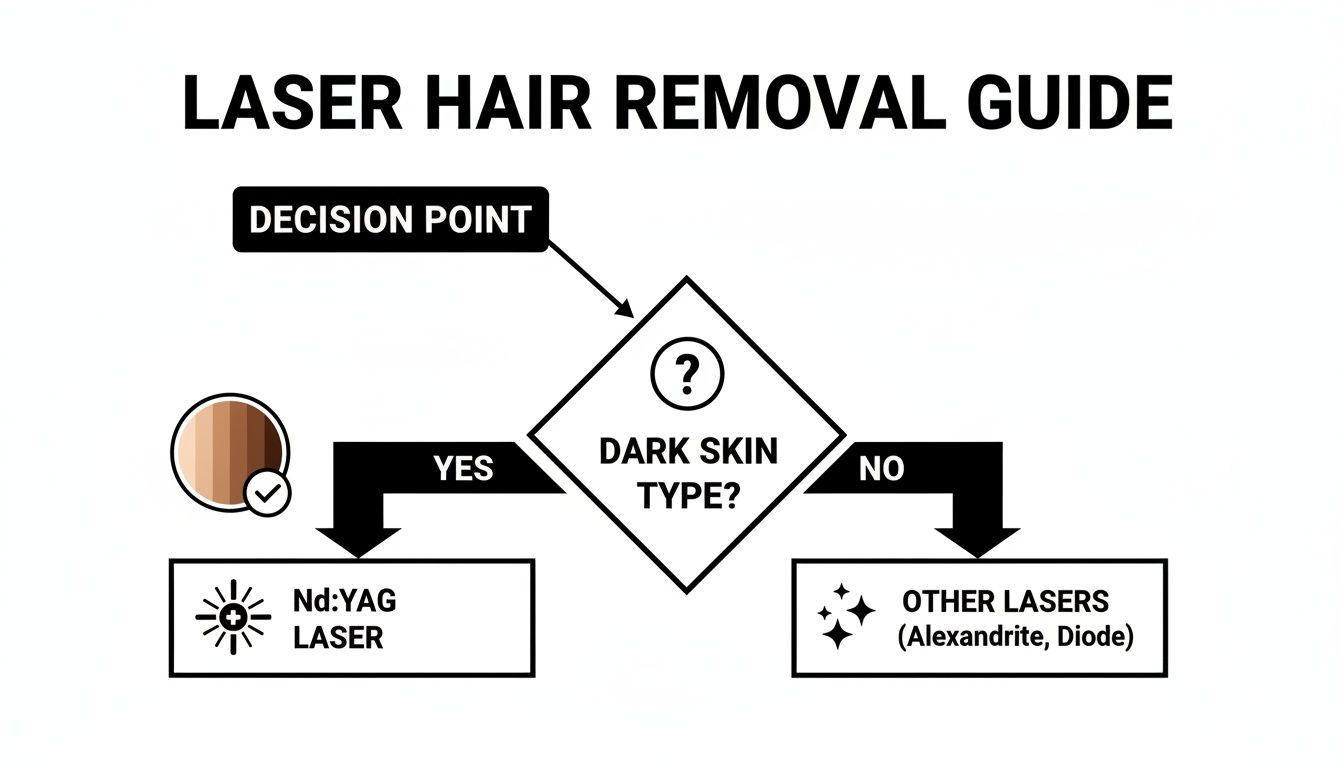
As you can see, for dark skin, all roads lead to a long-wavelength laser like the Nd:YAG. It's the only route that prioritizes both safety and efficacy.
Wavelength: The Critical Differentiator
The Nd:YAG laser is the gold standard here, operating at a 1064nm wavelength. This longer wavelength is crucial because it’s not easily absorbed by the melanin in your epidermis (the skin's surface). Instead, its energy bypasses the surface and dives deeper to zap the melanin concentrated right in the hair follicle.
On the other hand, the Diode laser typically uses a shorter 810nm wavelength. This works well for lighter skin (Fitzpatrick I-III), but for darker skin, its higher attraction to melanin is a problem. The laser's energy can get "stuck" at the surface, heating the skin itself and dramatically increasing the risk of burns, blisters, and pigmentation changes.
Expert Insight: Think of it like this: The Nd:YAG laser has a "smart pass" that lets it ignore the melanin at the surface and go straight for its target deeper down. The Diode laser, however, gets easily distracted by the surface melanin, which can cause a lot of collateral damage.
Safety Profile and Pigmentation Risk
Safety is everything when treating dark skin. Because the Nd:YAG's 1064nm wavelength bypasses the epidermis, it virtually eliminates the risk of thermal damage to your skin. This makes it the undisputed champion for preventing side effects like hyperpigmentation (dark spots) and hypopigmentation (light spots).
While some newer Diode lasers have been modified with longer pulse durations and better cooling to make them safer for dark skin, the inherent risk is still much higher than with an Nd:YAG. The margin for error is razor-thin, and your safety ends up depending almost entirely on the technician's skill and the specific device being used.
The market trend confirms this. The Nd:YAG laser stands out as the best option, with projections showing its segment growing at a massive 20.1% CAGR through 2030. The global market is set to expand from $1,087.5 million in 2023 to $3,595.1 million by 2030, largely because of its proven superiority for darker skin tones. You can explore more data on this market trend to see where the industry is heading.
Effectiveness and Comfort Levels
Both lasers get the job done, but they excel in different areas. The Nd:YAG is exceptionally good at treating the coarse, thick hair often found in areas like the bikini line and underarms—exactly the kind of hair many people with dark skin want to treat.
Diode lasers can sometimes be better for finer hair, but that small advantage is quickly overshadowed by the safety risks on dark skin. As for comfort, all modern laser systems use advanced cooling, like a chilled tip or a cryogen spray, to keep the skin comfortable. However, since the Nd:YAG deposits its heat deeper and away from the nerve endings at the surface, many clients report a much more comfortable experience overall.
Making the Right Choice: A Clear Comparison
To make your decision as simple as possible, here's a direct comparison of how these two lasers perform specifically for darker skin tones (Fitzpatrick IV-VI).
Nd:YAG vs. Diode Laser Comparison for Dark Skin
Here’s a side-by-side breakdown of the two leading technologies. This table focuses on the factors that matter most for anyone with a Fitzpatrick IV, V, or VI skin type, helping you understand why one is the clear recommendation.
Feature | Nd:YAG Laser (1064nm) | Diode Laser (810nm) | Recommendation for Dark Skin |
|---|---|---|---|
Wavelength | Long (1064nm), bypasses epidermal melanin. | Medium (810nm), higher melanin absorption. | Nd:YAG is the clear winner. Its long wavelength is the key to safe treatment. |
Safety Profile | Highest safety rating for dark skin. Low risk of burns or pigmentation. | Moderate to high risk. Requires extreme caution and expertise. | Nd:YAG offers superior safety. It was specifically designed for this purpose. |
Risk of Pigmentation | Very low. Protects the skin's natural melanin. | Higher risk of both hyper- and hypopigmentation. | Choose Nd:YAG to protect your skin tone and prevent discoloration. |
Patient Comfort | Generally more comfortable due to deeper energy delivery and cooling. | Can feel hotter on the surface. Comfort depends heavily on the cooling system. | Most patients find the Nd:YAG more comfortable, especially with integrated cooling. |
For anyone with a Fitzpatrick IV, V, or VI skin type, the choice is clear. The Nd:YAG laser isn't just another option; it's the gold standard for achieving the best laser hair removal for dark skin safely and effectively. Insisting on this technology is the single most important step you can take to ensure a successful and worry-free treatment.
So, Are You a Good Candidate for Laser Hair Removal?
While today's technology makes laser hair removal safer than ever for dark skin, the best results come from a treatment plan that’s built around you. It’s not just about your skin tone; a few key factors determine whether you'll get that smooth, hair-free finish you're after. Knowing what they are helps you set the right expectations from day one.
At its core, laser hair removal works by targeting the pigment—or melanin—in your hair follicle. The laser needs a clear target.
That means the best-case scenario is having hair that's noticeably darker than the surrounding skin. This contrast is what allows advanced lasers like the Nd:YAG to zap the follicle efficiently without bothering your skin. It’s also why laser treatments just don’t work on white, gray, blonde, or red hair—there isn’t enough pigment for the laser to lock onto.
It's More Than Just Skin Deep
Your hair's texture also plays a huge part in how well the treatment works.
Coarse Hair: If your hair is on the thicker, coarser side, you're in luck. It contains more melanin and gives the laser a bigger target, which often means faster, more dramatic results.
Fine Hair: Treating finer hair can be a bit trickier. It’s definitely not impossible, but you might need more sessions to see the reduction you want since the follicles are smaller and less pigmented.
Your overall health is another piece of the puzzle. Certain underlying conditions can mess with your hair growth cycles and affect your results.
For example, clients with Polycystic Ovary Syndrome (PCOS) often deal with hormonally-driven hair growth, a condition called hirsutism. Laser hair removal is fantastic for managing it, but because hormones can trigger new growth, you'll likely need more frequent maintenance sessions to keep things smooth.
Your Lifestyle Matters, Too
What you're putting in your body and how you treat your skin are just as important as your genetics. Certain medications, for instance, can make your skin extra sensitive to light, a condition known as photosensitivity.
If you’re taking certain antibiotics (like tetracyclines), acne medications (especially Accutane), or even some antidepressants, your risk of burns or a bad reaction from the laser goes way up. It’s absolutely critical to tell your technician about every single medication you’re on during your consultation.
Finally, let's talk about the sun. A recent tan is a major dealbreaker. Tanned skin has more active melanin, which confuses the laser and makes it hard for it to tell the difference between your skin and your hair. Treating tanned skin is a recipe for burns and hyperpigmentation. Any reputable clinic will insist you stay out of the sun and away from tanning beds for at least two to four weeks before your appointment. This ensures your skin is at its natural, baseline tone, which is the only way to treat you safely and effectively.
Your Treatment Journey from Preparation to Aftercare
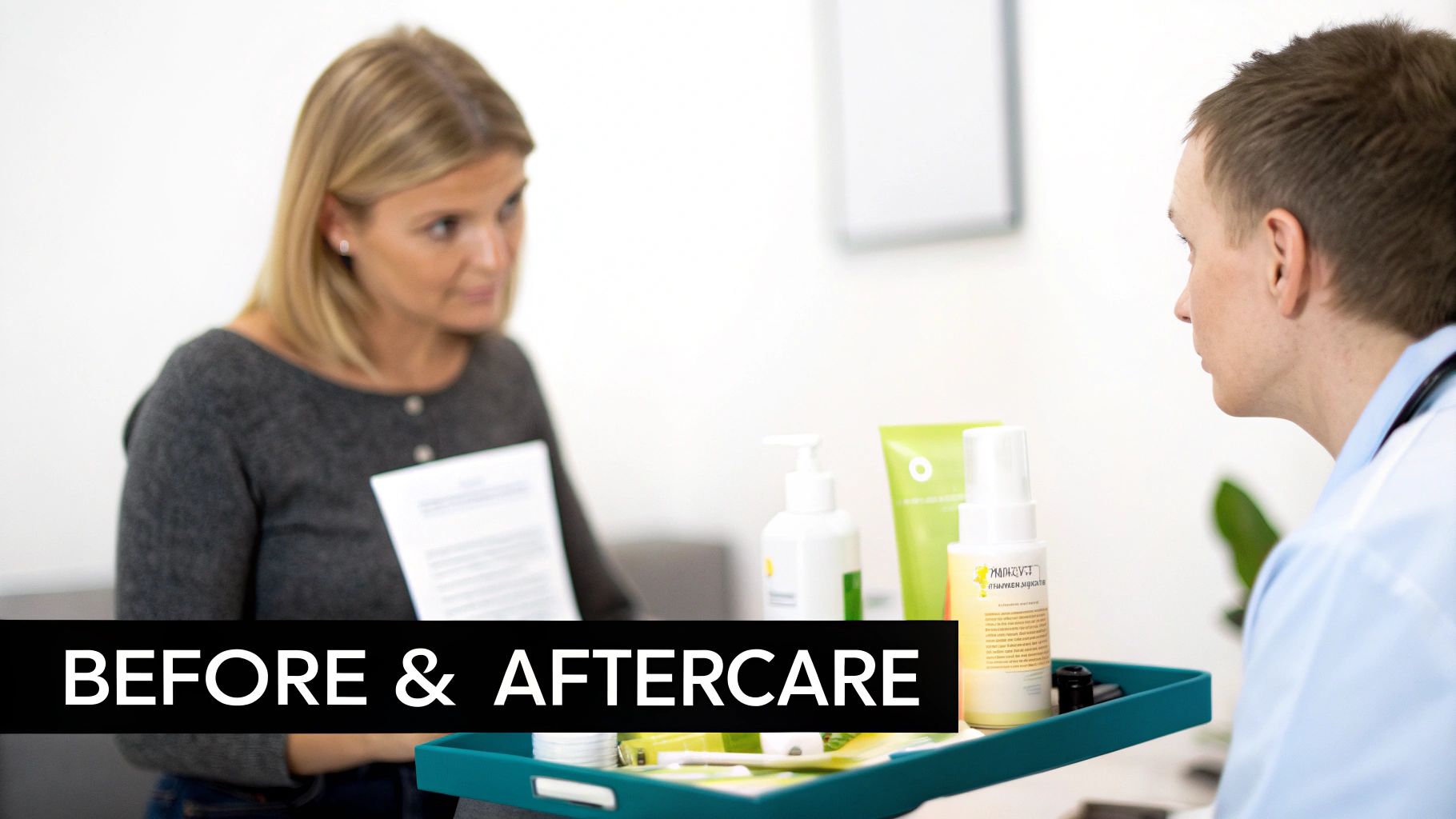
Getting the best results from laser hair removal on dark skin isn’t just about the technology—it’s a partnership between you and your specialist. Your journey to smooth skin starts weeks before your first session and continues with thoughtful aftercare. Nailing the prep and follow-up is just as crucial as the treatment itself.
Each step is designed to protect your beautiful skin, minimize any risks, and let the laser do its job effectively. Think of it as setting the stage for a flawless performance.
Pre-Treatment Essentials for Melanin-Rich Skin
To ensure your session is both safe and effective, there are a few non-negotiable rules. These are especially important for skin with more melanin, as they help prevent adverse reactions and make sure the laser targets the hair follicle, not your skin.
Avoid Sun Exposure: This is the golden rule. You absolutely must stay out of direct sunlight and avoid tanning beds or self-tanners for at least two to four weeks before your appointment. Tanned skin has more active melanin, which can confuse the laser and heighten the risk of burns or hyperpigmentation.
Shave the Area: Be sure to shave the treatment area 24 to 48 hours before you come in. This leaves the hair short enough for the laser to find the follicle right under the skin, without wasting energy on the hair above the surface.
Stop Waxing and Plucking: The laser needs the hair follicle to be intact to work. That means you'll need to stop waxing, plucking, or using any method that pulls hair from the root for at least four weeks before your treatment.
Following these steps is critical. For a more detailed checklist, check out our complete guide on how to prepare for laser hair removal.
During Your Laser Session: What to Expect
When you arrive for your appointment, your technician’s priority is your comfort. Most modern devices, like the Splendor X, come with a built-in cooling system that blows chilled air onto your skin to keep discomfort to a minimum. Many clients describe the feeling as a quick snap, much like a rubber band.
The length of a session really depends on the size of the area. A smaller spot like the upper lip can be done in just a few minutes, while a larger area like the full legs might take up to an hour.
Why Multiple Sessions Are Necessary: Laser hair removal is only effective on hair that's in its active growth phase (the anagen stage). At any given time, only about 10-20% of your hair is in this stage. This is why a series of treatments is required to catch every single follicle in its growth cycle.
This biological fact is why we recommend a series of 6-8 sessions, typically spaced four to six weeks apart, to achieve that lasting, significant hair reduction you’re looking for.
Aftercare: Your Key to Flawless Results
What you do after your session is every bit as important as what you did to prepare. Proper aftercare for dark skin is all about protecting the treated area and preventing any pigmentation issues. Your skin will be sensitive, so being gentle is key.
Right after your treatment, it's normal to see some mild redness or swelling. Don't worry—this usually calms down within a few hours.
Your Post-Treatment Plan:
Protect from the Sun: Continue to keep the treated area out of the sun for at least two weeks. When you do go outside, be generous with a broad-spectrum SPF 30+ sunscreen. This is the single most important thing you can do to prevent hyperpigmentation.
Keep it Cool: For the first 24-48 hours, avoid hot showers, saunas, steam rooms, and intense exercise. Heat can make your skin feel more sensitive and irritated.
Soothe the Skin: If you feel any discomfort, a cool compress or some aloe vera gel can work wonders. Steer clear of harsh exfoliants, retinoids, or any lotions with fragrance until your skin is fully back to normal.
By following this roadmap from prep to aftercare, you create the perfect conditions for your laser hair removal to succeed, ensuring the beautiful, smooth, long-lasting results you deserve.
How to Choose the Right Clinic and Technology
Picking the right laser is only half the story. The real key to getting safe, incredible results is finding a skilled provider who truly understands the nuances of dark skin. Your safety and final look depend entirely on the clinic’s expertise and the equipment they use. For anyone in the NYC and Long Island area, this means doing a little homework to find a center that not only has the best tools but also a proven track record with skin like yours.
The demand for laser hair removal is huge, particularly in North America, which leads the world in treatments for darker skin tones thanks to the availability of advanced lasers. The market pulled in USD 459.3 million in 2023, with the US claiming a massive 91.3% of that. With so many people getting treatments—around 457,000 in the US back in 2019—it’s more important than ever to choose a provider who stands out for their excellence.

Vetting Your Provider: A Checklist
Think of your consultation as more than just a price check—it's your chance to interview the clinic. Don't be shy about asking direct questions. A great provider will welcome your diligence and give you clear, confident answers.
Key Questions to Ask During Your Consultation:
Experience with Dark Skin: "How many clients with my skin type (for example, Fitzpatrick Type V) do you treat on a regular basis?"
Technology Used: "What specific laser do you use for dark skin tones?" The answer you want to hear is Nd:YAG or a system that uses it.
Patch Test Protocol: "Is a patch test required before we start a full treatment?" This is a non-negotiable safety check for any adverse reactions.
Technician Certification: "Are your laser technicians certified, and what specific training have they had for treating darker phototypes?"
If a clinic gets defensive or brushes off your concerns, that’s a major red flag. Just walk away. Your skin's health is never worth the risk.
The Rise of Advanced Blended Technology
While the Nd:YAG laser has long been the gold standard, technology never stops moving forward. The latest systems offer even smarter solutions designed for better safety and effectiveness on all skin tones, including the very darkest.
One of the most exciting advancements is blended laser technology, which combines different wavelengths into a single, powerful device. This gives you a much more customized and efficient treatment than a single-wavelength laser ever could.
The Splendor X Advantage: Systems like the Splendor X by Lumenis are the pinnacle of this new tech. It uniquely fires both the Nd:YAG (1064nm) wavelength (perfect for dark skin) and the Alexandrite (755nm) wavelength (great for lighter skin) in one synchronized pulse. This lets technicians fine-tune the treatment precisely to your unique skin and hair.
Why Blended Technology is a Game Changer
This dual-wavelength approach offers some serious benefits, especially if you're looking for the best laser hair removal for dark skin.
First off, it’s safer. By blending the wavelengths, the system can send effective energy to the hair follicle while keeping the surface of your skin cool. This dramatically lowers the risk of burns or pigmentation problems.
It’s also more effective. The ability to customize the energy blend means the treatment can nail both coarse and finer hairs in the same session, leading to better, more complete results. If you're local, you can learn more about the Splendor X technology available in our Long Island clinic and see exactly why we invested in this top-tier system.
Finally, smart features like a large, square-shaped spot size and a built-in cooling system make Splendor X treatments faster and way more comfortable. When you're clinic shopping, asking if they use this kind of modern, blended technology is a great way to tell if they’re committed to the highest standard of care.
Common Questions About Laser Hair Removal for Dark Skin
Even after you understand the tech and the process, it's completely normal to have a few last questions before you commit. Making a confident decision is everything, so let's clear up the most common concerns we hear from clients with dark skin.
We'll cover everything from pain levels to permanence, giving you the straightforward answers you need to take the next step.
Does Laser Hair Removal Hurt on Dark Skin?
Everyone’s pain threshold is different, but modern lasers are built with comfort in mind. For dark skin, the experience is surprisingly manageable, especially with advanced systems like the Splendor X that have built-in cooling. This tech blasts chilled air onto your skin right as the laser pulses, which makes a world of difference.
Most people describe the feeling as a quick, warm snap—like a rubber band hitting the skin. Because dark skin can be more sensitive to heat, this cooling feature isn't just a nice-to-have; it's essential. It protects the surface of your skin while letting the laser’s energy get right to the follicle, making the whole process both safe and comfortable.
A great technician will always check in with you, adjusting the laser’s settings based on your feedback to keep things effective but tolerable.
How Much Does Laser Hair Removal for Dark Skin Cost?
The price tag for laser hair removal can swing quite a bit based on a few key things. Where you live, the size of the area you're treating, and how many sessions you'll need all play a role in the final cost.
It’s simple math: larger areas like full legs or your back are a bigger investment than smaller zones like the upper lip or underarms.
To make it more affordable, most reputable clinics offer package deals that bring the per-session cost way down when you sign up for a full series. And while the upfront cost might feel like a lot, think about it this way: it’s a one-time investment compared to the never-ending costs of waxing, threading, or stocking up on good razors.
Crucial Takeaway: Don't chase the cheapest deal. Always prioritize a clinic that uses the right technology (like an Nd:YAG laser) and has real, proven experience with your skin tone. A bargain treatment can lead to poor results or, even worse, skin damage that costs far more to fix than you ever saved.
Is Laser Hair Removal Truly Permanent?
This is one of the biggest and most important questions we get. The FDA calls it "permanent hair reduction," not "permanent hair removal," and that small difference is key to setting the right expectations. The goal isn't to be completely hair-free forever, but to see a massive, long-term drop in hair growth.
After a full series of treatments—usually 6-8 sessions—most clients see a 70-90% reduction in hair. Whatever hair does decide to grow back is usually way finer, lighter, and much slower to appear.
It’s also important to remember our bodies are always changing. Hormonal shifts from things like pregnancy, menopause, or conditions like PCOS can sometimes wake up dormant hair follicles. That’s why most people find a quick touch-up session once a year or two is all they need to keep their skin smooth. The daily hassle is gone, replaced by simple, occasional upkeep.
Can I Get Laser Hair Removal on My Face If I Have Dark Skin?
Yes, you absolutely can. Getting laser hair removal on your face is a very common and safe procedure for dark skin, but only if the right laser is used. An Nd:YAG laser is the only safe bet for this delicate area, as it bypasses the pigment in your skin to avoid any risk of discoloration.
Popular facial areas for clients with dark skin include:
Upper Lip: Perfect for getting rid of that shadow and any coarse hairs.
Chin: A go-to for targeting stubborn, hormone-driven hairs.
Sideburns: Helps create a clean, smooth frame for your face.
"Unibrow" Area: Great for precise shaping between the brows.
Facial hair can be a bit more stubborn than body hair because it's so sensitive to hormonal changes. You might find you need a few more initial sessions or more frequent touch-ups to keep things looking perfect. This is why it's so important to choose a clinic with tons of documented experience treating faces on dark skin tones—it ensures your safety and the best possible results.
Ready to start your journey to smooth, confident skin? The team at NYC Laser Hair Removal specializes in providing the best laser hair removal for dark skin using the state-of-the-art Splendor X system. Our Long Island clinic is here to create a personalized, safe, and effective treatment plan just for you.
Book your consultation online today and discover the difference expert care makes.
Comments