
Does Laser Work on Blonde Hair? does laser work on blonde hair, Expert Guide
Let's get straight to it: yes, laser hair removal can work on blonde hair, but it’s definitely not a simple yes-or-no answer. Success really hinges on the specific shade and thickness of your hair, plus the sophistication of the laser technology we're using. The bottom line? Darker, coarser blonde hair is a much better target than fine, nearly-white hair.
The Honest Answer to Laser Hair Removal for Blonde Hair
Wondering if you’re a good candidate is the first step for anyone considering this popular treatment. While laser hair removal is famously effective for dark hair, the question of whether it works on blonde hair is a lot more nuanced. It all comes down to the amount of pigment, or melanin, within each strand.
Blonde hair naturally has less melanin than brown or black hair, which gives the laser less of a target to "see." This makes it more challenging, but it doesn't automatically mean you're out of the running. Your specific shade of blonde is the single most important factor.
To set some realistic expectations from the start, here’s a quick breakdown:
Dark Blonde or "Dirty Blonde" Hair: This type often has just enough pigment at the root for advanced lasers to lock onto effectively. You can generally expect good results, though you might need a few more sessions than someone with dark brown hair.
Medium to Light Blonde Hair: Here, the results can be more variable. The coarseness of the hair plays a big role; thicker light blonde hair may respond better than fine, wispy strands.
Platinum or White Blonde Hair: This hair contains almost no melanin, making it nearly invisible to traditional lasers. In these cases, laser hair removal is typically not an effective option.
This decision tree helps visualize how your hair shade influences the potential outcome.
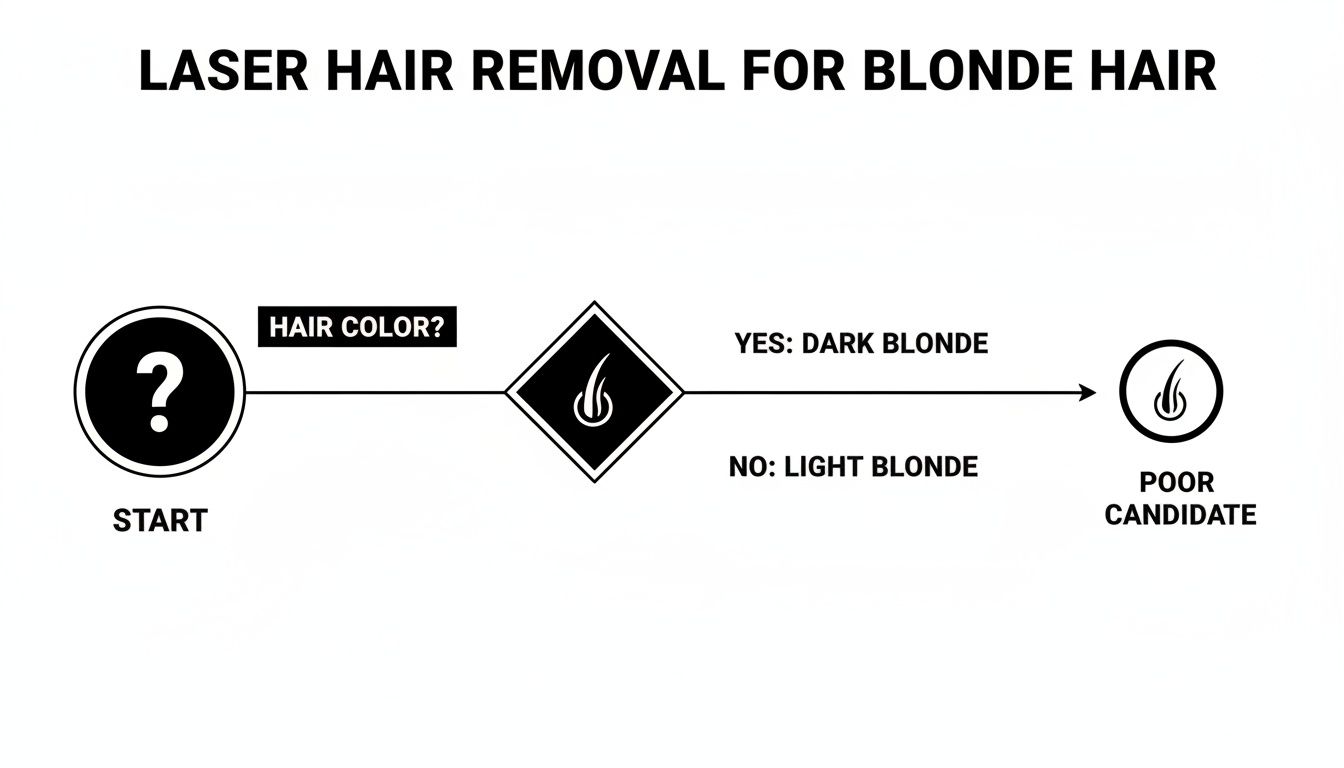
To make it even clearer, this table offers a quick reference for what you can expect based on your shade.
Laser Hair Removal Effectiveness by Blonde Hair Shade
Blonde Hair Shade | Typical Effectiveness | Best Technology Approach |
|---|---|---|
Dark Blonde / "Dirty Blonde" | Good to Excellent. Often contains enough melanin for lasers to target the follicle. | Advanced systems like the Nd:YAG or a blended Alexandrite/Nd:YAG laser can be very effective. |
Medium Blonde | Variable. Results depend heavily on hair thickness and the pigment concentration at the root. | A consultation and patch test are crucial. High-powered lasers with precise settings may yield results. |
Light/Strawberry Blonde | Poor. Typically lacks sufficient pigment for the laser to effectively heat and destroy the follicle. | Laser hair removal is unlikely to be successful. Electrolysis is a more suitable alternative. |
Platinum / White / Gray | Not Effective. These hairs have no melanin, making them invisible to all cosmetic lasers. | Laser is not an option. Electrolysis is the only FDA-approved permanent hair removal method for these shades. |
As you can see, while some blonde hair can be treated, the lightest shades are generally poor candidates for laser-based methods. This quick guide should help you understand your potential for achieving smoother skin before we dive deeper into the science behind the treatment.
Why Hair Color Is the Key to Laser Success
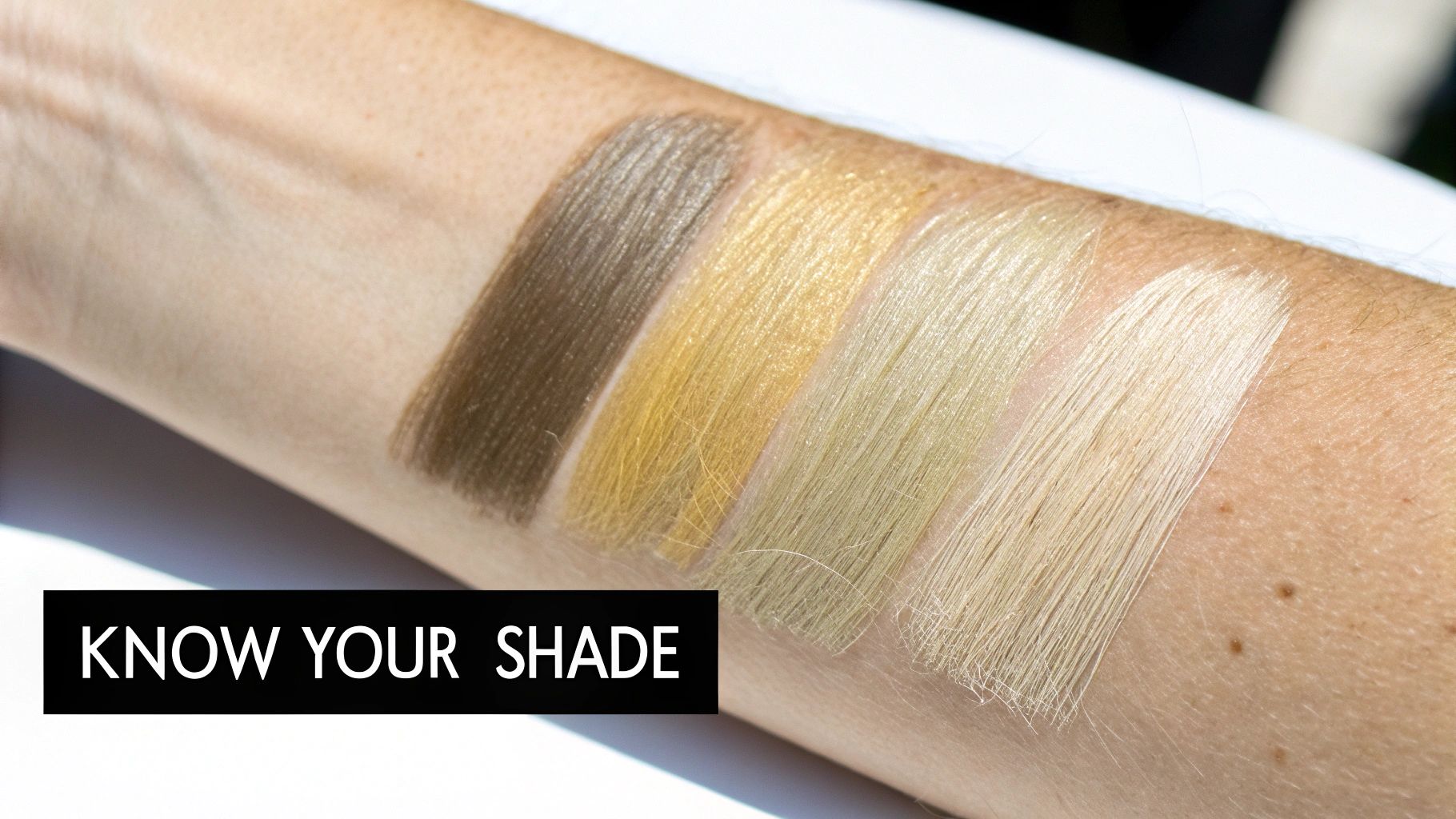
To get why laser hair removal on blonde hair can be a bit tricky, we first need to look at how the technology actually works. Think of the laser as a smart, heat-seeking device. Its entire mission is to find one thing in your skin: melanin, which is the pigment that gives hair its dark color.
When the laser sends out a pulse of light, that energy travels down the hair shaft right to the follicle. The dark melanin in the hair soaks up this light, instantly converting it into heat. This controlled burst of heat is what disables the hair follicle, stopping it from growing new hair.
This whole process is incredibly effective when there's a big contrast between dark hair and lighter skin. Dark hair is packed with melanin, making it an easy-to-spot target for the laser. It basically creates a perfect roadmap for the energy to travel down and zap the follicle.
The Melanin Challenge with Blonde Hair
Blonde hair, by definition, has way less melanin. This is the core of the problem. Without much pigment, the laser has a much harder time "seeing" the hair, which makes it tough to deliver enough heat to the follicle.
Without enough melanin to absorb the laser's light, the follicle simply won't get hot enough to be disabled. It's like trying to start a fire with a magnifying glass on a cloudy day—without a strong, focused beam, you just can't generate the heat you need.
This is exactly why the answer to "does laser work on blonde hair?" isn't a simple yes or no. In the past, the low pigment levels in blonde hair often led to disappointing results. Initial treatments might only show a 10-25% reduction in hair growth after one session, which is a far cry from what we see with darker hair. It’s a reality that really highlights why using the right, advanced technology is so critical for getting the job done.
The Role of Contrast and Technology
The effectiveness of any laser hair removal treatment boils down to two key factors working in sync:
Pigment in the Hair: The hair needs enough melanin to act as a chromophore—the molecule that actually absorbs the light energy.
Contrast with Skin: There has to be a clear difference between the color of the hair and the color of the skin around it.
This is why someone with dark hair and fair skin has always been the textbook "ideal candidate." The laser can easily pick out its target without risking any impact on the surrounding skin. For a deeper look at the mechanics, check out our guide to the science and process of laser hair removal. When we're treating blonde hair, technicians have to use sophisticated lasers that are sensitive enough to work on low-melanin targets while keeping the skin completely safe.
What Makes You a Good Candidate for Treatment
So, we know melanin is the key. But beyond the basic science, a few specific factors really determine whether your blonde hair is a strong contender for laser hair removal. Not all blonde hair is created equal, and figuring out where you land on the spectrum is the first step to setting realistic expectations.
Think of it this way: the laser needs a clear "signal" to find its target. The stronger that signal, the more effective the treatment. A combination of your unique hair and skin traits works together to either amplify that signal or turn down the volume.
The Shade and Thickness of Your Hair
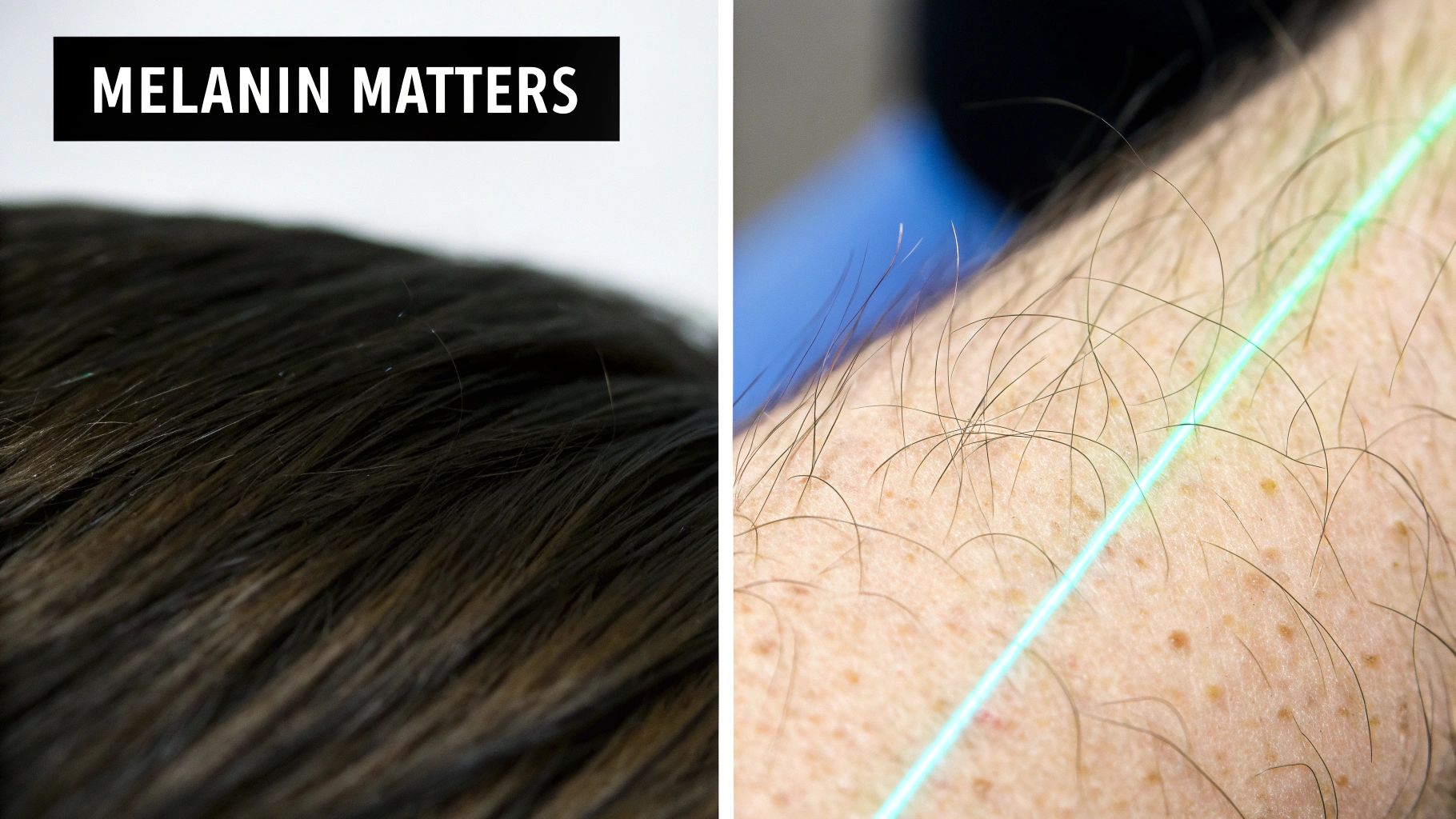
First and foremost is the exact shade of your blonde hair. A darker, "dirty blonde" shade has a lot more pigment down at the root than a light, platinum blonde. That extra pigment is exactly what the laser's energy needs to lock onto.
Hair thickness also plays a huge part. Coarser, thicker hair provides a more substantial target for the laser beam. A thick, dark blonde strand is much easier for the laser to "see" and treat effectively compared to fine, wispy "peach fuzz," even if they're technically the same color.
Let's break it down with a couple of real-world scenarios:
Scenario A (Good Candidate): Someone with coarse, dark blonde underarm hair. The mix of thickness and available pigment makes this an excellent target for the laser.
Scenario B (Poor Candidate): Someone with very fine, light blonde hair on their upper lip. With very little pigment and a flimsy structure, the laser will struggle to get a good result.
The goal is to find hair that has just enough pigment and substance for the laser to effectively heat and disable the follicle. This is why a professional assessment is so important—a trained technician can evaluate these nuances up close.
Skin Tone and Contrast
The classic ideal for laser hair removal has always been high contrast: dark hair on fair skin. This clean difference allows the laser to easily distinguish between the hair follicle and the surrounding skin, keeping the skin safe.
For blondes, this principle still holds true, though the contrast is naturally much lower. If you have blonde hair and fair skin, a skilled technician can adjust advanced lasers to target that subtle pigment without affecting your skin.
The challenge ramps up if you have blonde hair on a darker or tanned skin tone. With less contrast, there's a higher risk of the laser's energy being absorbed by the melanin in your skin instead of the hair.
This is where technology like the Splendor X becomes a game-changer. Its dual-wavelength system can be precisely calibrated for different skin and hair combinations, making treatment safer and more effective even in these tricky, low-contrast situations.
Ultimately, your candidacy is a unique mix of all these factors. During a professional consultation, a technician will analyze your specific hair and skin to give you a realistic forecast of your results, so you can move forward with confidence.
How Modern Lasers Are Solving the Blonde Hair Problem
For years, if you had blonde hair, effective laser hair removal just wasn't in the cards. Early lasers were pretty simple—they needed a dark, obvious target to work. But that’s no longer the whole story. Thanks to some serious tech upgrades, today’s laser systems are much smarter and built to handle the low-melanin challenge.
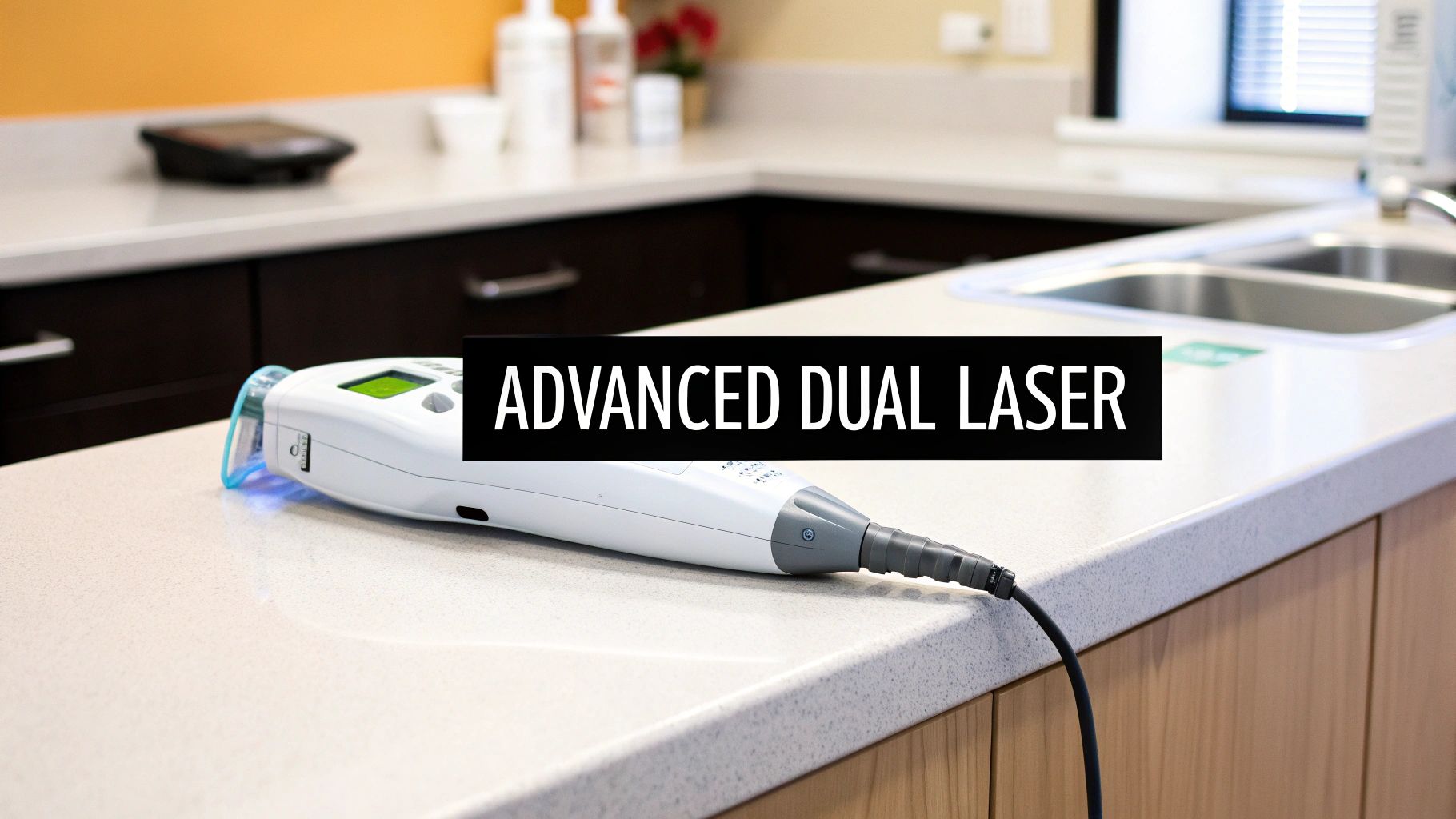
The real game-changer has been the development of dual-wavelength lasers. Instead of shooting a single beam of light and hoping for the best, these advanced systems combine two different types of laser energy in one pulse.
Think of it like trying to find something in a dark room with both a regular flashlight and a blacklight. Each one picks up on things the other can't see alone. By using both at once, you get a much clearer picture. That's exactly how these lasers work on lighter hair follicles that older tech would have completely missed.
The Power of Two Wavelengths
This new approach is all about combining two specific laser wavelengths, each with its own special job:
The Alexandrite (755nm) Laser: This one is a master at finding melanin near the skin's surface. It’s the “flashlight” in our analogy, quickly spotting any pigment it can find in the upper part of the hair follicle.
The Nd:YAG (1064nm) Laser: This wavelength goes deeper. It's our “blacklight,” able to reach the very base of the follicle and its blood supply, even when there isn't much melanin to light the way.
By firing both wavelengths at the same time, systems like the Splendor X launch a comprehensive attack on the follicle. This multi-pronged approach ensures the follicle gets hit from different angles and depths, which dramatically increases the chances of delivering enough heat to disable it for good, even with minimal pigment. Our guide on the Splendor X laser offers a deeper dive into how this technology is adapted for all skin and hair types.
This combined energy approach is the single most important factor in improving outcomes for blonde hair. It allows technicians to be more aggressive in targeting follicles while maintaining an exceptional safety profile for the surrounding skin.
Thanks to these advancements, the answer to "does laser work on blonde hair" is now much more optimistic. While platinum blonde is still tricky, peer-reviewed studies confirm that combining Alexandrite and Nd:YAG wavelengths gets the job done. For the right candidates (like those with darker or "dirty" blonde hair), we can now achieve a 70-90% long-term hair reduction after a full series of treatments—a result that was once considered impossible. You can discover more insights about these findings on Raleigh Laser & Aesthetics. This progress makes a professional consultation more important than ever to see if your specific hair type is a match.
What to Realistically Expect from Your Laser Journey
Let's be upfront: treating blonde hair with a laser is a journey, not a magic trick. It's a completely different ballgame than treating dark hair, and having the right mindset from the start is crucial for a great experience. Patience is your best friend here.
The biggest difference you’ll notice is the number of sessions required. While someone with dark, coarse hair might be thrilled with their results after 6 to 8 treatments, blonde hair often needs more—typically between 8 and 12 sessions. Because there’s less melanin for the laser to target, each session is a little less dramatic. We need more passes over time to effectively weaken those lighter follicles.
Defining Success: Think Hair Reduction, Not Total Removal
It's also super important to understand what "success" really means in the laser world. Any clinic worth its salt will tell you the goal is significant, long-term hair reduction, not 100% permanent removal. No laser on the market can promise you'll never see another hair again. That's just not how it works.
The real goal is to damage the follicles so that any hair that does manage to grow back is a shadow of its former self. We're talking dramatically finer, lighter, and way less noticeable. This gets you to that amazing place of having incredibly smooth skin that requires almost zero thought, freeing you from the daily grind of shaving. You can learn more about how effective laser hair removal can be for achieving permanent results in our detailed guide.
What the Numbers Say About Blonde Hair
In the past, most clinics would turn away clients with blonde hair, plain and simple. The technology just wasn't there. But modern advancements have completely changed the conversation, making great results achievable for many.
For the right candidates, a 50-70% reduction in blonde hair is a very realistic outcome, especially on larger areas like the legs or arms. Even on tougher, lighter hair types, studies and clinical results show that a full series of treatments can lead to a long-term reduction of up to 40-60%.
The takeaway is clear: while it demands commitment, the journey is often worth it. The goal is to achieve a state of smooth, manageable skin where hair is no longer a daily concern.
This practical mindset helps frame the commitment involved. At NYC Laser Hair Removal, our treatment packages are built to deliver these results over time, giving you a clear and effective path to the smooth skin you're after.
Finding the Right Laser Hair Removal Clinic
Armed with the right knowledge, your final step is finding a trusted provider to turn your goals into reality. When you have blonde hair, choosing the right clinic isn't just important—it's everything.
The expertise of the technicians and the quality of their technology will directly determine your results. A great clinic bridges the gap between science and real-world smoothness.
Your journey should always kick off with a thorough consultation. This initial meeting is where a skilled technician will assess your specific hair color, hair thickness, and skin tone to give you an honest evaluation. It's your opportunity to ask critical questions about their experience with lighter hair and see the actual lasers they use.
The Non-Negotiable Patch Test
For anyone wondering does laser work on blonde hair, the patch test is the definitive first answer. Any reputable clinic will insist on performing a small test on the intended treatment area.
This crucial step accomplishes two key things:
It confirms your hair's response. We can see exactly how your follicles react to the laser energy in real-time.
It guarantees your skin's safety. It allows the technician to fine-tune the settings for optimal results without compromising your skin.
Think of the consultation and patch test as your personalized roadmap. It removes all guesswork, ensuring that if you move forward, you do so with a clear, safe, and effective plan tailored specifically to you.
At NYC Laser Hair Removal, our certified technicians create a personalized treatment plan from your very first visit. We prioritize transparency and safety, making sure you understand every step of the process. This commitment to personalized care ensures you can begin your journey with total confidence, knowing you're in expert hands.
We focus on connecting you with a team that has both the technology and the skill to deliver the smooth skin you're looking for.
Common Questions About Laser for Blonde Hair
Even after understanding the science, it’s natural to have a few more questions. We’ve rounded up the most common concerns we hear from clients to give you clear, straightforward answers. Our goal is to make sure you feel completely confident about your next steps.
Is Laser More Painful for Blonde Hair?
Not really. While a technician might use a slightly higher energy setting to get the laser's attention on a low-pigment follicle, your comfort is always the priority. Modern lasers like the Splendor X are built with powerful, integrated cooling systems that keep your skin feeling comfortable the entire time.
Most of our clients say the sensation is like a quick snap from a rubber band—definitely tolerable.
What Happens if the Laser Doesn’t Work on My Hair?
If your hair is truly platinum blonde, white, or gray, it just doesn't have the pigment needed for the laser to see it. This is exactly why a professional consultation and a patch test are non-negotiable first steps. An honest clinic will be upfront and tell you if you aren't a good candidate.
For hair with zero pigment, electrolysis is the only FDA-approved method for permanent hair removal. It works by sending an electric current directly into the follicle, bypassing the need for pigment entirely. It works on everyone.
Could Laser Make My Blonde Hair Grow Back Darker?
This is a persistent myth, but it's incredibly rare. The entire point of laser hair removal is to damage the hair follicle, so any hair that does grow back comes in much finer, softer, and lighter. The phenomenon you might have heard of—paradoxical hypertrichosis, or stimulated growth—is a very infrequent side effect and isn't specific to blonde hair.
How Do I Get Ready for My First Session?
Good preparation is key to getting the best results and keeping your skin safe. Following these rules helps the laser do its job effectively:
Avoid the Sun: For at least four weeks before your appointment, stay out of the sun and skip the tanning beds or self-tanners. The more contrast between your skin and hair, the better.
Don't Touch the Root: The laser needs the hair root to be present in the follicle. That means no waxing, plucking, or using depilatory creams in the area for four weeks beforehand.
Shave the Area: Simply shave the treatment area 24 hours before you come in. This ensures the laser’s energy goes straight to the follicle instead of getting wasted on the hair above the skin.
We’ll give you a complete list of pre-care instructions during your consultation, so you’ll know exactly what to do.
Ready to see if advanced laser technology can work for you? At NYC Laser Hair Removal, our experts use the state-of-the-art Splendor X system to create personalized treatment plans for every client. Book your complimentary consultation today and take the first step toward beautifully smooth skin.
Comments