
What Is the Hair Growth Cycle and How It Affects Your Laser Treatment
Ever wondered how your hair just knows when to grow, when to rest, and when to fall out? It’s all part of the hair growth cycle, a quiet, continuous rhythm happening just beneath the surface of your skin. Understanding this natural process is the key to getting the most out of your laser hair removal treatments and achieving that permanently smooth skin you’re after.
Understanding Your Hair’s Natural Rhythm
Think of your skin like a sprawling garden where every single hair follicle is a plant. Not all plants bloom at the same time. Some are actively growing, some are dormant, and others are getting ready to shed their leaves to make way for new life. That’s exactly what’s happening with your hair, right now, all over your body.
This ongoing, out-of-sync process is what we call the hair growth cycle. Each individual hair follicle runs on its own unique timeline, cycling through distinct phases of growth, transition, and rest. It’s the reason you don’t lose all your hair at once—thankfully!
At any given moment, different hairs are in different stages. This is the single most important concept in laser hair removal. To work effectively, the laser has to catch the hair at a very specific point in its lifecycle to permanently disable the follicle.
The Three Core Phases
The whole process boils down to three main stages that define a hair’s life from beginning to end. Getting a handle on these phases makes it crystal clear why laser hair removal isn’t a one-and-done deal and requires a series of sessions.
Anagen (The Growth Phase): This is the main event. The hair is actively growing and is physically connected to its root (the dermal papilla), which acts like a pipeline for blood and nutrients.
Catagen (The Transition Phase): A very short pit stop where the hair detaches from that blood supply and growth comes to a halt.
Telogen (The Resting Phase): The final stage. The hair is just hanging out, inactive in the follicle, before it eventually sheds and a new hair begins to form.
The key takeaway is simple: Laser hair removal is only effective when the hair is in the active Anagen phase. This is because the laser needs that direct connection to the follicle's root to deliver its energy and stop future growth.
Timing your treatments to catch as many hairs as possible in this "golden window" is what separates a successful hair removal journey from a frustrating one.
The Three Key Phases of Hair Growth
To really get what the hair growth cycle is all about, we have to look at the tiny drama happening inside every single hair follicle. Think of it like a three-act play that each hair goes through. Understanding these stages is the key to seeing why laser hair removal is all about strategic timing, not just a one-and-done zap.
This diagram shows the journey each follicle takes, from actively growing to eventually shedding.
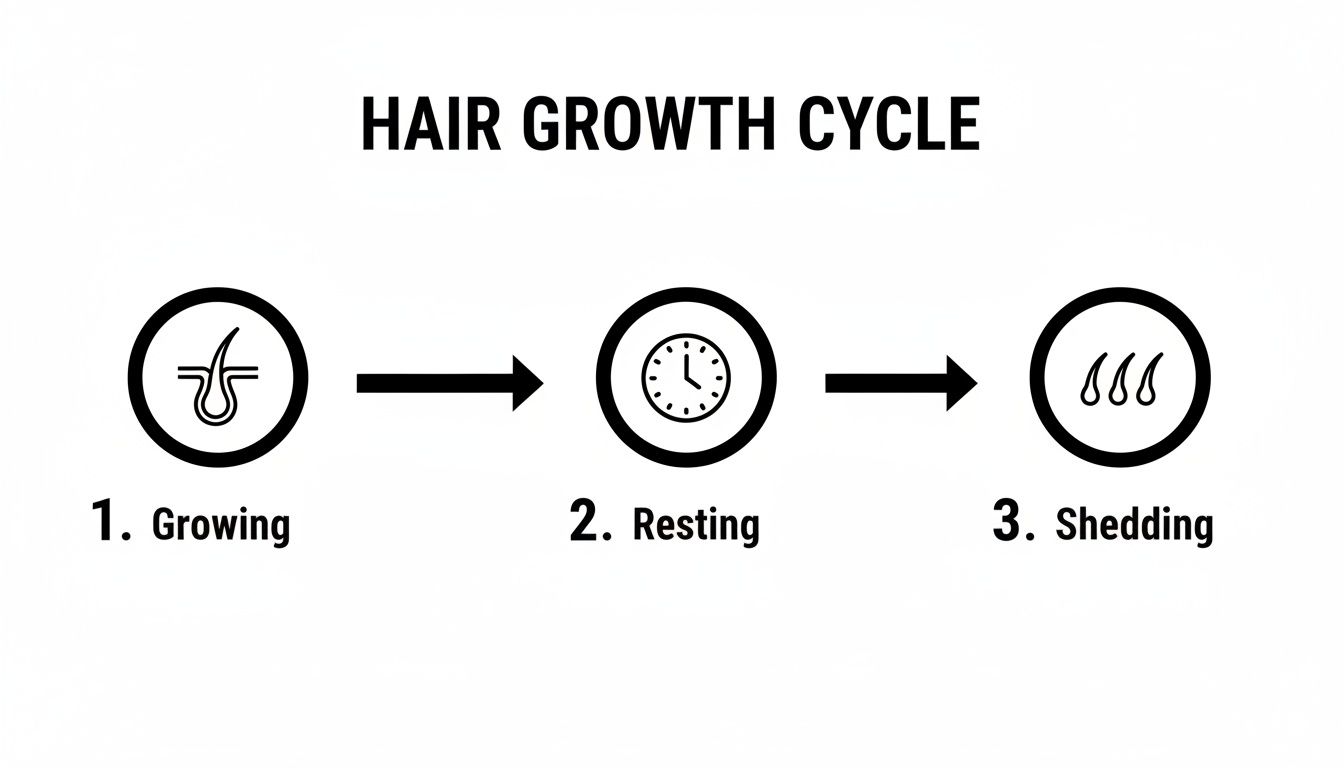
It’s a great visual for a simple reason: while one hair is growing, its neighbor could be resting or getting ready to fall out. This is exactly why we have to space out your treatments.
Anagen The Active Growth Phase
First up is the Anagen phase. This is the powerhouse of the cycle, the “on” switch where the follicle is busy building a new hair and pushing it up to the surface. Most importantly, it's connected to its blood supply (the dermal papilla), which feeds it all the nutrients it needs to grow. For laser hair removal, this is our golden window of opportunity.
At any given moment, an impressive 85% to 90% of the hairs on your scalp are in this productive stage. But here's the catch: the Anagen phase length varies wildly depending on the body part. On your head, it can last for years. For body hair on your legs or underarms, it’s much shorter—often just a few months. This is a crucial detail that explains why treatment schedules are different for different areas. For a deeper dive into the biology, check out this in-depth overview on hair growth timelines.
Catagen The Brief Transition Phase
After that growth spurt, the hair enters the Catagen phase. This is a short but vital transition where the follicle starts preparing for a break. Over just a few weeks, the hair follicle shrinks and—this is the important part—detaches from its nutrient source.
Once that connection is severed, the pathway for the laser’s energy to reach and destroy the follicle is gone. It's a very brief stage, with only about 1-2% of your hairs in this phase at any one time.
Telogen The Final Resting Phase
Finally, we hit the Telogen phase, or the resting stage. The hair has stopped growing and is now just hanging out, dormant in the follicle, waiting for its cue to shed. This resting period can last for several months.
Eventually, the cycle kicks off again. A new Anagen hair starts growing beneath the old one, pushing it out and causing it to shed naturally. Right now, about 10-15% of your body hair is in this Telogen phase. Since these hairs are completely detached and inactive, they are also impossible to treat with a laser.
To make this easier to remember, here's a quick cheat sheet summarizing all three phases.
The Hair Growth Cycle at a Glance
Phase | What Is Happening? | Typical Duration | Percentage of Hair |
|---|---|---|---|
Anagen | The hair is actively growing and connected to its blood supply. This is the ideal phase for laser treatment. | 2–6 years (scalp); 3–4 months (body) | 85-90% |
Catagen | The hair follicle shrinks and detaches from its nutrient source. Laser is ineffective here. | 2–3 weeks | 1-2% |
Telogen | The hair is dormant and "resting" before it eventually sheds. Laser is ineffective here, too. | 2–4 months | 10-15% |
This table clearly shows why timing is everything. We are always aiming to catch as many hairs as possible in that active Anagen phase.
The Big Picture: Your hair follicles are never all on the same schedule. While some are actively growing (Anagen), many others are transitioning (Catagen) or resting (Telogen). This is precisely why a single laser session can't give you the results you want and why a series of treatments is necessary to catch each follicle in its prime.
Why Anagen Is the Golden Window for Laser Hair Removal
Knowing the science behind hair growth is one thing, but using it to our advantage is where the magic of laser hair removal really happens. The entire strategy boils down to targeting hair during one very specific time: the Anagen phase, its active growth stage. This isn’t just a helpful tip—it's the only way the treatment works.
Think of it like this: a plant can only drink water if its roots are firmly connected to the soil. The Anagen phase is the only time your hair is physically “plugged in” to its root—the dermal papilla—giving it a direct line to the blood supply that fuels its growth.
The Laser's Direct Pathway to the Follicle
Laser hair removal sends a concentrated beam of light down the hair shaft into the follicle. The pigment (melanin) in your hair soaks up that light energy, instantly converting it to heat. This targeted heat is what damages the follicle and stops it from making more hair.
For this to work, the laser needs a clear, uninterrupted path from the visible hair all the way down to the root.
During Anagen: The hair is firmly attached to the follicle’s base. This creates a perfect pathway for the laser’s energy to travel directly to its target, effectively shutting down the hair-producing machinery.
During Catagen and Telogen: The hair has already detached from that vital connection. It’s like trying to water a plant that’s been pulled from the ground; the pathway is broken.
Trying to laser a hair in the Catagen or Telogen phase is completely pointless. The heat just fizzles out without ever reaching the follicle’s growth center, so that specific hair will just keep growing back later.
Why Timing and Technology Are Everything
This is exactly why a single laser session can't give you perfectly smooth skin. On any given day, only about 10-20% of your body hair is in that ideal Anagen phase. The rest is either transitioning or resting, making it totally immune to the laser—for now.
The goal of a multi-session treatment plan is to systematically catch different groups of hair as they enter their Anagen window. Each session targets a new "crop" of active follicles, gradually reducing overall hair density over time.
This is where the science behind advanced systems like the Splendor X laser really makes a difference. Its precise energy delivery allows our technicians to effectively target only the hairs that are in the correct growth stage. If you want to dive deeper into the tech, check out our guide on how laser hair removal works and the science behind the process.
The success of your entire journey is built on this simple principle. It’s not about blasting the skin with a more powerful laser; it’s about applying the right technology at exactly the right time, syncing each treatment with your body's natural cycle.
How the Hair Cycle Dictates Your Treatment Schedule
So, we’ve established that only hair in the active Anagen phase can be treated. This single biological fact is the reason laser hair removal isn’t a one-and-done deal. At any given moment, only about 10-20% of your hair is actually in this perfect stage. So, how do we get to the rest? The secret isn’t more power—it’s perfect timing.

Our entire strategy is built around systematically catching new waves of hair as they enter their growth phase. Think of it like a stadium full of people doing "the wave"—not everyone stands up at once. Your treatment schedule is designed to target each new section as it pops up.
The Logic Behind Spaced-Out Sessions
This is why we schedule appointments 4 to 8 weeks apart. That interval isn’t a random guess; it’s a strategic window calculated to align with your body’s natural hair growth rhythm.
When you come back for your next session, a brand-new group of follicles that were previously dormant has woken up and entered the Anagen phase. Now, they’re vulnerable to the laser.
This methodical approach ensures that over a series of treatments, we can target the maximum number of follicles possible. Each appointment builds on the last, progressively thinning out the hair until you achieve that lasting smoothness.
If you wait too long between appointments, you miss the window for a whole group of hairs. Come in too soon, and there won’t be enough new, active follicles to make the session worthwhile. Consistency is everything.
Why Your Schedule Is Personalized
The hair growth cycle also explains why the ideal timing between sessions is different for various parts of the body. Hair on your face, for instance, grows and cycles much faster than the hair on your legs.
Here’s a general idea of how we tailor your schedule:
Facial Areas (like the upper lip or chin): These hairs have a much shorter growth cycle. We typically schedule treatments closer together, usually every 4 to 6 weeks, to keep up.
Body Areas (like legs, back, or bikini line): The cycle is longer here, so we can space treatments further apart—generally every 6 to 8 weeks.
Your technician will map out a personalized plan based on the area you're treating, your unique hair patterns, and how your skin is responding. Following this custom schedule is the single most important factor in reaching your goals. For a deeper dive into what your timeline might look like, our guide on how often to schedule laser hair removal sessions breaks it down even further.
What Factors Can Influence Your Hair Growth?
Your hair growth cycle isn’t a fixed blueprint—it’s a dynamic process that listens to your body’s unique cues. Think of it less like a rigid schedule and more like a sensitive ecosystem. A whole host of internal and external factors can speed it up, slow it down, or even interrupt its natural rhythm.
Understanding these influences is key to setting realistic expectations for your laser hair removal journey. It explains why your timeline might look different from a friend's and why consistency is so important for getting that smooth, lasting result.
The Role of Hormones and Age
Hormones are the ultimate messengers in your body, and they have a major say in how your hair behaves. Big life events like puberty, pregnancy, or menopause trigger hormonal shifts that can completely change the game for your hair growth. A surge in androgens (male hormones that everyone has) can activate new, unwanted hair or even shorten the Anagen phase for the hair on your head.
Age is another huge player. As we get older, the Anagen (growth) phase naturally gets shorter. This means hair might not grow as long as it used to, and some follicles may eventually stop producing hair altogether, leading to natural thinning over time.
Your Hair’s Genetic Blueprint
At the end of the day, your DNA lays the groundwork for your entire hair growth story. Your genes are what determine core traits like:
Hair Density: How many follicles are packed into each square inch of skin.
Anagen Phase Length: This dictates how long your hair can actually grow before it sheds.
Hair Color and Thickness: These traits directly impact how well the laser can "see" and target the melanin in your hair.
This genetic lottery is exactly why some people naturally have thicker, faster-growing hair and might need a few more sessions to see their final results compared to someone with finer, sparser hair.
Lifestyle Factors That Make a Difference
Beyond biology, your daily habits play a surprisingly big role. Your diet is a huge one. Hair is made primarily of protein, so if you're not getting enough of it—or other key nutrients like iron, zinc, and biotin—your follicles won't have the fuel they need to thrive.
Chronic stress is another major disruptor. When you're constantly stressed, your body produces more cortisol, which can prematurely shove a large number of hair follicles from the Anagen (growth) phase straight into the Telogen (resting) phase. This can lead to noticeable shedding, a condition known as telogen effluvium.
This is why a cookie-cutter approach to laser hair removal just doesn’t work. A great technician looks at all these variables to build a treatment plan that’s tailored to you, adjusting the schedule and expectations to work with your body’s unique rhythm, not against it.
Putting It All Together: Making Your Laser Hair Removal a Success
Understanding your hair growth cycle is the first step, but how you prep for your sessions is what locks in those incredible results. To make every treatment as effective as possible, you need to work with your body’s natural rhythm, not against it. Think of it as setting the stage for the laser to do its best work.
The single most important rule is to shave the treatment area 24-48 hours before your appointment. This trims the hair down so it's just beneath the skin's surface—the perfect length for the laser. It ensures all that powerful energy goes straight to the follicle instead of getting wasted on the hair above the skin.
What to Stop Doing Before Your Session
Just as important is what not to do. For the laser to work, the hair root needs to be in the follicle. That means you have to avoid any hair removal methods that pull the hair out completely.
No Waxing or Sugaring: These methods rip the entire hair out, leaving an empty follicle that the laser can't target.
No Plucking or Tweezing: Just like waxing, this removes the hair and its bulb, making the treatment for that specific hair useless.
No Depilatory Creams: While they don't pull hair out, these creams can irritate the skin and make it way too sensitive for a laser treatment.
Following these simple rules is your secret weapon. It ensures that when you walk into your appointment, the maximum number of hairs are in that precious Anagen phase and ready to be zapped for good. It’s how you get the most value out of every single session.
How well you prepare directly impacts your results and even how many sessions you'll end up needing. To get the full picture, check out our guide on how many laser hair removal sessions you will actually need.
Your Top Questions About Hair Growth and Laser Removal
Let's clear up a few of the most common questions we hear about the hair growth cycle and how it connects to your laser treatments. Getting the facts straight is the first step toward feeling confident and understanding the science behind your smooth-skin journey.
Can I Make My Hair Grow Faster to Speed Up the Process?
It’s a great question, but the short answer is no. Your hair growth cycle is biologically programmed and runs on its own internal clock—it can’t be sped up.
The best strategy for seeing faster, more effective results is simply to stick to the treatment schedule your specialist creates for you. This ensures we're always targeting hair as it naturally cycles into that active Anagen phase, making every single session count.
If the Laser Is So Effective, Why Do I Need So Many Sessions?
This comes down entirely to the hair growth cycle. At any given moment, only about 10-20% of your hair is in the Anagen phase, which is the only time the follicle is connected to its root and vulnerable to the laser.
Each session zaps the hairs that are active right then. Your future appointments are strategically timed to catch the next wave of follicles as they wake up and enter that same critical growth window.
The bottom line is that consistency is everything. Following your recommended schedule allows us to methodically treat nearly every follicle over time, which is how we achieve that comprehensive, long-lasting reduction you're looking for.
Ready to start your journey to smoother skin? Trust the experts at NYCLASER to create a personalized treatment plan that works with your unique hair growth cycle. Book your consultation today
Comments