
Laser Hair Removal Hyperpigmentation A Guide to Safe Treatment
Let's get one of the biggest worries out of the way: yes, laser hair removal can sometimes cause the skin to darken in treated areas. This is called post-inflammatory hyperpigmentation (PIH), but the key thing to know is that it is almost always preventable when you have the right technology and an experienced technician on your side.
So, what’s really going on when this happens? Let's break it down.
What Causes Hyperpigmentation From Laser Hair Removal
The core issue comes down to how a laser interacts with melanin, the natural pigment that gives your hair and skin its color. When you understand this relationship, it’s easy to see why modern lasers are so much safer and more effective than their predecessors.
Think of PIH as your skin’s overprotective security system. It's the same reason a dark spot can linger after a bad pimple finally heals. When your skin senses any kind of trauma or inflammation—like a burn or a cut—it panics and floods the area with extra melanin to shield and repair it. This defensive rush is what creates that temporary discoloration.
The Role of Laser Energy and Melanin
A laser zaps unwanted hair by sending a highly focused beam of light to find and heat the dark melanin inside the hair follicle. That heat is what disables the follicle, stopping it from growing new hair. Simple enough, right?
The catch is, if the laser is outdated or isn't calibrated perfectly for your unique skin tone, it can struggle to tell the difference between the melanin in your hair and the melanin in your skin.
When that confusion happens, the laser can accidentally heat the surrounding skin. Your skin perceives this "energy spill" as an injury and immediately kicks its defense system into gear. The result? An overproduction of melanin that shows up as the very dark spots you were trying to avoid.
The risk of hyperpigmentation isn't about the laser treatment itself. It's about a mismatch between the laser technology, the settings being used, and your specific skin type.
Why Skin Tone Is a Critical Factor
Historically, this has been a huge concern, especially for anyone with a deeper skin tone. Laser hair removal has been a top aesthetic treatment for years—it was already the third most popular non-surgical procedure in the U.S. back in 2016. But early lasers just weren't built for Fitzpatrick skin types IV, V, and VI.
The high concentration of melanin in darker skin tones acts like a magnet for laser energy, which dramatically increased the risk of burns and PIH with older devices. In fact, some studies show that PIH can affect up to 87% of people of color after some type of skin trauma, and a poorly executed laser treatment can easily become that trigger. You can dig into the market trends and data yourself over at Market Data Forecast.
To help you quickly grasp the key risk factors, here's a simple breakdown:
Hyperpigmentation Risk Quick Facts
Concern | Explanation | Key Takeaway |
|---|---|---|
Outdated Technology | Older lasers (like IPL or Ruby) use a single wavelength that can't easily distinguish between skin and hair pigment. | Modern, dual-wavelength lasers are essential for safety. |
Incorrect Settings | If the energy level is too high for your skin type, it can overheat the epidermis, triggering PIH. | Your technician's expertise is just as important as the machine. |
Sun Exposure | Tanned skin has more active melanin, making it harder for the laser to isolate the hair follicle. | Avoid sun exposure for at least two weeks before and after your session. |
Skin Trauma | Waxing, harsh scrubs, or certain medications can make your skin more sensitive and reactive. | Follow pre-care instructions carefully to keep your skin calm. |
Understanding these points makes it clear why choosing the right clinic is a non-negotiable part of the process.
This is exactly why we invested in the Splendor X system at NYC Laser Hair Removal. It was engineered with advanced dual-wavelength technology specifically to solve this problem, allowing us to safely and effectively treat every single skin tone without compromise.
How Lasers Interact with Different Skin Tones
To get why laser hair removal hyperpigmentation happens, you need to understand how the laser "sees" your hair and skin. Think of the laser as a heat-seeking device with a very specific mission: find and neutralize the dark pigment, or melanin, that’s packed into each hair follicle.
When the laser fires, it sends a focused beam of light into the skin. This light is instantly absorbed by the melanin in the hair, where it converts to heat. That heat travels right down the hair shaft to the follicle, damaging it just enough to stop future hair growth. For someone with lighter skin and dark hair, it’s a simple mission with a crystal-clear target.
The Challenge of Melanin-Rich Skin
But the game changes completely with darker skin tones. For anyone with melanin-rich skin, the laser's "target" is suddenly everywhere. There’s a high concentration of melanin in the hair, but there's also a significant amount in the surrounding skin.
This is where older or poorly calibrated lasers run into trouble. Instead of zeroing in on just the hair follicle, their energy gets scattered and absorbed by the skin itself. That unintended energy absorption is what kicks the skin's inflammatory response into high gear, causing it to overproduce melanin and create those unwanted dark spots.
This flowchart breaks down the basic chain reaction that leads to discoloration when the laser’s energy isn’t perfectly controlled.
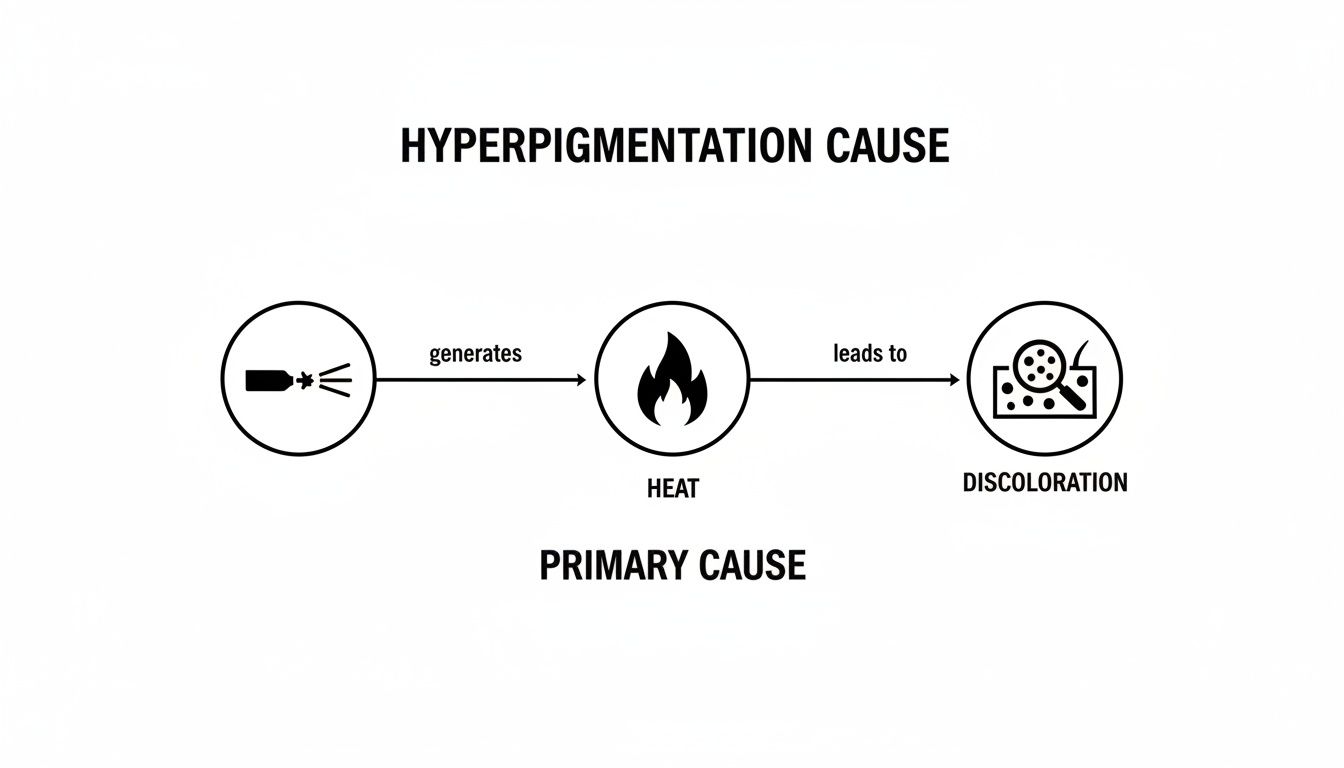
As you can see, the root of the problem is excess laser heat hitting the skin, not the hair follicle.
Understanding the Fitzpatrick Scale
In the professional world, we use the Fitzpatrick scale to standardize how we talk about skin tone. It classifies skin into six types based on how much pigment it has and how it reacts to the sun.
Type I: Pale white skin, always burns, never tans.
Type II: White skin, burns easily, tans minimally.
Type III: White to olive skin, tans slowly, burns moderately.
Type IV: Light brown skin, tans easily, burns minimally.
Type V: Brown skin, tans easily, rarely burns.
Type VI: Dark brown to black skin, tans profusely, never burns.
For years, laser hair removal was considered safest for Types I-III simply because the contrast between their light skin and dark hair made targeting easy. But for skin types IV, V, and VI, you need a much smarter, more sophisticated laser—one that can bypass the melanin in the skin. A one-size-fits-all approach isn’t just ineffective for these skin tones; it’s dangerous.
This is exactly why post-inflammatory hyperpigmentation is such a big deal. A 2020 study on diode lasers found a 24.1% incidence of PIH, but the numbers told an even clearer story: the side effect was completely absent in White participants but common among Black and Mixed-race individuals.
The solution is all in the technology. We now have modern lasers, especially those with longer wavelengths like the Nd:YAG, that are specifically built for this job. They penetrate deeper into the skin to reach the follicle directly, without scattering a ton of heat into the top layer of skin (the epidermis).
For anyone considering treatment, especially if you have a darker complexion, this is the most important thing to know. Our guide to laser hair removal for dark skin dives even deeper into how you can ensure a safe and effective experience. Knowing the right questions to ask and the right technology to look for empowers you to choose a clinic that puts your skin's health and safety first.
How to Prepare Your Skin for Safe Laser Treatment
The best laser hair removal results—the kind that leave your skin clear, smooth, and even-toned—actually start weeks before you even step into our Westbury clinic. Think of it like priming a canvas before painting. Proper skin prep is everything, and it’s your number one defense against laser hair removal hyperpigmentation.
This process is a partnership between diligent pre-care and gentle post-care. Nailing both sets the stage for the laser to work its magic effectively, targeting the hair follicle without agitating the surrounding skin.
Pre-Treatment Preparation: The Non-Negotiables
Your pre-treatment routine is all about creating a calm, stable baseline. We want to eliminate any variables that could make your skin extra sensitive or reactive to the laser’s energy. The main goal here is to maximize the color contrast between your hair and your skin, giving the laser a clear, unmistakable target.
Here are the essential steps to take in the weeks leading up to your session:
Avoid All Forms of Tanning: This is the golden rule, and it's non-negotiable. Sun exposure, tanning beds, and even self-tanning lotions add melanin to your skin. When your skin is tan, the laser can get confused and struggle to tell the difference between skin pigment and hair pigment. This confusion is a direct trigger for hyperpigmentation. Plan on keeping the treatment area completely out of the sun for at least four weeks before your appointment.
Pause Certain Skincare Ingredients: Many of our favorite heavy-hitting skincare ingredients can increase photosensitivity, making your skin far more vulnerable to the laser. You'll need to stop using the following on the treatment area for about one week before your session: * Retinoids (like Retin-A, retinol, and tretinoin) * Alpha Hydroxy Acids (AHAs), such as glycolic acid * Beta Hydroxy Acids (BHAs), such as salicylic acid * Benzoyl peroxide
Stop Waxing and Plucking: The laser needs the hair follicle to be present to work. Methods like waxing, tweezing, or epilating pull the hair out from the root, leaving nothing for the laser to target. Shaving is the only approved hair removal method between sessions because it leaves the follicle perfectly intact right below the skin's surface.
Shave the Area: Be sure to shave the treatment area 24 hours before you come in. This clears hair from the surface—preventing the laser from singeing it and burning the skin—while leaving the follicle underneath as the ideal target.
Post-Treatment Care: Protecting Your Healing Skin
After your session, your skin enters a sensitive healing phase. The entire goal of post-care is to soothe inflammation and protect your skin from any potential trigger that could cause discoloration. Think of this as guarding your investment in smooth, clear skin.
Your technician will give you specific instructions, but these are the universal pillars of great post-treatment care:
Apply Calming Lotions: Use gentle, fragrance-free moisturizers or a soothing gel like aloe vera. This helps calm any redness or mild swelling right away, dialing down that initial inflammatory response.
Wear Broad-Spectrum SPF Religiously: Your skin is extra vulnerable to UV rays after treatment. Applying a broad-spectrum sunscreen of SPF 30 or higher every single day is crucial. This is your best defense against new hyperpigmentation forming.
Avoid Heat and Strenuous Activity: For the first 24-48 hours, steer clear of anything that raises your body temperature and could irritate the treated follicles. That means no hot tubs, saunas, steam rooms, or intense workouts.
Be Gentle with Your Skin: Don’t use harsh scrubs, exfoliants, or abrasive washcloths on the area for at least a week. Just let your skin heal peacefully.
To make it even clearer, here’s a simple checklist breaking down what to do before and after your laser appointment.
Pre-Care vs Post-Care Checklist for Hyperpigmentation Prevention
Action Item | Pre-Treatment (2-4 weeks prior) | Post-Treatment (First 2 weeks) |
|---|---|---|
Sun Exposure | Strictly avoid all sun, tanning beds, and self-tanners. | Apply SPF 30+ daily and keep the area covered from direct sun. |
Skincare Routine | Pause retinoids, AHAs, BHAs, and benzoyl peroxide 1 week prior. | Use gentle, soothing moisturizers like aloe vera. Avoid all exfoliants. |
Hair Removal | Stop waxing/plucking 4 weeks prior. Shave 24 hours before session. | Let hair shed naturally. Avoid tweezing stray hairs. Gentle exfoliation after day 3-5. |
Physical Activity | Normal routine is fine. | Avoid hot showers, saunas, and intense workouts for 24-48 hours. |
Clothing | Arrive with clean skin and loose, comfortable clothing. | Wear loose, breathable fabrics to prevent friction and irritation. |
Following this checklist helps create the perfect conditions for a successful treatment and a smooth, speedy recovery. It's a team effort between you and your technician.
Key Takeaway: Think of pre-care as setting the stage for success, and post-care as protecting your results. Both are equally vital for preventing hyperpigmentation and getting that flawless finish you're looking for.
The Splendor X Solution for All Skin Tones
When the biggest risk of laser hair removal hyperpigmentation boils down to a mismatch between technology and skin tone, the only real solution is a system that can adapt to everyone. At NYC Laser Hair Removal, we put our trust exclusively in the Splendor X, a device built from the ground up to treat every skin tone with incredible precision and safety. It’s a complete departure from the old, one-size-fits-all approach that left so many clients at risk.
Think of it like an artist painting a portrait. They wouldn’t just grab a single, generic color off the shelf. Instead, they’d expertly mix custom shades to perfectly match their subject’s unique skin tone. The Splendor X does exactly that, but with laser light, thanks to its groundbreaking BLEND X technology.
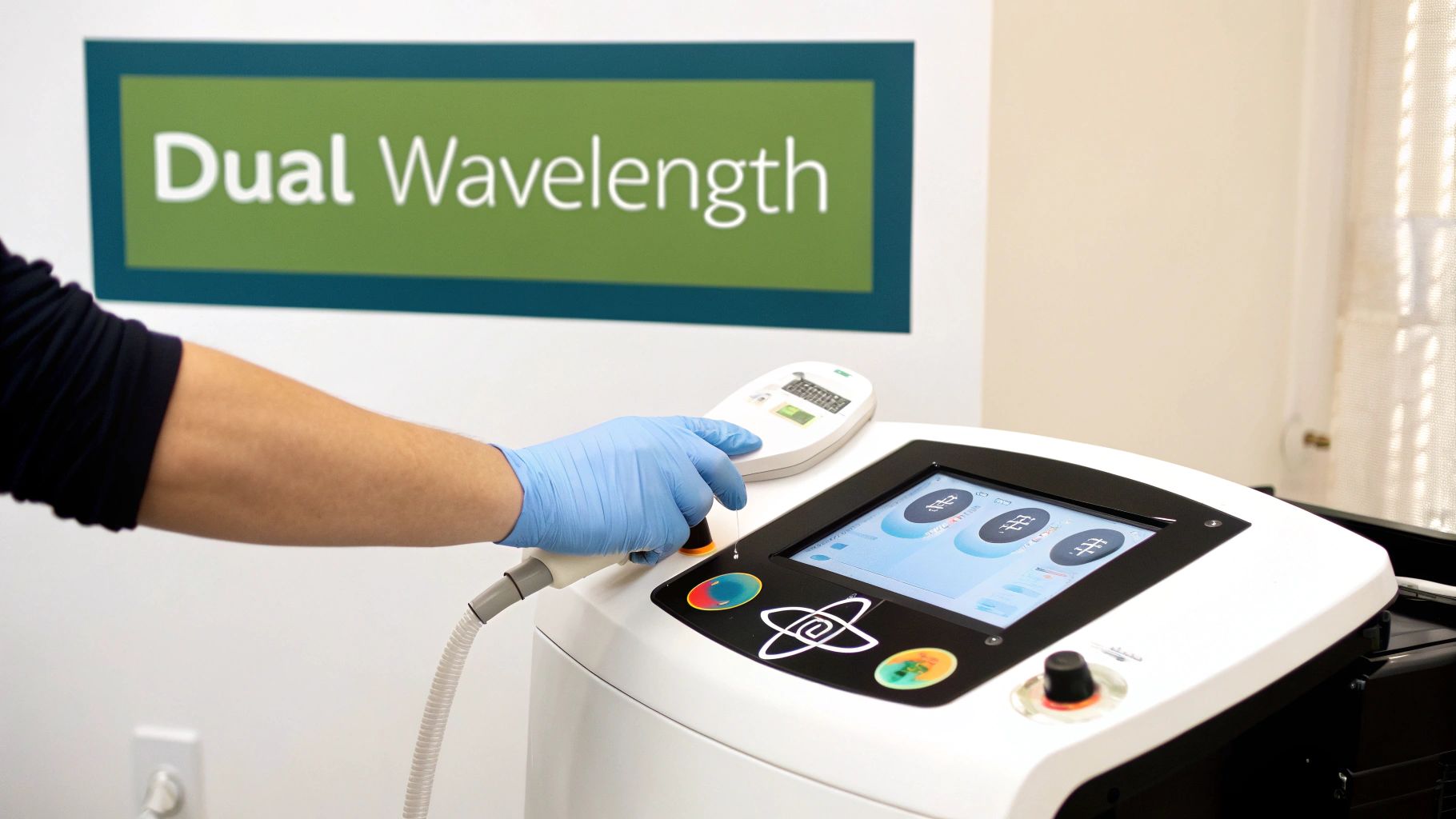
Combining the Best of Both Worlds
Older laser systems force a technician to choose between one of two wavelengths. This instantly creates a compromise, especially for clients with olive or mixed-heritage skin who don't fit neatly into one box. BLEND X technology gets rid of this limitation by firing two of the most effective laser wavelengths at the same time, in custom ratios.
Alexandrite (755nm): This has long been the gold standard for lighter skin tones (Fitzpatrick I-III). Its shorter wavelength is powerfully absorbed by melanin, making it a powerhouse for zapping dark hair on fair skin.
Nd:YAG (1064nm): This is the go-to wavelength for safely and effectively treating darker skin tones (Fitzpatrick IV-VI). Its longer wavelength bypasses the melanin in the top layer of skin and penetrates deeper to target the hair follicle directly. This is key to avoiding burns and hyperpigmentation.
By combining them, we create a personalized treatment beam for you in real time. This dual-action approach means we can aggressively target the hair follicle while intelligently leaving your surrounding skin pigment untouched and unharmed.
The Splendor X doesn't just treat different skin tones; it creates a custom-tailored treatment for your unique skin and hair combination during every single pulse. This level of personalization is the ultimate defense against post-inflammatory hyperpigmentation.
Prioritizing Safety and Comfort
Beyond its smart laser technology, the Splendor X was designed with client safety as its top priority. One of its most important features is the integrated Dual Cooling System (DCS). This system blasts a continuous jet of cold air right onto the skin's surface immediately before, during, and after each laser pulse.
This constant cooling provides two major benefits:
It keeps you comfortable. Most of our clients report way less discomfort compared to older laser devices that use less effective cooling methods.
It protects your skin. By keeping the epidermis cool, the DCS acts as a powerful safety measure. It minimizes thermal stress on the skin, which in turn dramatically reduces inflammation—the direct trigger for hyperpigmentation.
This combination of smart technology and protective features is why our Long Island clinic has become the premier destination for safe and effective treatments on any part of the body, from the upper lip to the full back. We believe everyone deserves to experience the benefits of laser hair removal without worrying about side effects.
A Faster, More Efficient Treatment
The Splendor X also features a unique square-shaped spot size—a detail that might sound small but makes a huge difference. Traditional round laser spots often lead to missed areas or too much overlapping, which can mean patchy results or unnecessary skin irritation. The square footprint ensures 100% coverage with no gaps, leading to more uniform results in fewer sessions.
This efficiency means your treatments are faster and your skin experiences less overall heat exposure, further contributing to a safe and positive outcome. If you’re interested in a deeper dive, you can learn more about what makes this device special in our complete guide to Splendor X laser hair removal. This advanced system allows us to confidently deliver the smooth, clear skin you want, without the risks you don’t.
A Treatment Plan for Existing Hyperpigmentation
If you're dealing with dark spots from a bad laser treatment you got somewhere else, it’s easy to feel frustrated and stuck. The good news? Most cases of this post-inflammatory hyperpigmentation are temporary. With the right plan, you can speed up the healing process and get your even skin tone back.
Think of it as a recovery mission for your skin. It's been thrown into an overprotective state, and our goal is to gently calm it down. This means protecting it from any more irritation while actively treating the discoloration that’s already there.
Your First and Most Critical Step: Sun Protection
Before you even think about buying a new serum, your number one priority has to be sun protection. UV radiation is the main trigger for melanin production. Exposing those existing dark spots to the sun is like pouring gasoline on a fire—it will only make them darker, more stubborn, and much longer-lasting.
This isn't just about avoiding a sunburn on a beach day. Even small amounts of sun exposure, like walking to your car or sitting by a window, can kick your pigment cells into high gear.
Action Plan: Apply a broad-spectrum sunscreen with an SPF of 30 or higher to the area every single day. No exceptions. If you’re outdoors, reapply it every two hours. This is a non-negotiable step that stops the spots from getting worse and gives your other treatments a fighting chance.
Building Your Topical Treatment Arsenal
Once your sun protection is on lockdown, you can start introducing gentle but effective ingredients to help fade the excess pigment. Consistency is far more important than aggression here. Using harsh products can cause more inflammation, which is how you got into this mess in the first place.
Look for products with these powerhouse ingredients:
Niacinamide: Also known as Vitamin B3, this is a superstar for preventing pigment from transferring into your skin cells. It’s also anti-inflammatory, which helps keep your skin calm.
Vitamin C: A powerful antioxidant that brightens skin and fades dark spots while also protecting against the environmental damage that can trigger more pigmentation.
Azelaic Acid: This gentle acid is fantastic for evening out skin tone and has anti-inflammatory benefits, making it perfect for post-inflammatory hyperpigmentation.
Kojic Acid: Derived from fungi, this ingredient works by blocking an enzyme needed for melanin production, directly helping to lighten existing spots.
Remember, patience is everything in skincare. It can take 6-12 weeks of consistent use to see a real difference in hyperpigmentation. Stick with your routine and trust the process.
When to Seek Professional Guidance
If your at-home routine isn’t giving you the results you hoped for after a few months, or if the hyperpigmentation is especially dark, it’s time to call in a professional. A qualified dermatologist or an experienced aesthetician can offer more powerful, tailored solutions. For a deeper dive into the science behind these spots, you should learn more about how to treat post-inflammatory hyperpigmentation for clear skin in our detailed guide.
Professional options might include:
Prescription-Strength Topicals: A pro can prescribe higher concentrations of ingredients like hydroquinone or retinoids (like tretinoin) for more dramatic results.
Chemical Peels: A series of light chemical peels with ingredients like glycolic or salicylic acid can speed up exfoliation, helping lift those pigmented cells off the skin's surface faster.
Corrective Laser Treatments: In some cases, specific lasers designed to target pigment—like an Nd:YAG laser—can be used at very precise settings to break down the excess melanin without causing more inflammation.
Working with an expert ensures you’re on the safest, most effective path to getting your skin back. They can accurately assess your skin and create a recovery plan that brings back clarity and confidence.
Your Safe Laser Hair Removal Journey with Us
Ready for smooth, clear skin without the anxiety over hyperpigmentation? We get it. That's why your entire experience at our Westbury clinic is built around one thing: putting your skin’s health first. It's a transparent, effective process designed to make you feel confident and cared for, from the moment you walk in for a chat to your final, flawless result.
It all starts with a conversation. We believe every successful treatment is rooted in a comprehensive, one-on-one consultation where we truly get to know you and your skin.
Your Personalized Consultation and Patch Test
This first meeting is, without a doubt, the most important part of your entire plan. We don’t do one-size-fits-all treatments here—especially when the goal is to prevent laser hair removal hyperpigmentation.
During your private session, one of our expert technicians will perform a thorough skin analysis. We’ll discuss your goals, your medical history, and any past experiences you've had with hair removal. Think of it as a strategy session for your skin.
Then comes the most crucial step: the patch test. It’s simple but non-negotiable. We test the Splendor X laser on a small, hidden area to see exactly how your skin responds. This lets us lock in the perfect settings for your specific skin tone and hair type, completely removing guesswork and making your safety our top priority.
A professional patch test is the gold standard for preventing adverse reactions. It's how we ensure the laser settings are perfectly calibrated for your skin before a full treatment ever begins.
Designing Your Treatment Package
Once we’ve confirmed you're a great candidate for the treatment, we'll map out a personalized plan that makes sense for you. At NYC Laser Hair Removal, we offer flexible and affordable packages to fit your needs and budget.
Whether you're looking to treat a small area like the upper lip or a larger zone like the full legs or back, we have a solution that delivers real value. Our packages come in single sessions or bundles of three or six, with the multi-session packs offering significant savings. This structure makes it easy to commit to the full course you'll need for permanent hair reduction.
We’ll walk you through every option, explaining how many sessions we recommend and the best schedule to get you the results you’re looking for. Our goal is a clear, easy-to-understand plan that gets you to your desired outcome.
Begin Your Journey at Our Westbury Clinic
Our professional team is here to provide an experience that's as comfortable as it is effective. We're conveniently located and ready to help you start your journey to radiant, hair-free skin.
Location: 355 Post Avenue, Suite 101, Westbury, NY 11590
Hours: Monday – Saturday, 10am – 6pm
Don't let the fear of dark spots hold you back any longer. Book your complimentary consultation with us today and see how our advanced technology and expert care can deliver the beautiful, even-toned skin you deserve.
Your Hyperpigmentation Questions, Answered
Let's clear the air on some of the most common concerns we hear about laser hair removal and skin discoloration. Think of this as your quick-reference guide to making a confident, informed decision about your treatment.
Is Hyperpigmentation from Laser Hair Removal Permanent?
In almost every case, no. Post-inflammatory hyperpigmentation (PIH) is your skin's temporary reaction, and it typically fades over several months as your skin cells naturally turn over. You can definitely speed up that process with the right aftercare, consistent sun protection, and some targeted topical treatments. At NYC Laser Hair Removal, our whole approach, especially with the Splendor X system, is designed to minimize this risk from the very first pulse.
The key takeaway? While laser hair removal hyperpigmentation can feel alarming, it's almost always a temporary issue that resolves with time and proper care. Our strategy is always prevention first, using the best technology available.
Can I Get Laser Hair Removal if I Already Have Dark Spots?
This is where true expertise comes into play. It’s possible, but it requires a careful, seasoned approach because laser energy can sometimes make existing pigmentation, like melasma, worse. A thorough consultation isn't just a suggestion—it's essential. At our clinics, we always start with a detailed skin assessment and a patch test to map out the safest path forward. The highly customizable settings on the Splendor X give us the precision we need to treat you safely, even with pre-existing dark spots.
How Long Should I Wait After Sun Exposure for My Session?
We're firm on this one: wait a minimum of four weeks after any significant sun exposure or even using self-tanners. When your skin is tan, it has more active melanin, which dramatically increases the risk of the laser targeting your skin instead of the hair follicle. Keeping the treatment area out of the sun is the single most important thing you can do to prepare for a safe and effective session.
Is the Splendor X Laser More Painful Than Other Lasers?
Most of our clients tell us the Splendor X is a world away from the discomfort of older lasers. The magic is in its integrated Dual Cooling System (DCS), which blasts chilled air onto the skin's surface right before, during, and after each laser pulse. This does more than just reduce the "zap" feeling—it provides a powerful layer of protection for your skin, bringing the risk of side effects way down.
Ready to start your journey to smooth, clear skin with technology designed for your safety? Book your complimentary consultation at NYC Laser Hair Removal today and let's create a personalized plan that puts your skin first. Find out more at https://www.nyclaser.com.
Comments